The Raw Milk Question
In 2009, the state of Maine ordered farmer Dan Brown to stop selling his raw milk. It kicked off a five-year legal battle that stoked the flames of Maine’s dairy wars. But, after Farmer Brown lost his case and hung up his milking hat, things quieted down.
Twenty years later, raw milk has surged back into the zeitgeist. Influencers are saying it tastes like ice cream, RFK Jr. is taking shots of it at the White House, and Gwyneth Paltrow is putting it in her coffee.
All of which makes for a pretty obvious question… What’s the appeal? Is raw milk some kind of superfood? Or something to avoid at all costs?
Featuring Dan Brown, Andy Bisson, Danny Bisson, Nicole Martin, Pamela Ruegg, and Mary McGonigle-Martin.


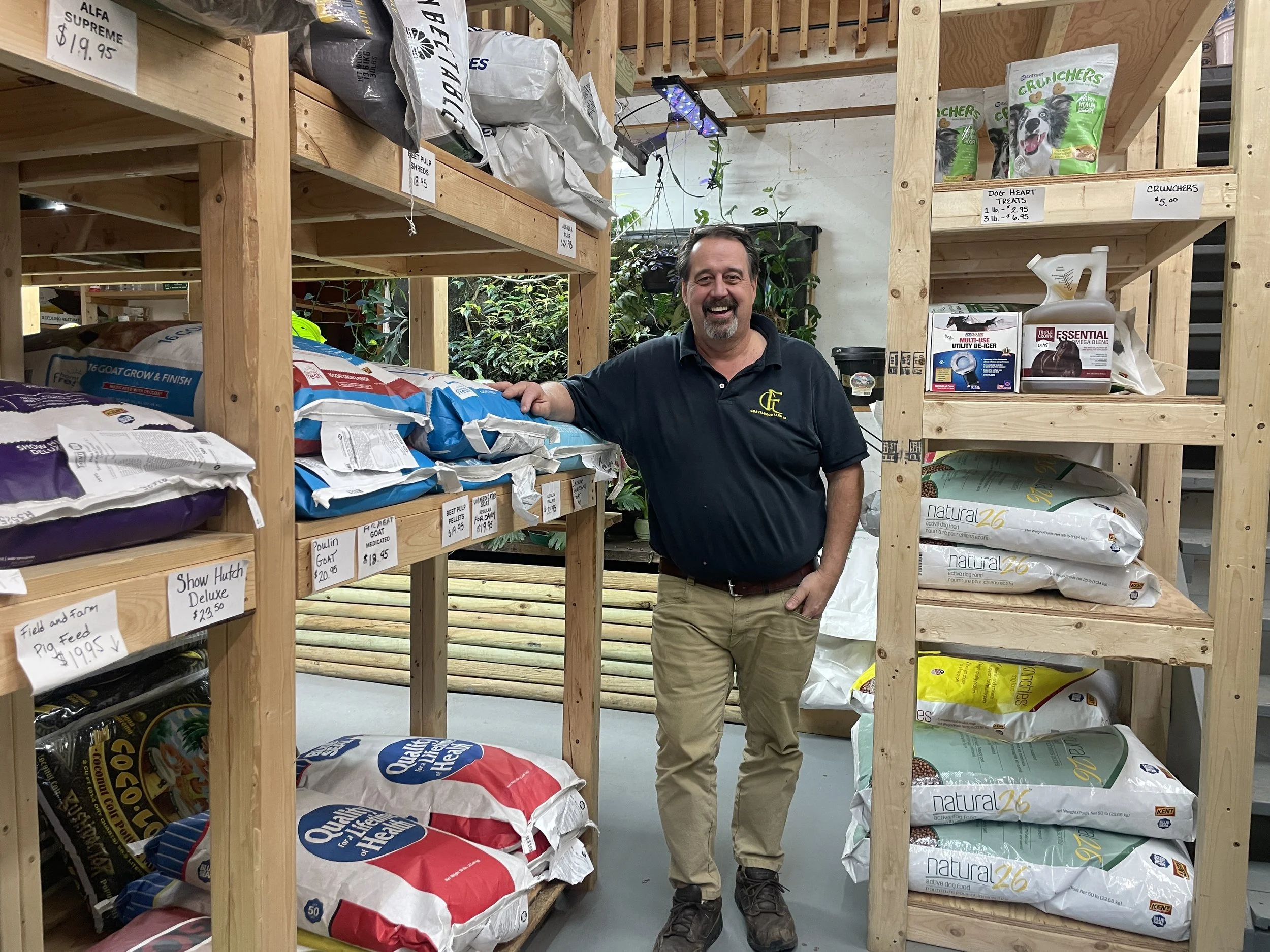
No longer a dairy farmer, Dan Brown now owns a grow and feed store in Blue Hill, Maine. (Photo by Marina Henke)
ADDITIONAL MATERIALS
For a comprehensive history of dairy check out Milk! A 10,000 Year History by Mark Kurlansky.
During the height of Dan Brown’s case he gave a speech to a rousing crowd in Blue Hill. You can watch that here.
Signs posted around the shop remind customers at L.P. Bisson & Sons that raw milk is not going anyway. (Photo by Marina Henke)
The debate over raw vs. pasteurized milk has been happening for a long time. The Milk Question by Milton Joseph Rosenau is a fascinating (we daresay, poetic) read.
The Pasteurized Milk Ordinance is a nearly 500-page document that outlines the intricacies of milk regulation in the U.S. Here’s its most current version.
The Food and Drug Administration fact-checks many different raw milk claims on this page, including pasteurization's affect on vitamin content and potential probiotic benefit.
SUPPORT
To share your questions and feedback with Outside/In, call the show’s hotline and leave us a voicemail. The number is 1-844-GO-OTTER. No question is too serious or too silly.
Outside/In is made possible with listener support. Click here to become a sustaining member of Outside/In.
Follow Outside/In on Instagram or join our private discussion group on Facebook.
CREDITS
Host: Nate Hegyi
Reported, produced and mixed by Marina Henke
Editing by Taylor Quimby
Our staff includes Felix Poon, Justine Paradis and Jessica Hunt
Executive producer: Taylor Quimby
Rebecca Lavoie is NHPR’s Director of On-Demand Audio
Special thanks to Bill Marler.
Music by Blue Dot Sessions and Elin Piel.
Outside/In is a production of New Hampshire Public Radio
Audio Transcript
Note: Episodes of Outside/In are made as pieces of audio, and some context and nuance may be lost on the page. Transcripts are generated using a combination of speech recognition software and human transcribers, and may contain errors.
Nate Hegyi: It was a summer day in 2009, when an unexpected visitor pulled up to Dan Brown’s farm. It was a small operation. A few cows, couple hundred chickens.
Dan Brown: I was outside milking the cow when he pulled up. It’s vivid. It’s right there. It’s like a 9/11 type thing. It’d be burned into my mind for the rest of my life.
[MUX IN, Highway 430, BlueDot]
Nate Hegyi: A guy named John stepped out of the truck. He had one of those government lanyards around his neck and a big clipboard. He was a state health inspector… and he told Dan Brown: Listen. You have got to stop selling your milk.
Dan Brown: I was not nice to him. I'll be the first one to admit I was very nasty, very antagonistic. I didn't want to hear what he had to say.
Nate Hegyi: At the time Dan sold his milk raw… which means no pasteurization. Now technically this was legal where he lived in Blue Hill, Maine. But Dan’s setup was a pretty homegrown operation. He packaged it in recycled plastic juice bottles, and then he sold it straight to customers who’d pull into his driveway with cash. So the health inspector told him until he outfitted his barn with stainless steel tanks and properly labelled his bottles, Dan’s raw milk was violating Maine’s health code. This is NOT how Dan saw it.
Dan Brown: I naively said, “I don't recognize your authority, get the F off my property.” And then the short version is they spent the next three years explaining their authority to me, and they did it really well to the point that I was no longer farming anymore.
Nate Hegyi: Dan may be a man of superlatives, but this is no exaggeration. Over the next three years the dairy wars came to Blue Hill. The state sued Dan for not following their regulations. Dan fought back.
CHANTING PROTESTORS: Who is Farmer Brown, we are Farmer Brown!
Nate Hegyi: He became kind of a weird celebrity. People all across the country took up his cause.
DAN TV INTERVIEW: They’re not saying I can’t do anything. They’re saying YOU can’t come to my house and buy my milk.
Nate Hegyi: Reporters – even The New York Times – showed up at his front door.
NEWS CLIP: Farmer Brown is this man, Dan Brown of Gravelwood Farms in Blue Hill.
DAN SPEECH: I’m a farmer, it’s all I’ve ever wanted to be, it’s all I’ve ever done. Thank you very much (applause).
[MUX UP AND OUT]
Nate Hegyi: Dan’s day in court eventually arrived. In 2014 the Maine Supreme Court officially ruled that he was no longer allowed to sell dairy products. And with that, the milk wars in Maine quieted down.
Dan Brown: There was nothing good about the lawsuit. It ended a chapter of my life. I want to say that unequivocally. I was very happy doing what I was doing, and I loved it. It was fabulous but it was really just a house of cards.
[MUX IN, Delham Corner, Blue Dot]
Nate Hegyi: But recently raw milk has been back in the zeitgeist. RFK Jr. is taking shots of it at the White House!
PAUL SALDINO: Do you want to do a shot of raw milk to toast this with me?... Secretary Kennedy cheers!
Nate Hegyi: Gwyneth Paltrow is talking about it on podcasts!
AMY POEHLER: How do you drink your coffee?
GWYNETH PALTROW: With, with raw heavy cream…I know…
Nate Hegyi: And of course, Joe Rogan has weighed in….
JOE ROGAN: People who’ve lived on farms have been drinking raw milk since the beginning of time. It’s normal and healthy. It tastes better.
Nate Hegyi: All these raw milk chugging celebrities make for a pretty obvious question. What’s the appeal? Is raw milk some kind of superfood?
Marina Henke: Did you tell me I can taste the difference?
Danny Bisson: Yes, I can.
Nate Hegyi: Or is it something to avoid at all costs?
Mary McGonigle-Martin: You wouldn't give your kids raw chicken. You wouldn't give your kids raw beef. The milk is the same.
Nate Hegyi: I’m Nate Hegyi, this is Outside/In and Producer Marina Henke has the story, after a break.
BREAK
Marina Henke: All right, so who… who is this?
Andy Bisson: They're just by numbers. I don't name them. I just put numbers on it.
Marina Henke: This is Outside/In a show where curiosity and the natural world collide. I’m Marina Henke.
Marina Henke: How many gallons of milk is she producing for you a day?
Andy: Well… probably about 12 gallons. You know, she's a good cow.
[MUX IN, CronoCrono, BlueDot]
Marina Henke: So what IS raw milk? Once fairly dairy ignorant myself, if you'd asked me a couple years ago, I'd have guessed raw milk must be organic, pasture-fed, and definitely from very happy cows. But… it means none of those things. Raw milk is simply milk that has not been pasteurized.
So, to get to the bottom of the raw milk craze, I thought I should see pasteurization up close. That's exactly what I'm here to do at LP Bisson & Sons, a small family farm in Topsham, Maine.
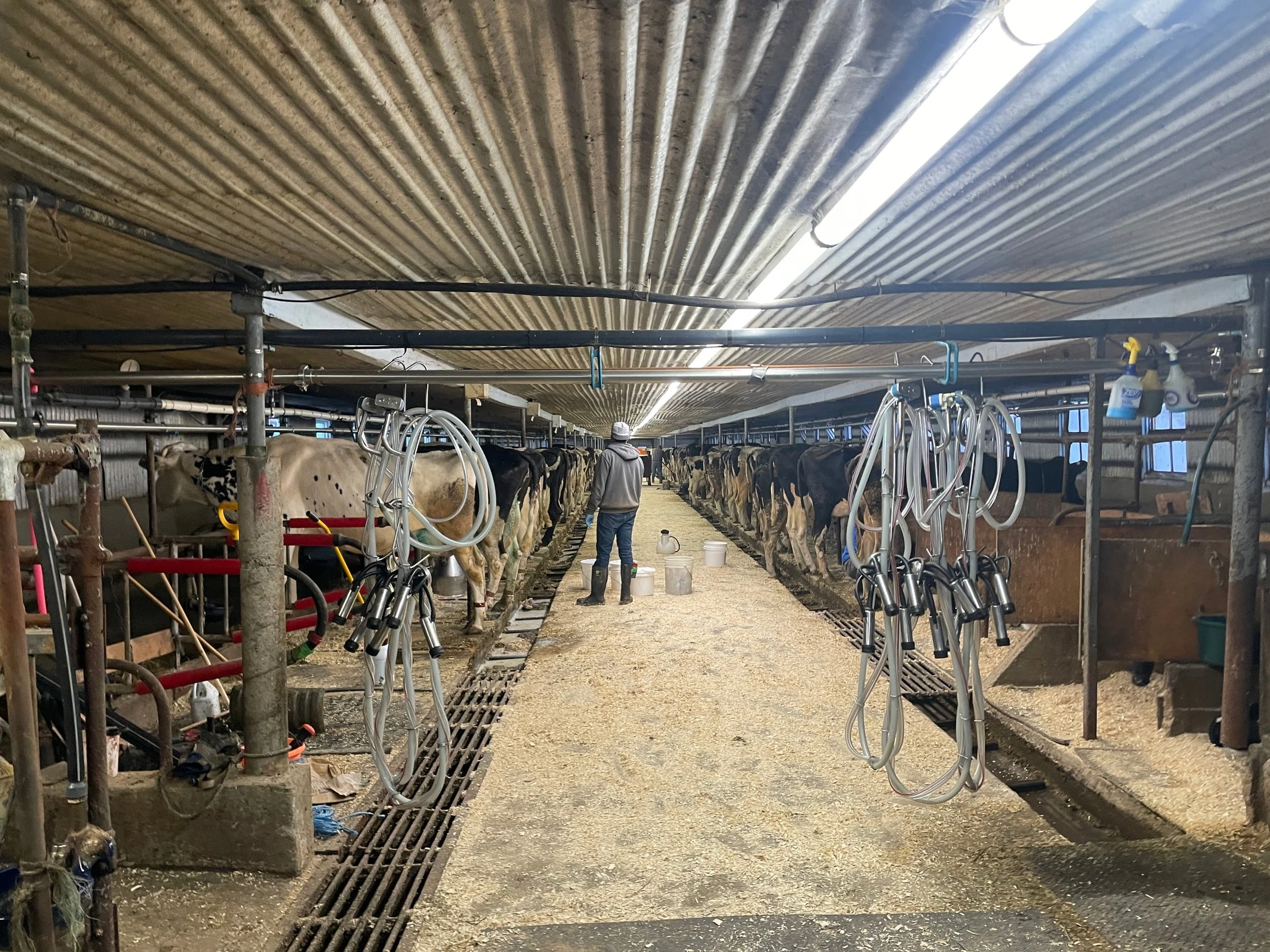
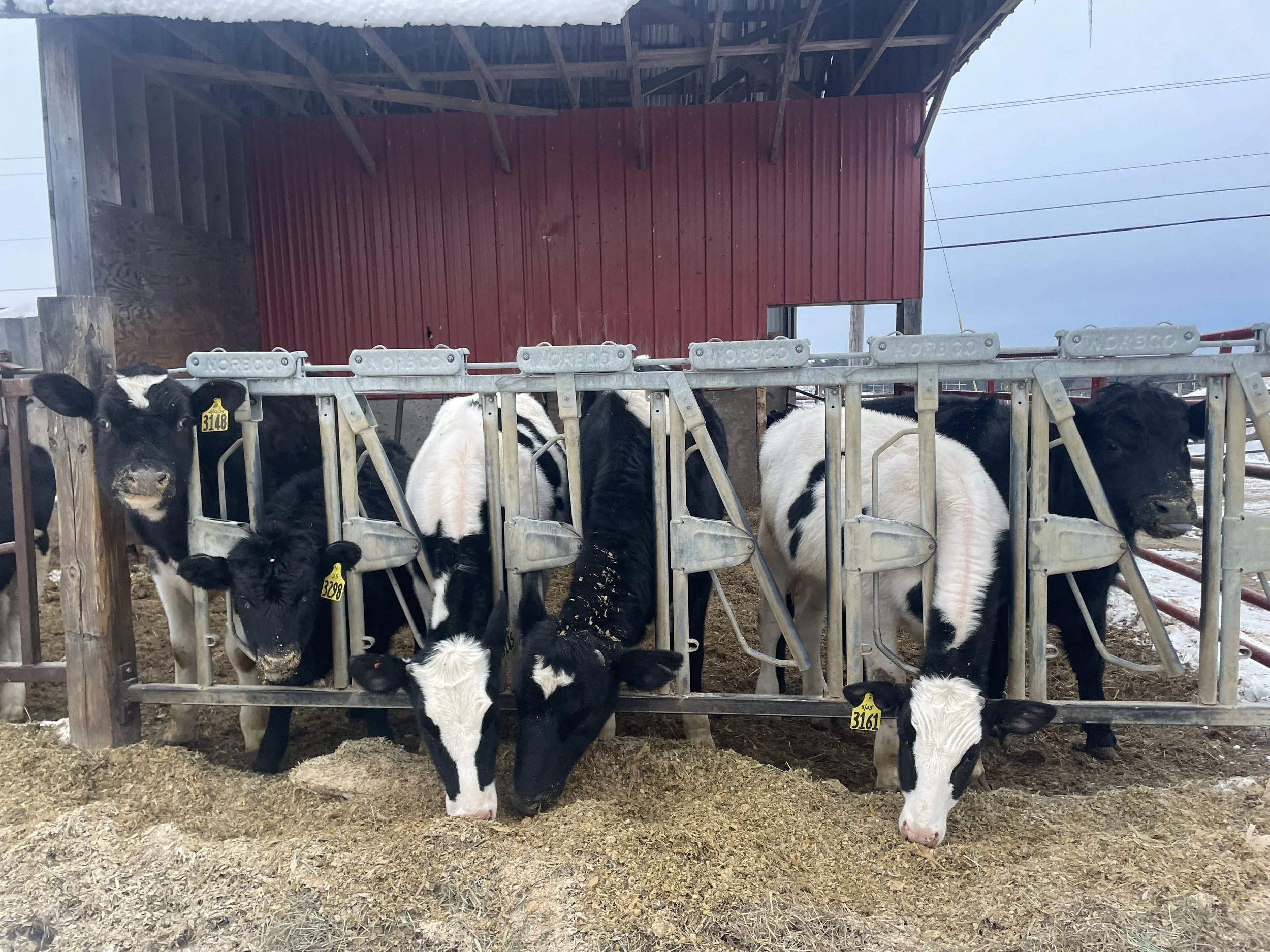
Dairy farmer Andy Bisson is leading me down a long concrete walkway with dozens of picturesque black & white cattle lined up on either side. One by one, a team of two farmhands are attaching an octopus-looking milking machine to each cow’s udder.
Marina Henke: And so that milk that I'm watching go through that tube right now that's going to be…?
Andy: Yep! Going in that… going in that stainless steel line. And I'll bring you back in the milk room and I'll show you where that's going.
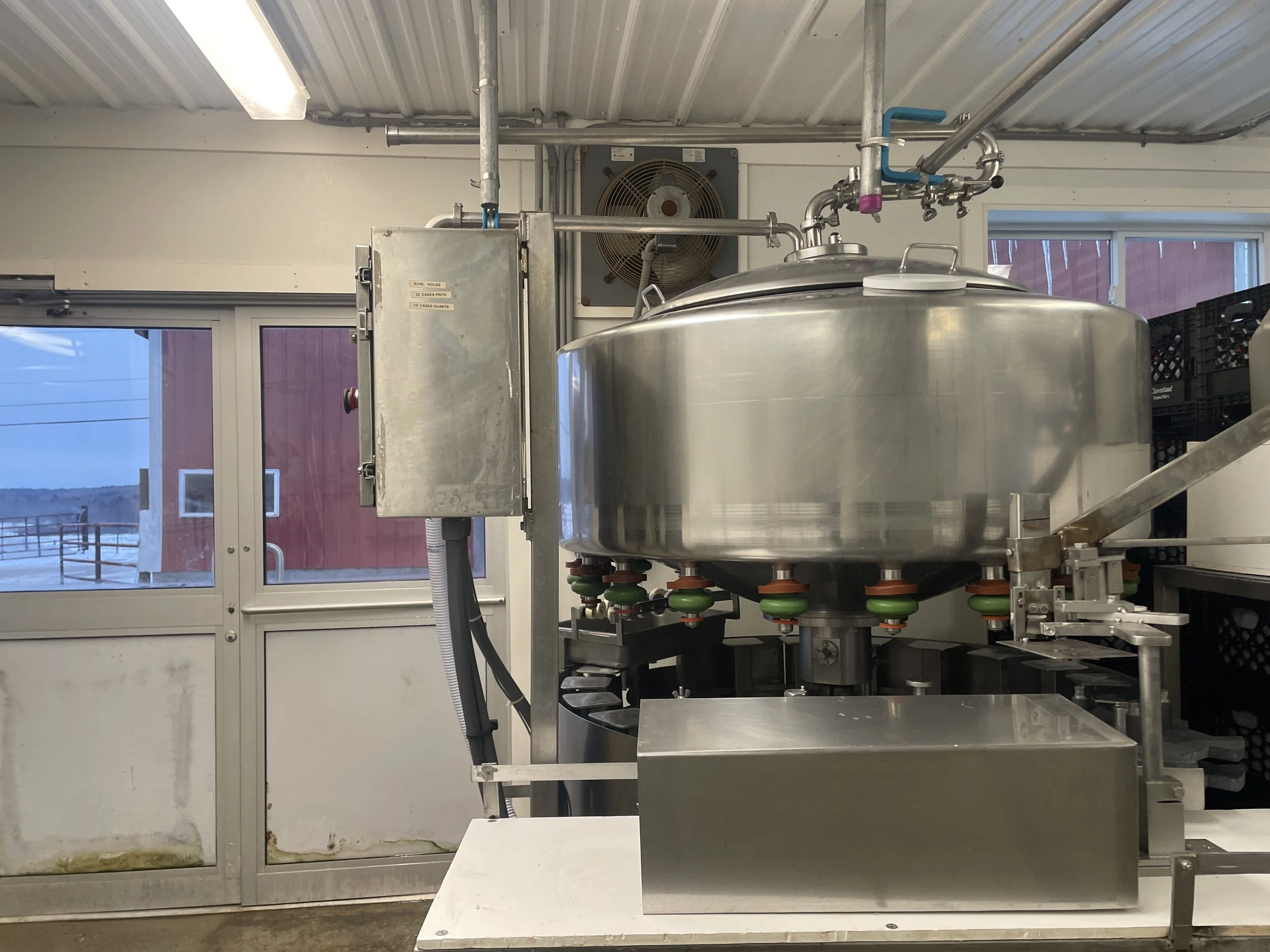
Marina Henke: The “Milk Room” is a labyrinth of shiny steel. There’s a huge metal vat that can hold 10,000 pounds of liquid. I watch as milk flows into it.
Marina Henke: So wow we are watching creamy white milk just kind of tumble into this big glass… orb? I don't know what else to call that
Andy Bisson: Jars. They call them glass jars.
Marina Henke: In the room over is another stainless steel barrel. It looks like one of those freestanding aluminum pools you might have had as a kid, but with a big lid on it. This is the pasteurization vat.
Marina Henke: So once it's made it to here, it's like gone through a whole journey. That milk.
Andy: Yep. It's a lot of work. (Laughs).
[MUX UP AND OUT]
Marina Henke: Pasteurization is essentially an elaborate game of temperature control. Milk must be made very hot and then very cold. Both things need to happen fast.
That’s because once milk hits 40 degrees fahrenheit, it becomes an ideal breeding ground for bacteria. That’s why food inspectors love the joke, “Life begins at 40.” Hilarious… right?
But to the credit, back in the day, life was beginning in milk pails across the country. Tuberculosis, cholera, scarlet fever… all of these diseases could be spread through milk.
And, where a cow is milked is very close to where a cow poops – which is the source of most bacterial contamination. By the 1840s almost HALF the babies born in Manhattan died in infancy. Milk was one of the main culprits.
And then came the process I just watched happen in a barn in Topsham, Maine…Pasteurization.
Nicole Martin: It’s hot, but it's not boiled, it’s not sterilized…it’s a very, very quick heat treatment for a very short period of time.
Marina Henke: This is Nicole Martin, a dairy microbiologist from Cornell University. For her, the process of pasteurization begins with a funny looking bacteria called coxiella burnetii.
Nicole Martin: The pasteurization procedures that we currently use are based on eliminating or getting a five log reduction of that pathogen in the milk.
Marina Henke: And when you say… you said a five log reduction?
Nicole Martin: Five orders of magnitude reduction. Man, scientists don't like absolutes. We don't say kill or not kill. We say, how much kill do we get right (laughs).
[MUX IN, TeleMezzo, BlueDot]
Marina Henke: How do you know you’ve killed nearly all the bad bacteria in milk? You heat it to the temperature that wipes out the MOST resistant cells. The most common method requires that milk be heated to 161 degrees Fahrenheit and kept there for 15 seconds. It’s during those 15 seconds that all the other pathogens besides coxiella burnetii are dying left and right.
Nicole Martin: The way you could think about it is that in a serving size of milk, you have an exceptionally small chance of having a residual pathogen in that product.
Marina Henke: In 1908 Chicago was the first city to mandate pasteurization. Other cities soon followed suit, especially as they saw the dramatic improvements in public health. This includes a commonly cited example: an orphanage that switched to pasteurized milk saw the mortality rate of their children drop by nearly 50 percent.
Meanwhile, raw milk became pricier to produce, as farmers had to jump through stricter regulatory hoops. A string of raw milk related outbreaks in the 80s was the nail in the coffin.
In 1987 the federal government mandated that any milk passing state lines had to be pasteurized.
[MUX up and out]
Marina Henke: But… this mandate said nothing about what happened within a state. Which is why, depending on where you live, raw milk can still be legal to sell. Although BOY is it confusing: in Maine you can buy raw milk at farms and stores, in New York you can buy it just at farms, in Florida you can buy it at farms and stores… but only as PET FOOD.
This patchwork system has meant that raw milk productions stay small. As reported by the FDA only about 1% of Americans consume raw milk weekly.
But – that number is growing. Take it from Andy Bisson, the dairy farmer who showed me around his farm. Because while, yes, he produces pasteurized milk, he also sells it raw.
Andy Bisson: I still sell more raw milk than I do pasteurized milk. I probably sell almost three times as much raw milk as I do pasteurized.
[MUX IN, Arroz con Leche, Blue Dot]
Marina Henke: The question that rises to the top here is… what do people see in raw milk that they are willing to covertly buy it as PET FOOD only to drink it themselves?
[STORE BELL]
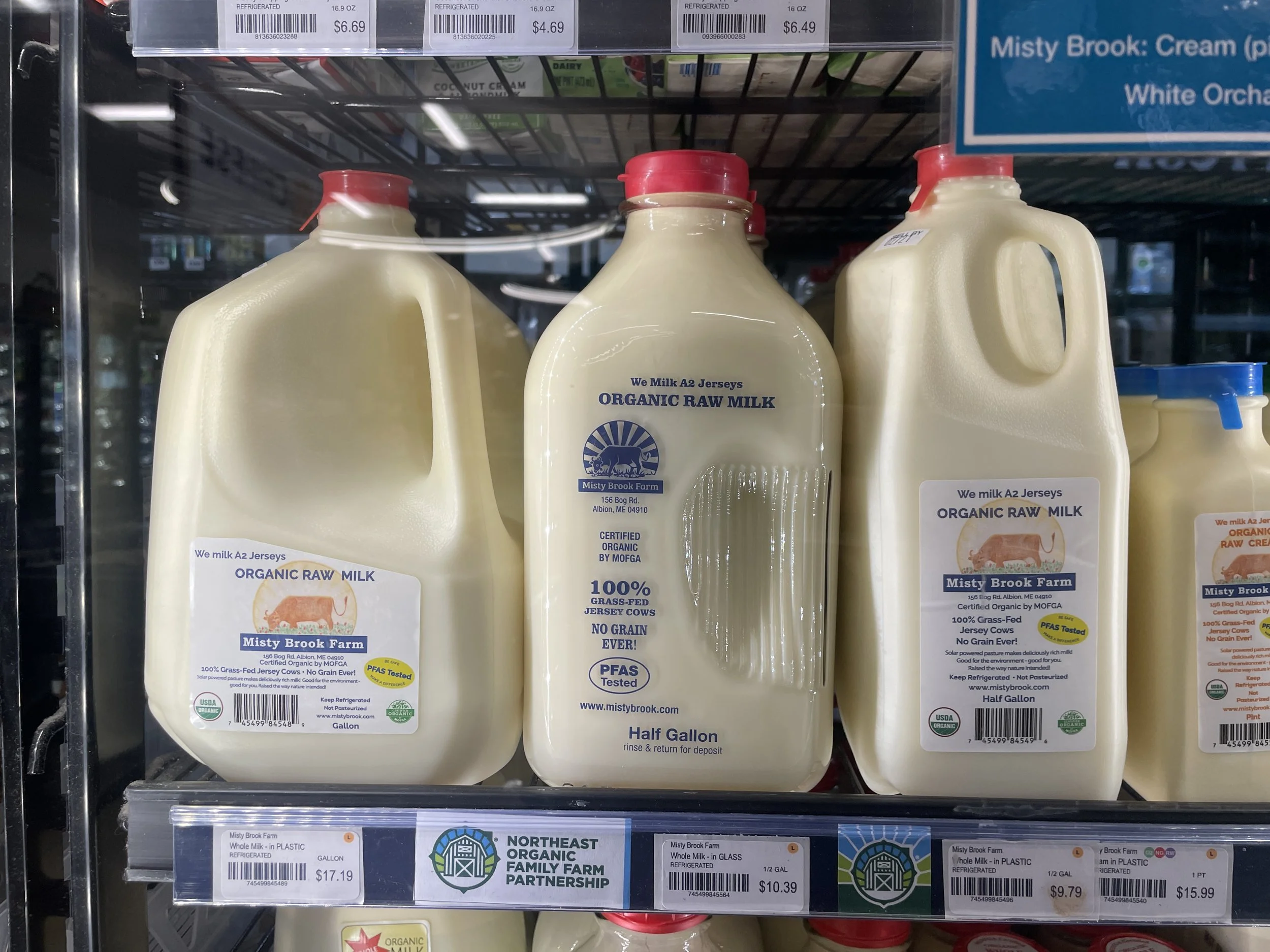
Marina Henke: So a gallon of raw and unpasteurized is $6….
Marina Henke: Andy’s nephew Danny runs Bisson’s front of shop, where you can pick up a gallon of raw or pasteurized milk for 6 dollars a pop.
Marina Henke: Are there people that are coming here like specifically excited to buy the – the raw milk product?
Danny Bisson: Yeah definitely. They love the raw. Even when we added the pasteurized, they was all worried that we was going to get rid of the raw and we stayed right with the raw. We're like, “No, raw is here to stay.” So they was all happy about that.
Marina Henke: Just like his customers, Danny prefers to drink raw milk. Talking to him was a crash course in the most common reasons for the preference. Up first?
Marina Henke: Did you tell me you're like, I can taste the difference?
Danny Bisson: Yes I can. Changes that flavor just a little bit.
Marina Henke: Raw milk drinkers tend to say that pasteurized milk just tastes worse. They’ll use words like “flat” or “boiled”. It reminds me of the way people compare the difference between Coke and Diet Coke. And just like how I will take Diet Coke’s superiority to the grave, raw milkers tend to feel strongly about their opinions.
INFLUENCER CLIPS: I got two liters and I’m going to give it a go… let’s see if it’s all it’s cracked up to be… oh my god that tassels like ice cream, that doesn’t even taste like milk!
[MUX OUT]
Marina Henke: But beyond the taste, raw milker drinkers tend to believe it's just a healthier product. First, there's the idea that pasteurization reduces milk’s vitamin content. And this is partly true. When rising temperatures start to kill that coxiella burnetii and ecoli bacteria some vitamins also get reduced. This includes a few common ones that you may recognize including Vitamin C and E.
Another common argument is that all that pasteurization kills the “good bacteria.”And again, there’s some truth here. Raw milk contains lots of bacteria, some of which includes things like lactobacillus which you might recognize from your yogurt labels.
This “good bacteria” came up a lot when I was talking to Dan Brown – the ex-farmer at the center of Maine’s dairy wars. He may not sell milk anymore, but he is still a big fan of it for this exact type of reason.
Dan Brown: I'm not sugar coating it. I'm not hiding it. I'm putting it in a five gallon bucket with no lid on it. It's exposed to the air. It's getting contaminants on it. I just disagree on whether those contaminants are bad for you.
Marina Henke: Plus, Dan and others will say – yeah, there are some germs. But even the bad ones, in small amounts, are good for your immune system. This argument extends way beyond the raw milk debate.
Dan Brown: We don't fall on the swing set anymore. We don't get exposed to dirt.
Marina Henke: He’s pointing to his daughter who was there during the interview.
Dan Brown: That kid's been squishing potato bugs and rolling around in the dirt since the day she was born. She's got an immune system!
Marina Henke: Now I want to be clear about the next point, because there is a misconception I’ve heard a few times reporting this story: Pasteurizing milk does NOT include the addition of any synthetic ingredients.
But, most pasteurized milk produced at big scales is fortified with Vitamin A & D. This was implemented in the 1930s and 40s to combat childhood diseases like rickets. Many raw milk drinkers think… “why take stuff out to only add stuff back in?”
Dan Brown: It's a perfect food as it is. Let's not ,let's not strip everything out of it and replace it with synthetic.
[MUX IN, Sandpiper in Motion ]
Marina Henke: If given a choice I suspect many of us do not want to drink something that tastes bad, is empty of nutrients, and was unnecessarily injected with extra ingredients. But… there are MANY scientists out there who are tired of hearing these arguments.
Nicole Martin: I kind of put it in a few different buckets when I talk about what changes during pasteurization.
Marina Henke: Again, this is Nicole Martin, professor of dairy foods microbiology at Cornell University. We started with the vitamin issue.
Nicole Martin: There are some heat sensitive vitamins that are found in raw milk.
Marina Henke: But Nicole tells me that prior to pasteurization most of these vitamins are present in very small amounts.
Nicole Martin: So yeah, you can see this reduction. But is milk a good source of those things to begin with? No, not really. Right? Like they're there, but you're not solely getting your vitamin A from milk for example.
Marina Henke: This is a very different framing than what’s found on some of the most popular raw milk websites… which tend to overemphasize the vitamin content in their product.
Raw Farm USA – which is where RFK and Gwyneth Paltrow get their milk from – lists their product’s vitamin content by the QUART. Even for those most committed to a dairy forward lifestyle…that’s a lot of milk.
[BEAT]
Marina Henke: The bacteria argument offers similar complications.
Nicole Martin: You know I hear a lot about the good bacteria, right? “There are these bad bacteria. But what about the good bacteria?” Here's where, you know, I think the nuance of the reality comes in because, yes, you can find organisms like lactobacillus in raw milk… but they're there at very, very low levels.
Marina Henke: So Nicole says there’s not much of a benefit there, either. And if your raw milk DOES have a lot of extra bacteria… that might not be a good sign.
Nicole Martin: If you are to consume raw milk, if you're a raw milk consumer, you want that farm to be clean. You want the animals to be clean, you want the equipment to be clean. You want the product to be held and handled well to prevent the growth of bacteria. If that's the case, then you're going to have very, very low levels of all bacteria, including any that might have some potential probiotic function.
Marina Henke: In other words, the safer your raw milk is from bad bacteria… the less good bacteria you will get from it too.
[MUX UP AND OUT]
Marina Henke: But, raw milk farmers remain convinced: their product is better. PLUS, they’ll tell you that raw milk dairies have come a long way since the 1800s.
BARN AMBI IN…. Marina Henke: Can you tell me what's happening? I'm seeing some milk being poured into a pail.
Andy Bisson: That there’s the cows that have high cell counts.
Marina Henke: Back in Topsham, Maine dairy farmer Andy and I watch one of his cows get their daily mastitis test. This will tell whoever’s milking if a cow might be sick. And if they ARE their legs get marked with a big red tag.
Andy Bisson: … that one there's got two red tags. She's got two bad quarters. And so we just put it in the milk machine.
Marina Henke: Got it. So that means that milk won't be going in to be sold?
Andy: Nope, no...
Marian Henke: Milk that makes it through mastitis testing gets analyzed again… this time by the state’s Milk Quality Laboratory. Once a week, a state inspector pulls up to Andy’s barn, grabs a sample, and tests it for abnormally high cell counts. Passing this type of regulation is what makes it legal for farmers to sell raw milk in Maine. It’s also what gives them peace of mind.
Marina Henke: Is it stressful to wait for the tests? Are you ever like, what am I going to see?
Andy Bisson: Not really. I just go with it. You know, I've been doing it long enough. I just… I keep a close eye on it…
[And So Goes it, Blue Dot, MUX IN]
Marina Henke: But not everyone I talked to feels as comforted by these tests.
Marina Henke: Yeah so on that pre-harvest side like what are the biggest barriers to making that milk healthy?
Pam Ruegg: Um… It's a farm! (Laughs)
Marina Henke: This is Dr. Pam Ruegg. She’s a veterinarian and professor at Michigan State University.
Pam Ruegg: I specialize in dairy cattle udder health, and in ensuring that milk is produced from healthy cows.
Marina Henke: Now Pam loves a good barn and she’s spent a lot of time in them providing veterinary care to cows. Which is why she will confidently say that – mastitis test aside – contamination during the milking process is unavoidable.
Pam Ruegg: The data is really consistent. 3 to 10% of all loads of milk will contain bacteria. Either salmonella, campylobacter…
Marina Henke: Think gastroenteritis…
Pam Puegg: …enterotoxigenic E coli, listeria or today it could include the bird flu organism.
Marina Henke: This isn’t just milk that comes from “dirty barns” or “unhealthy cows.”
Pamela Ruegg: As somebody who goes to farms of all scales and has for more than 40 years, I wish that was correct. It just… the data doesn't show it is.
Marina Henke: Milking units fall off, teats aren’t completely cleaned.
And in the most home-grown operations, bits of manure can land in open-air pails. Pam has seen this up close. Like about a decade ago, she knew of an outbreak that happened in Colorado. A whole bunch of people ended up hospitalized with E-coli.
Pam Ruegg: I actually know the veterinarian who worked on that farm. And I talked to her. I ran into her at a meeting soon after that outbreak, and she said she was shocked when it happened because that farm… she said you could eat off the floor! Even in those circumstances, you know, you just can't predict it.
Marina Henke: For Pam the solution is obvious.
Pam Ruegg: Pasteurization wasn't invented because people wanted to put more cost in the processing of milk. It was invented because people got sick.
Marina Henke: After the break, what happens when people get sick.
[MUX UP AND OUT]
BREAK
Marina Henke: Hey, this is Outside/In a show where curiosity and the natural world collide, I’m Marina Henke.
Mary McGonigle-Martin: When I was 19 years old I started learning about nutrition and I just totally fell in love.
Marina Henke: Mary McGonigle-Martin had always been a health nut. So when her seven-year-old-son Chris got diagnosed with ADD, she looked to his diet. A lot of people recommended that she cut out dairy.
Mary McGonigle-Martin: But my son lived on dairy and he was a very picky eater, and there was like, no way I could take away the dairy
Marina Henke: One day she walked into her local health food store in California and saw huge signs advertising the benefits of you guessed it… raw milk.
Mary McGonigle-Martin: And I went, oh, that's right, raw milk is supposed to be a healthier option.
[MUX IN, Calisson Sad Story, Blue Dot]
Mary McGonigle-Martin: Every week I'd go in, I'd look at it. “Hmm. Better not.” Look at it. I mean, I… it was this big process and I made the mistake of going to their website.
Marina Henke: What she saw there was re-assuring. Clean barns, happy cows. And promises of pathogen-free milk.
Mary McGonigle-Martin: And I went, oh, great, I don't have to worry they test the milk.
[MUX BEAT]
Mary McGonigle-Martin: So I bought it in August… I bought the first week, a little quart, I bought the second week, another quart… It was that third half gallon that was contaminated.
Marina Henke: A day after drinking that gallon Chris got sick. By the evening, he’d had diarrhea more than 16 times. Mary knew it was time to go to the hospital.
Mary McGonigle-Martin: So September 7th we went to the emergency room, September 8th we were admitted to the hospital and we did not get home till November 2nd.
Marina Henke: That’s nearly two months. Chris got diagnosed with something called “hemolytic uremic syndrome.”
Mary McGonigle-Martin: When you get a pathogenic E coli O157:H7 infection, it carries this toxin called the Shiga toxin.
Marina Henke: For 5-10% of kids, that toxin starts to destroy your red blood cells. Your platelet counts plummet, as well as your hemoglobin. Finally, all of that starts to clog your kidneys.
Mary McGonigle-Martin: Chris went into complete renal failure.
[MUX IN: Boundless things, Epidemic]
Mary McGonigle-Martin: He had to be put on a ventilator because he, he was dying.
Marina Henke: Chris did not die, but he did come close. By the end of his hospital stay his pancreas had shut down, he’d had seizures, and he had little recollection of what had happened.
Mary McGonigle-Martin: … if there was a pathogen in that milk, I would think, oh, it's vomiting and diarrhea. Never, ever in my wildest dreams did I think this could happen.
[FADE OUT]
Marina Henke: When it comes to raw milk, hemelytic uremic syndrome is probably the worst case scenario. The stories are harrowing. There was the family who was eager to support their local farm. Their daughter ended up so sick from HUS that to this day she can’t speak or walk.
Pam Ruegg: I think the sad thing of it is, is when these things happen, they happen to people who are trying to do the right thing, for their children. They really believe that there's going to be some benefit and they end up with devastating, terrible consequences.
Marina Henke: Dr. Pam Reugg again, veterinarian and dairy scientist.
A part of me hesitates to relay these stories. It's hard to argue with someone whose kid has almost died. And most kids who drink raw milk will not get hemelytic uremic syndrome. In fact, deaths from raw milk consumption may be lower than you think. Over twenty years, the CDC has only reported 3 deaths from raw milk. And, as many raw milk websites remind me, this is the exact same number of people who have reportedly died from pasteurized milk.
But once you take into account that fact that only about 1% of Americans regularly drink raw milk… the numbers tell a slightly different story.
Pam Ruegg: 80% of all outbreaks of outbreaks associated with dairy products occur in the states where it's legal to sell raw milk.
[MUX IN, Cabana Flats]
Marina Henke: In other words, the reason those numbers are so low… is because so few people drink raw milk. To public health officials raw milk is simply not worth the risk. But, the problem with these number games is that people often just use their own numbers.
Dan Brown: My test result is sitting right behind me, crunching numbers at my desk. She's drank it since she was two years old, every day with her cereal!
Marina Henke: Ex-farmer Dan Brown. Again, pointing across the room to his daughter.
Marina Henke: I'll tell you, I've talked to people kind of on all sides of the spectrum here of, like, some people who tell me there's, there's no way you can guarantee, sort of, clean, clean milk without pasteurization. What do you say to that?
Dan Brown: I would say you're right. There is no way you can 100% guarantee that that milk's safe. 100%. You want 100% guarantee? How many things are 100% guarantee in life?
[MUX UP AND OUT]
Marina Henke: Having spent the past few months steeped in the raw milk waters, I do think there is something a bit more intangible going on here. As much as the raw milk craze can feel like it orbits around “good bacteria” and “farm germs,” conversations often come back to personal rights. Dan Brown thinks the choice to drive down his driveway and pick up a gallon of milk is a decision between him and his customers.
Dan Brown: Who is the government to tell you, “You can't drive up the driveway?” What's next? I can't have one for my family. I am opposed to that philosophy.
Marina Henke: For its boosters, raw milk isn’t just a poster child of perfect nutrition. It has become a mascot for freedom. And it’s this sentiment which has made it so sticky in certain political spheres. You hear it in the endless raw milk reels I am now being shamelessly served…
CLIPS: We don’t need them to make our decisions, we can make our own decisions… Food freedom! Is it important to you? It’s important to me and my family… Every time a family cow gives milk it gives independence, and that’s what they don’t want…
[MUX fades in, Gerner]
Marina Henke: The raw milk craze can sound loud online – but at the risk of letting social media warp reality it does feel important to say this: at mass scale, pasteurization has won the dairy wars. Most of us go to the grocery store, pick up pasteurized milk, and think little of it. But what social media does offer are shots of new converts turning to raw milk for a promise of health benefits that aren’t necessarily there.
For this reason, Pam Ruegg doesn’t see much of a victory to be had. Especially because educating people doesn’t seem to move the needle.
Pamela Ruegg: You know we’re in a period of skepticism in science… there’s just a bunch of people who have to experience things themselves until they believe them. So that’s kinda where we’re at today.
[MUX IN, Etude 12, Blue Dot]
Pamela Ruegg: I don't know what you do. I mean, I really don't know what you do. It's an unpredictable risk. And so when things are unpredictable, I mean, you could print on the label, you have a risk of... consuming 3 to 10% of this milk may contain dangerous pathogens. And, you know, you can have severe long-term consequences like kidney failure, Guillain-Barre syndrome, miscarriage, neonatal death, but, um, I don't know that that's going to really change people's opinions.
[MUX UP AND LONG FADE]
Marina Henke: Read the news today, and it’s clear that these debates – between private rights and public health – apply to a lot more than just dairy. Vaccines, fluoride, even recreational drugs... They all have echoes of the same thing.
Dan Brown: It’s all about just taking the cuttings off of these plants to sell nursery stock…
Marina Henke: Can you describe what we're looking at just for a second?
Dan Brown: Well, this is just what in the industry, this is a grow room.
Marina Henke: And in a plot twist I truly was not prepared for, short-lived raw milk celebrity Dan Brown is now in one of these businesses.
Marina Henke: There's probably about, like, what, 30 little cannabis plants in here?
Dan Brown: 10,15,16…18 in here.
Marina Henke: Cannabis. After he lost his case in 2014 and was banned from selling raw milk, some marijuana growers in the state offered to show him the ropes. Now, he owns a combination grow and feed store. You can pick up grain for your goats and your CBD gummies at the same time.
Dan Brown: I don't smoke cannabis, I don't drink, I don't smoke. It's a business to me. I just grow it. I love growing it. It's… I put a tomato plant in the ground or a cannabis plant in the ground. It doesn't matter to me. It's just, it's still farming. It's just a different crop.
[MUX IN, Walking Shoes, Blue Dot]
Marina Henke: Dan’s days look pretty different than they did when he was milking cows, but he’s still interacting with a lot of the same people. Including a certain lanyard wearing health inspector.
Dan Brown: I don't hate John anymore. I did for many years. He's now my inspector. He didn't say boo! We don't bring it up. He doesn't talk about it. I don't talk about it...
Marina Henke: Wai-wai-wait. The same guy who walked out of his car with the clipboard is the same guy who walks in here to check that your I's are dotted?
Dan Brown: Yeah…. He comes in, he does his little clipboard, checks his things off. “There's your certificate.” “There's what I'm selling, John.” All good. It's cut and dry.
Marina Henke: These inspections go well because, whether he likes them or not, as a business owner he accepts that marijuana – like milk – is regulated by laws.
Dan Brown: When I got into this business, I said, I don't care. I'll get every damn, I'm going to beat you at your own game. I'll get every damn license you want. I'll pay you all the taxes you want. I did everything. I got fricking every license you can imagine. I'll beat you at your own damn game. I never would have had that philosophy if I hadn't gone through what I went through over here. And I think that's where I am. Ten years later, I'm still here because I've… You want to play in the sandbox, you play by their rules.
Marina Henke: Dan has already lost at this game once, and he won’t again. But he still believes in a limited government that lets people make their own choices – about milk, weed, you name it. And every day when he wakes up you know what he does? Pours a little raw milk into his coffee.
[MUX IN, Straight to the One]
CREDITS
Nate Hegyi: This story was reported, produced and mixed by Marina Henke. It was edited by our executive producer Taylor Quimby. I'm your host, Nate Hegyi. Our staff also includes Justine Paradis, Felix Poon and Jessica Hunt. Rebecca Lavoie is NHPR's director of on demand audio.
Marina Henkei: Special thanks to Bill Marler. Music is from Blue Dot Sessions and Elin Piel.
Nate Hegyi: Outside/In is a production of New Hampshire Public Radio.
BARN AMBI FADES IN… Marina Henke: I feel like I should ask her a question because she's been waiting so patiently with us. Do you have any comments?
Cow:....
Marina Henke: No comment.
Andy: She’s getting ready to eat (laughs)