Return of the Kiwi Apocalypse: 10 years of Outside/In
** We’re celebrating our 10 year anniversary and want you to come! Join us in Portsmouth, New Hampshire on February 6th for a night of storytelling, featuring former Outside/In guests and hosted by our very own Nate Hegyi. Get your tickets here! **
In celebration of Outside/In’s 10th anniversary we’re looking back at our very first episode: “The Kiwi Apocalypse,” first published in December of 2015. Afterwards, we’ll get an update to the story and talk about how weird it is to have a podcast old enough to be in middle school.
Here’s our original description for The Kiwi Apocalypse:
Iago Hale has a vision: it’s one where the economy of the North Country is revitalized by local farmers selling delicious cold hardy kiwi berries to the masses.
Meanwhile, Tom Lautzenheiser has been battling a hardy kiwi infestation in Massachusetts for years, and is afraid that this fight will soon be coming to the rest of New England.
Should we worry about the cold hardy kiwi and what does the quest to bring it to market tell us about what an invasive species is?
This episode was produced by our original host, Sam Evans-Brown.
Featuring Iago Hale, Tom Lautzenheiser and Bryan Connolly.

SUPPORT
Grab a ticket for our 10 year anniversary live show here!
Outside/In is made possible with listener support. Click here to become a sustaining member of Outside/In.
Follow Outside/In on Instagram or join our private discussion group on Facebook.
CREDITS
Outside/In’s Host: Nate Hegyi
“The Kiwi Apocalypse” was reported and produced by Sam Evans-Brown, with help from Maureen McMurray, Taylor Quimby, Logan Shannon, and Megan Tan.
The rest of the episode was produced by Nate Hegyi and Taylor Quimby.
Our staff includes Justine Paradis, Felix Poon, Marina Henke, and Jessica Hunt
Executive producer: Taylor Quimby
Rebecca Lavoie is NHPR’s Director of On-Demand Audio
Music by Blue Dot Sessions
Our old theme music is by Breakmaster Cylinder.
Outside/In is a production of New Hampshire Public Radio
Submit a question to the “Outside/Inbox.” We answer queries about the natural world, climate change, sustainability, and human evolution. You can send a voice memo to outsidein@nhpr.org or leave a message on our hotline, 1-844-GO-OTTER (844-466-8837).
Audio Transcript
Note: Episodes of Outside/In are made as pieces of audio, and some context and nuance may be lost on the page. Transcripts are generated using a combination of speech recognition software and human transcribers, and may contain errors.
Taylor Quimby: I've been feeling old, Nate.
Nate Hegyi: Yeah. How so?
Taylor Quimby: The other day, I was eating a bagel, and I asked my son if I had any cream cheese in my beard. He was like, ah, it's hard to tell. There's so much gray.
Nate Hegyi: Ooh.
Taylor Quimby: What a burn. Right.
Nate Hegyi: Yeah, yeah. It's outside in a show where curiosity and the natural world collide. I am Nate Hegy in the studio with our esteemed executive producer, Taylor Quimby, TCU.
Taylor Quimby: So I've been thinking about Seinfeld a lot lately. Were you a fan?
Nate Hegyi: Were. Ah. Are you a fan? Yes, it's in syndication. I watch it a lot. I love it.
Taylor Quimby: To that point. Seinfeld is one of those shows that, you know, to me, it's practically timeless. Like, there's a an episode for virtually every situation that you could reference and be because of the reruns and streaming. It just it goes on forever. Uh, and here's the thing, Nate. Outside in has officially been a podcast for longer than Then Seinfeld's original TV run.
Nate Hegyi: Nice. That's awesome.
Taylor Quimby: So Seinfeld was on for nine seasons. Nine years this month. Outside in, uh, just hit our 10th anniversary. Our first episode came out on December 1st, 2015. Wow.
Nate Hegyi: You know that. You know that Jerry Seinfeld only ended the show because he was told, like, you got to end it on a high note here at Outside In. We're not going to end it on a high note. We're just gonna keep going.
Taylor Quimby: Hey, the high note is now we're still in the high note. We're going more for the Simpsons.
Nate Hegyi: Yeah, yeah, we are South Park. We are Simpsons. We are family Guy. Today on Outside In, we are celebrating a special milestone.
Taylor Quimby: Yeah, ten years is long enough to give you a little bit of vertigo. Couldn't have imagined we'd still be working on the show.
Nate Hegyi: Oh, wow. You sound really excited. Taylor. Come on.
Taylor Quimby: No, no, I just mean when you start something, you just don't think that far ahead. You're like, just trying to survive day by day.
Nate Hegyi: And so we wanted to listen back to that very first episode that went out on the podcast feed.
Taylor Quimby: Yeah. And afterwards we'll talk a little bit more about the past, present and future of Outside in just talking.
Jerry Seinfeld: What's the show about?
George Costanza: It's about nothing.
Jerry Seinfeld: No story.
George Costanza: No, forget the story.
Jerry Seinfeld: You gotta have a story.
George Costanza: Who says you gotta have a story?
BREAK
Nate Hegyi: I am Nate Hegyi in the studio with executive producer Taylor Quimby. And today, in celebration of ten years as a podcast, we're going to replay our very first episode, The Kiwi Apocalypse.
Taylor Quimby: And for newer listeners, this story was produced by our first host, your predecessor, Nate Sam Evans-brown. It came out in December of 2015. And a quick disclaimer A few years ago, Sam hung up his hat as a journalist and became executive director of Clean Energy New Hampshire.
Nate Hegyi: So now you'll occasionally hear him as a source in the news advocating about renewable energy. I actually just heard him on Marketplace the other day, but back then he was just a humble podcaster.
Taylor Quimby: But I got to tell you, the reason I'm so excited to play this is because it feels like something we might have produced today in 2025. It hits a lot of the same big themes that have stayed with us now for ten years.
Nate Hegyi: All right, let's hear it.
Sam Evans-Brown: I love kiwis. If I could, I would plant a kiwi vine right in my backyard. Ripe kiwis, when you cut them in half and spoon out that sweet green fruit from the fuzzy brown skin. Definitely my favorite. But most kiwi are being grown in places like Italy, France, New Zealand, places that don't have the bitter cold winters that we have here in New England. But and this is something that I'm almost positive you did not know. There are 50 species of kiwi, including some from Siberia. But the ones that can handle the cold, you can't buy them in stores, at least for now. But the people who do know about them seem to love them.
Iago Hale: Our instructor was saying, yeah, these are Kiwis. And I was like, oh my God, Kiwis. I've never seen anything like that. And popped one in my mouth. And it was just you just wonder, like, how can you be on a planet for three decades and no one just ever tell you that there's something like that, like that out there? It was really upsetting, I said, because it's not like it's not like you can go in a market and buy them.
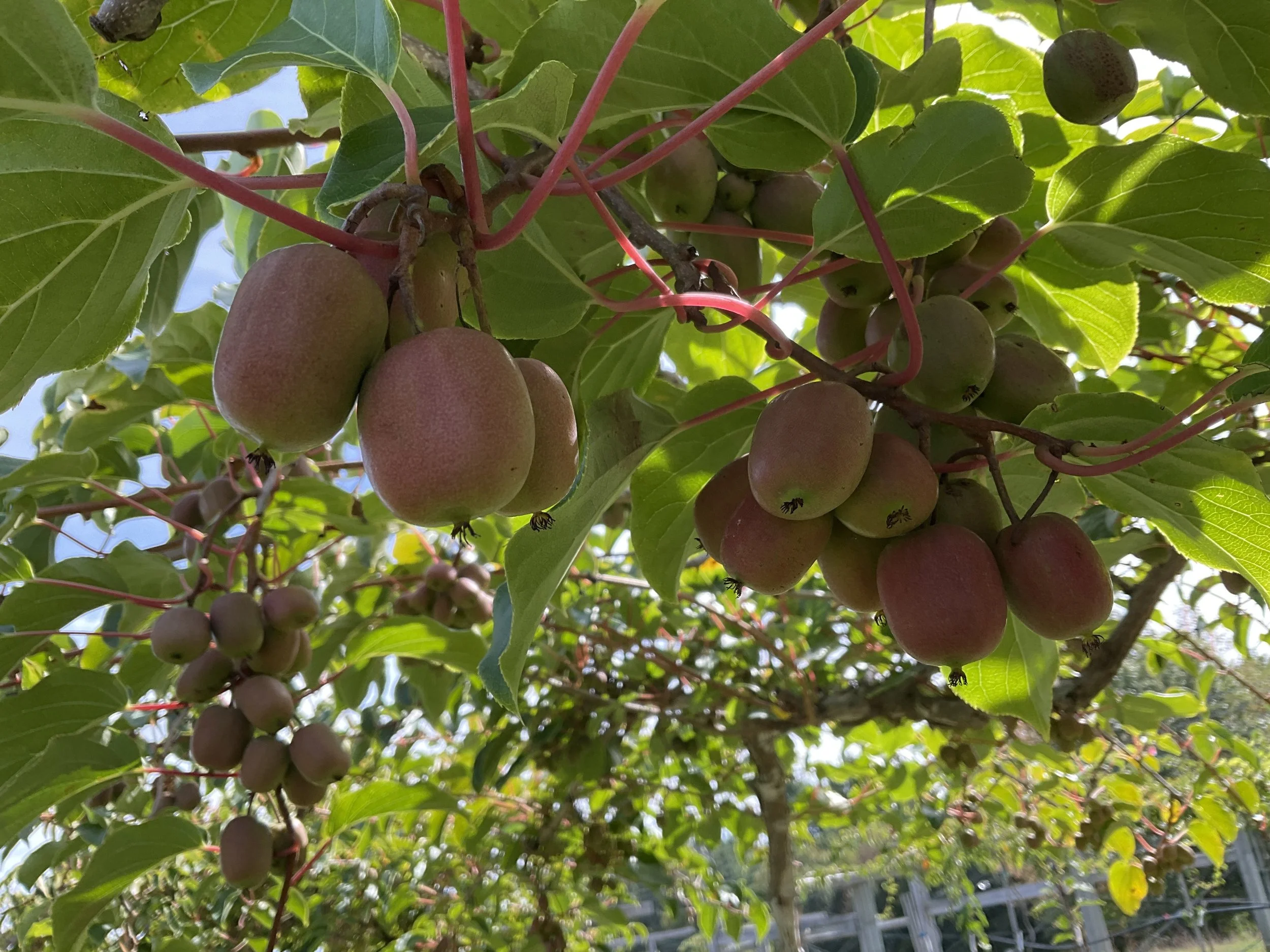
Sam Evans-Brown: This is Iago Hale. He's at the University of New Hampshire, and he's trying to bring these new Kiwis to the state. And these Kiwis, you probably wouldn't even recognize them as Kiwis. They're tiny and the skin is hairless and edible. So what would you call them?
Iago Hale: I personally like kiwis just because, you know. But I've been told by our office that that's not an acceptable name.
Sam Evans-Brown: Welcome to outside In, a show about the natural world and how we use it. I'm Sam Evans-brown. Today we're talking about wee wees, which actually go by the name Kiwi Berries, or as I shall call them henceforth, Hardy Kiwi. They sound totally harmless and adorable, but we're talking to two people with very different visions for this fruit. One thinks it could be the next big thing, which could save the economy and places that are struggling to make it work. The other is terrified. We're going to talk about how this sweet little fruit figures in a surprisingly complex debate, and we'll hear both sides, both sweet and unsavory.
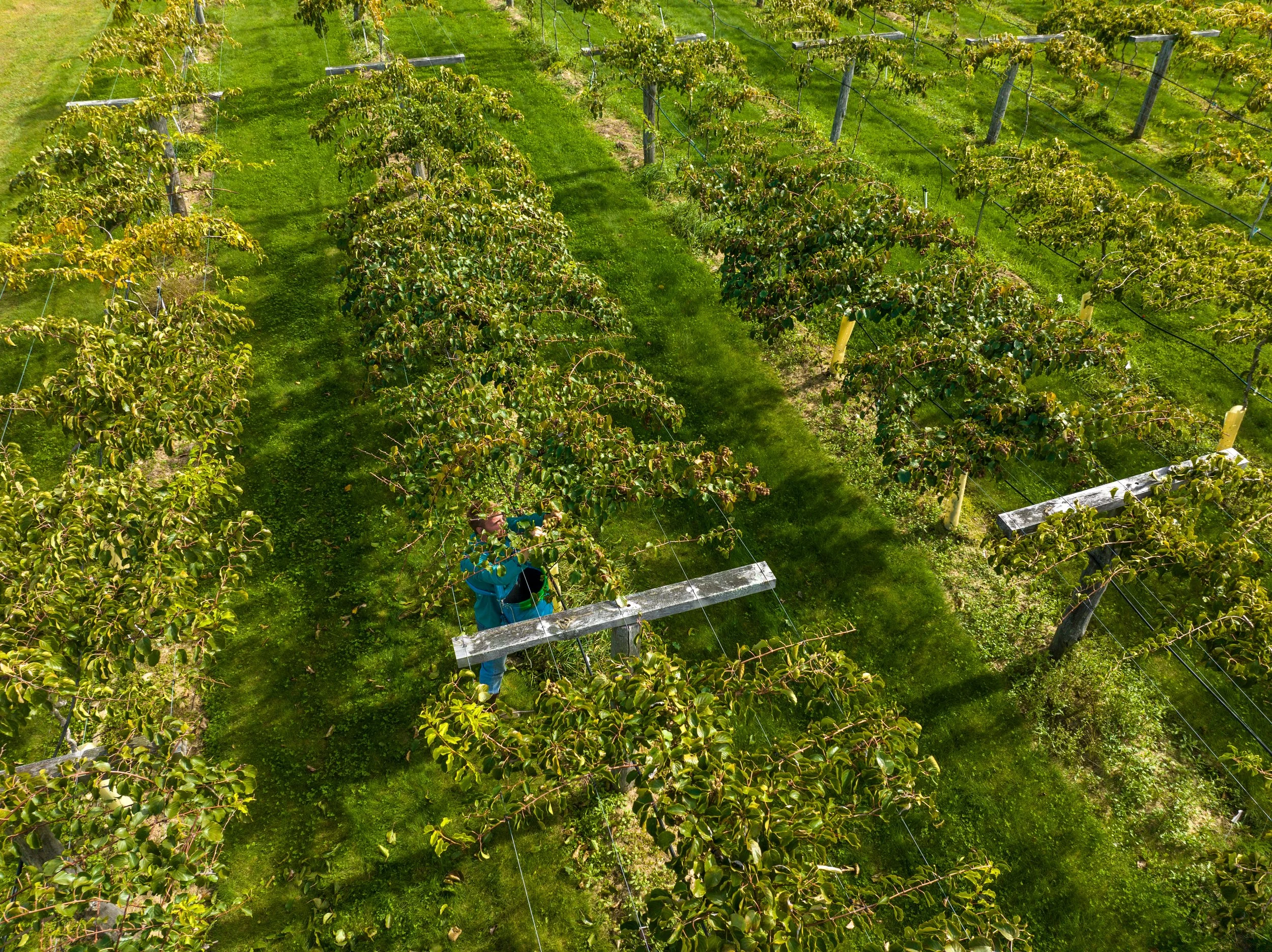
Iago Hale: Okay, so what you're looking at right now is just about one acre of the Unh, uh, experiment Station, Kiwi vineyard. This is our research.
Sam Evans-Brown: Down in Durham. There are these posts about six feet tall, with wires in between them. And every few feet, there's a vine that grows up to the wire and then sends out shoots sideways along it. You might mistake them for grapevines, like at a winery, but they're a little different. Kiwis grow like a canopy that stretches out over your head instead of like a wall in front of you. Regular kiwis, the ones you can get at the grocery store, come from China and are also grown commercially in New Zealand, Italy, Chile, Greece and it's big business. We're talking millions of tons of Kiwis grown and sold. The species of Kiwi Iago is trying to bring to market come from places way up north in the Asian continent, places where it's really, really cold. Cold, like New Hampshire's North country, where Iago thinks these hardy Kiwi could grow even in the lousy soils up there.
Iago Hale: The Kiwis aren't that fussy, you know, kind of average FPS. They don't need particularly fertile soils. So there's a lot of things about them that I think fit New Hampshire quite well.
Sam Evans-Brown: A bit about the North Country. We're talking about a part of the state that used to be a real economic center in New Hampshire about a hundred years ago, but slowly the mills have been shutting down. People started leaving, businesses were boarded up, factories were left behind empty. The median income is $23,000 a year, less than in the rest of New Hampshire, and 4% of the population moved away between 2010 and 2014. Times are tough up there, and when you stroll through towns, you feel it, which is why Iago wants to bring them something great, like a fruit that nobody else is growing. And to hear him tell it is way better. Hale says regular kiwi is something like 5 or 6% sugar, whereas hardy kiwi are closer to 25 or even 30% sugar.
Iago Hale: It's, uh, it also has a lot of acid to it. So it has this really complex flavor to it. A lot of tropical kind of flavors. Pineapple, mango, papaya. I mean, they're they're amazing. You really sound I know, they're really amazing. So, um, but.
Sam Evans-Brown: This plant is still kind of wild. It does all sorts of things that are pretty inconvenient for farmers. Its vines grow so quickly that it has to be pruned constantly. Many species don't put out a ton of fruit, and the species that do don't handle the winters well. So iago's trying to breed the various varieties together to come up with something that he can take to market.
Iago Hale: But I think as soon as we make the headway that I expect we will, this is going to be huge.
Sam Evans-Brown: And there is some precedent for this.
Iago Hale: You know, I mean, you know, the the blueberry story, right? Like like so most okay.
Sam Evans-Brown: Here's the blueberry story. In the early 1900s, a USDA researcher teamed up with a farm in new Jersey to start finding and planting wild blueberry bushes that had nice, big, uniformly sized berries. In the span of just six years. They came up with a variety that eventually turned into a huge success commercially. So really, almost in living memory, the blueberry has gone from a totally wild unfarmable plant to what it is today. These days, North American farmers earn almost $1 billion a year producing blueberries.
Iago Hale: My long term vision here is a. We're going to create an industry where one doesn't exist. You know, and I kind of take the blueberry as a as a nice story there that this could be big and this can create a lot of jobs. But I also see this particularly for the North country where soils are terrible, pastures are depleted. You know, the environment is quite harsh. If you can get a high value crop up in Coos County, that that could be really transformative.
Sam Evans-Brown: Transformative is an interesting word to choose in this situation. There's another group of people who also think cold hardy Kiwis could be transformative. Hey, Tom.
Tom Loutzenhiser: Morning, Sam. Morning.
Sam Evans-Brown: This is Tom Loutzenhiser. He's a botanist with Massachusetts Audubon.
Tom Loutzenhiser: So I feel like my objective today is to blow your mind, because you're gonna. You're gonna look at that in a whole new way when you see what's out here. And, uh, it's really, um, it's like walking into a different world.
Sam Evans-Brown: Tom is studying a park in Lenox, Massachusetts, over in the Berkshires. It's a very pretty spot. There's over a thousand acres of forests with miles of trails. And the park used to be a well manicured estate.
Tom Loutzenhiser: There was. Aspen Wall Hotel was a luxury hotel at the top of the hill, about maybe three quarters of a mile from where we are now. And, uh.
Sam Evans-Brown: And how long ago was that there?
Tom Loutzenhiser: That was around 1910. Um, and I think the hotel burned down shortly thereafter.
Sam Evans-Brown: And if you Google the Hotel Aspen wall, the image that comes up is this hand tinted photo that shows the front of the hotel. And on some of the trees in front of the entrance.
Tom Lautzenheiser: You can just see this foliage kind of draping over the lower part of these tree trunks. And it's like, huh? I swear there's hardy kiwi.
Sam Evans-Brown: This is Tom Lautzenheiser. His theory as to where the hardy kiwi in this park came from. They were planted by some gardener at an old fancy hotel. If that's right, they've been left on their own for about a hundred years, and the result is pretty jaw dropping.
Sam Evans-Brown: Wow.
Sam Evans-Brown: Okay. So. Okay, so.
Tom Lautzenheiser: That is all Hardy Kiwi.
Sam Evans-Brown: Can you describe can you describe this?
Tom Lautzenheiser: Well, what you're seeing is, uh, essentially a a patch of forest that has been completely overwhelmed by hardy kiwi.
Sam Evans-Brown: You come up a hill in this park and the vines are just everywhere. It's like a scene from some movie that's set in a jungle somewhere. Kiwi vines carpet the ground and they're climbing up every tree and cover them in this shaggy jacket of leaves. There's a space about the size of a football field, where whole trees have been pulled down by the weight of the vines. Tom says this part happens during ice storms when the kiwis freeze up and get really heavy. It's so out of control. You can see it in satellite photos.
Tom Lautzenheiser: You can see clearly when you know what to look for. Um, you know, normal forest canopy on an aerial photo is a nice, smooth appearance. And then this is this is like little holes, kind of like drops of acid or or, you know, caterpillars eating your sweaters or something. Just.
Sam Evans-Brown: The kiwi vines are probably 3 or 4ft thick on the ground, and you can walk around on top of them, and it feels kind of like you're walking around in one of those inflatable bouncy houses, except sometimes the bouncy house trips you. Oh, this is one Kiwi plant. It has spread by putting down new roots every time the vine touches the ground again. There are about 20 acres in the park that have been totally covered in kiwi vines. And if you add in the areas that aren't quite that bad, there's somewhere between 50 and 100 acres that are infested.
Sam Evans-Brown: Okay.
Sam Evans-Brown: But that's only part of the story.
Sam Evans-Brown: A little bit on the tree there. Yeah, yeah.
Tom Lautzenheiser: Yeah.
Tom Lautzenheiser: Yeah. Oh it is, it is sneaking.
Sam Evans-Brown: All over this park. There are kiwi seedlings. That delicious fruit has been picked up by birds or raccoons. And the seeds are making their way outward from the site of the old hotel.
Tom Lautzenheiser: Sneaking into the. Subcanopy.
Sam Evans-Brown: Those seedlings are sprouting, and even though they're completely shaded by the other trees in this park, they're surviving and starting to climb toward the light. Even in spots where at first glance, you might not notice them, Tom and his team have surveyed about 500 acres around the worst infestations, and found kiwi sprouts in 40% of that space. Tom is afraid. He's afraid that there's some sort of Kiwi apocalypse poised to sweep over New England.
Tom Lautzenheiser: I don't want that happening across New England. That seems like a bad outcome for what I view as a novelty.
Sam Evans-Brown: Tom says he's seen hardy kiwi berries on sale before, and he shudders every time he does because he's seen what they can do. He does not like Iago's vision of kiwi as a cash crop. He does not think this fruit should be the next blueberry.
Tom Lautzenheiser: And the thing is, is for me, it's like I'm trying to not get emotional about it because it's like. I mean, this is the evidence that we have a potential problem here. And it's frustrating to to show people this who then, you know, really just don't make the connection that if they put this vine out on a landscape, this is a potential consequence.
Sam Evans-Brown: This is a familiar story. A guy finds a plant on some other continent, and because it's pretty or tasty or useful, he brings it home with him. Then it escapes from control, and it's incredibly invasive, and it runs rampant across a landscape for decades before people finally start to notice and spend tons of money to try to keep it in check. That's what's happened with Oriental bittersweet, with glossy buckthorn and the Himalayan blackberry, which is absolutely everywhere in the Pacific Northwest.
Bryan Connolly: My brother in law lives in Portland, and it's the same thing, like every vacant lot.
Sam Evans-Brown: This is Bryan Connolly, a botanist at the University of Framingham in Massachusetts.
Bryan Connolly: There's the BlackBerry, you know. And what do I do? I you know, I was there with my son, who was 2 or 3 at the time, and we were going around picking them and eating them, enjoying them, you know.
Sam Evans-Brown: Delicious though they may be, they are clearly invasive and incredibly disruptive of native ecosystems. But invasiveness is not a black or white or yes or no question.
Bryan Connolly: Um, there is no silver bullet to say this plant is invasive or noninvasive, and we also don't have a crystal ball predicting what these species can actually do.
Sam Evans-Brown: The problem with the Kiwi apocalypse scenario is, while they may be going crazy in Lenox, mass, there are lots of places where kiwi have been planted and have been ignored for years or decades even. And all that happens is you wind up with a few big dreadlock looking vines, but they don't spread like crazy.
Bryan Connolly: That's the crux of the matter with the kiwi is, you know, we have one big site where this plant is dominating hundreds to maybe, you know, thousands of acres, but it's basically the only place in the world that it's really acting this aggressive. And so is this, you know, a peek into the future or is this some sort of unique situation?
Sam Evans-Brown: So this brings up another possibility for Jago's Kiwi. We could wind up denying ourselves a useful plant because it's problematic in just a few places. For instance, there's this tree called the black locust. It makes great firewood. It's rot resistant, so it's excellent for fence posts.
Bryan Connolly: Great, wonderful smelling flowers that are fantastic for honey. The flowers are actually edible.
Sam Evans-Brown: In some habitats, like in prairies or out on Cape Cod. It can cause problems, but it's just another tree in the forest. It's not so bad. Regardless, it was put onto the Massachusetts list. Some folks from the committee that made that decision still aren't sure it was a good call. In other words, we don't know the end of this story yet. We just know the beginning, and we have to guess what the end will be. Iago, for the record, has been to Lenox, Massachusetts, and has seen the Kiwi apocalypse. In the words of Tom Lautzenheiser. Iago has even lifted his loppers in solidarity and helped to cut down some of the vines down there. But he's also been to other places like Mount Desert Island in Maine, where he's seen kiwi plants that were abandoned 30 years ago and never went crazy like the one in Lenox, I guess.
Sam Evans-Brown: But it is.
Sam Evans-Brown: Cute. I mean, it tastes like a kiwi.
Iago Hale: Yeah, yeah, yeah.
Sam Evans-Brown: Which again, it's kind of a stupid comment, but like.
Iago Hale: But sorry, was I not clear that these were these Kiwis were.
Sam Evans-Brown: A lot of the things he's trying to breed into hardy Kiwis are the kind of things that could actually make this problem go away. He wants the plants to put out less vine, and to need to be babied in an orchard in order to put out large amounts of fruit. So will hardy kiwi be like the black lotus, promising, but still shut down? Or like the Himalayan blackberry, a scourge across the whole region?
Logan Shannon: I have food texture.
Iago Hale: This is like a jam.
Sam Evans-Brown: Or will this wind up being more like the blueberry? Ubiquitous, delicious. Profitable and above all, tame?
Logan Shannon: Well. Oh, it's. Well, it's sort of grapey. I kind of like it because it's bitter in the back. There's a little bit of bitterness, but it's also sweet. I do not like the texture. The texture and consistency freaks me out.
Sam Evans-Brown: But, but but that's like you.
Logan Shannon: That's totally me. And I'm a weirdo.
MUX UP
Nate Hegyi: I thought that was like, for for the first episode, very well produced. We had the original theme song in there. It was awesome.
Taylor Quimby: It was pretty fully formed. Yeah, I gotta say, I mean, the other thing though, is, is that in those early days, we, uh, you know, we we didn't have a regular publishing schedule.
Nate Hegyi: I know I was going to say, like, I wonder how long that 17 minute piece took to produce compared to the turnaround we have for half an hour pieces nowadays.
Taylor Quimby: But what I love listening back to this story is how, in a lot of ways, we have been telling versions of it for ten years, like so many environmental issues are just not that clear cut. And so whether we're hearing from scientists or conservationists or just regular folks, again and again, it's people who are often trying to make the best decisions with limited information. In a world where the impact of our decisions are really, really hard to predict.
Nate Hegyi: That is such a perfect segue to a conversation I actually just had with Iago Haile, that guy who is championing the hardy Kiwi.
Iago Hale: I just made a big mistake back then.
Nate Hegyi: Uh, yeah. So. So it turns out, uh, the varieties of kiwi berries that Iago was using back in 2015, uh, were not hardy enough to thrive in the North Country's tough winters.
Iago Hale: I had kind of taken those early growers and that early enthusiasm and and through a lot of materials at them that just weren't very good.
Nate Hegyi: Iago has since shifted his focus a little bit more South, where he's having better luck, and he's developing some different varieties that might do better in colder conditions. But the salvation of the North Country, he said, did not happen. Yeah, it's interesting though, because on the flip side, you know, the idea of a Kiwi apocalypse in New England also hasn't really borne out, in part because scientists have discovered that these berries rely on dung beetles to really propagate in the wild. So back when that park in Massachusetts was a hotel estate, they had a lot of dairy cows, which means a lot of poop, which means a lot of dung beetles.
Taylor Quimby: Oh, wow.
Iago Hale: We can see through historical layers that where we're seeing these naturalized vines, they're right on the pasture forest edge of these historic dairy productions.
Nate Hegyi: So Iago says we're just not seeing a big invasion of kiwi berries outside of these areas that were once cattle farms. And we should say that a couple of years after this episode originally aired, Massachusetts decided not to list the kiwi berry as an invasive species.
Taylor Quimby: It's so funny that this first episode was kind of proposed as this either or vision of the future. It's either terrible or other, you know, incredible. And as is often the case, the answer is like neither. It's just kind of exactly. It was like.
Nate Hegyi: It was high stakes and nothing seemed to really materialize. We've got to take a break, but when we come back, we're gonna dive down nostalgia lane a little bit and talk more about what it means to hit ten years as a show.
BREAK
Nate Hegyi: All right. Welcome back. This is outside in I'm Nate hegy, celebrating ten years of the show with Taylor Quimby.
Taylor Quimby: And by the way, we're gonna keep this party going. Uh, we are doing a special live event on February 6th here in New Hampshire. So obviously this is for listeners mostly in the New England region. But hey, if you feel like flying out, we will be extra glad to see you. It's going to be kind of a moth style storytelling event. Um, but, you know, you'll get a chance to meet the team and hang out and remember all the good times, the theme of the night. I'm very fond of this is metamorphosis.
Nate Hegyi: Ooh. And we've got a link to more about it in the show notes. So get your tickets now. Yeah. Uh, okay. So, Taylor, you are officially the only current outside end staffer who was around when we first started the show. How does it feel to be looking back at ten years of outside in?
Taylor Quimby: It feels really weird. Um, just personally, when the show first came out, my son was, like, just over toddler age. And, you know, I have, over my career, occasionally exploited his cuteness for radio and podcast, for example, I think in 2019 he would have been eight. We had him on to talk about fishing.
Taylor's son: Well, when you when you're driving there, you're very exciting because you're like, oh, I really want to put that worm on the hook and start fishing.
Nate Hegyi: My lord, Finn sounds so young there.
Taylor Quimby: Which is which is all to say, he is now in high school. So ten years is a crazy time.
Nate Hegyi: I was just thinking. My dog was born three months before the show was born. And now he's old. He's got gray hair.
Taylor Quimby: Yeah.
Nate Hegyi: When you were creating outside in, did you guys, like, know exactly what you were trying to do? Like what the philosophy of the show was?
Taylor Quimby: I mean, we, you know, we had an idea. The tagline used to be different. It was a show. God, what was it? It was. It was about the natural world and how we use it.
Nate Hegyi: Yeah.
Taylor Quimby: That's it. And I think Sam was particularly interested in, you know, really making it clear that there isn't this clear distinction between, you know, wilderness and nature and us, although we got a lot of complaints about that tagline over the years because a lot of people thought it was sort of like exploitative, you know, as in that it's like sort of promoting the exploitation of nature for human purposes. Yeah. Which was not the idea. I think the other thing that we knew we wanted to do was we wanted to have a really welcoming and accessible show that understands, like everybody has a relationship to the outdoors in different ways. This doesn't need to be a show. That's for people who consider themselves green or environmentalists or, you know, who who like, deeply, deeply know about and care about climate change. So, like, we had this exercise early on where we were supposed to identify, you know, who are our sort of mental picture of a listener is. And we we all kind of had a similar thing, which was like somebody who maybe does some hiking or like does does some stuff outside, maybe recycles is interested in, but sometimes intimidated by environmental coverage.
Nate Hegyi: Yeah, and I kind of still feel like that's the philosophy of the show today. You know, we're making it for people who maybe their experience with the outdoors is just their backyard. And that's wonderful and and great. And we want them to listen to the show.
Taylor Quimby: Like, you know, when we did eventually change the tagline, we had gotten advice early on that, like, the word curious is kind of a four letter word. Like, it's not descriptive. There's too many shows that do that. And we're eventually I was like, screw that. Like that is a main value of outside in. Yeah. And so, you know, being curious, which to me also says like having fun, being non-judgmental about learning about things, um, tapping into all the things that get us excited about nature when we're kids, whether it's like weird bugs or, uh, space. Yeah. Like that. That's not a bad thing. And that we can cover serious issues without losing that same curious perspective. Right. And I think that's something that we've probably struggled with here and there over the years as the news has changed and, and, um, you know, politics of environmentalism and climate have changed, but we've held on to it. And I still it's really, really important to me as an executive producer that that's something the show does.
Nate Hegyi: How do you think the show has changed, though?
Taylor Quimby: Well, technically, like we put out a weekly podcast now and so like we're the episodes are a little bit shorter. I do think for all I just said about keeping that curiosity, like we were pretty silly in the early days. Yeah. Like if you listen back to the the old, uh, Ask Sam theme, which is what is now the outside inbox. I mean, I made that and it is ridiculous. You've heard it, right?
Nate Hegyi: I don't think I've heard it.
Taylor Quimby: Why do geese make V's? Does a bumblebee sneeze? Can a person eat trees? Can a polar bear freeze? Is a kidney stone, kind of like a pearl in a clam. Well, I don't know. Ask Sam.
Nate Hegyi: Oh my God. That's a great one, I like that. Come on. I liked that. I vote for Maw Maw of Taylor making our, uh, our theme music.
Taylor Quimby: I'm down in theory. Do you feel like the show has changed? Just in the, you know, years that you've been here? Which what is now, like four years?
Nate Hegyi: Four years? Uh, yes. I think that the show has changed. I mean, our editing process a lot. A lot of behind the curtain things that have changed, uh, to make it a smooth, well-oiled machine. Yeah.
Taylor Quimby: Um, you're referring to when I introduced the outside inversion of Squid Games, where I make you all face off against each other.
Nate Hegyi: Exactly. Exactly. You know, only the strongest survive. Yeah. Um, no, I think I think, like, uh, you know, our scope. I love the fact that we send our producers to places that are not New England, uh, out West California, uh.
Taylor Quimby: St. Louis…
Nate Hegyi: St. Louis. Yeah, exactly. Like doing that I think is really exciting. That's the biggest one, I would say. It's just the breadth of our reporting is expanded. Do you think we'll still be around in 2035?
Taylor Quimby: I don't know if we're not replaced by robots. Like let's talk about five years and then and then we'll come back to ten.
Nate Hegyi: It's really cool. I feel incredibly lucky to work for the show every day because, you know, ten years is a really long time for a podcast and for a public radio show. And I really hope that we, uh, we have many years to go after this. Yeah.
Taylor Quimby: Me too.
Nate Hegyi: Well, that is it, folks. Uh, but if you have been a longtime fan and are as absolutely shocked as we are that we've survived this long, uh, we'd love to hear from you. I mean, what episodes have stuck with you? How do you think the show has changed over the years?
Taylor Quimby: As usual, you can email us at Outside In at npr.org. We love getting voice memos, but you can also call us at the trustee hotline one 844 Go Otter. You know it.
Nate Hegyi: I am the Empire Strikes Back of hosts. I'm Nate hegy. Kiwi apocalypse was reported and produced by the new Hope host, number one original Sam Evans-brown, with help from the show's first executive producer, Maureen McMurray, as well as Taylor Quimby, Logan Shannon and Megan Tan. Our current staff includes Marina Hankey, Justine Purdy, Felix Boone, and Jessica Hunt.
Taylor Quimby: And since we're just naming lots of people, I think we should shout out some of the other people who have helped make outside in what it is today Erica, Janek, Molly Donahue, Jimmy Gutierrez. Um, there's a whole bunch of other people who've contributed.
Nate Hegyi: Including Rebecca Lavoie, who is NPR's director of on Demand audio music in this episode is by blue Dot sessions.
Taylor Quimby: The old theme music that you heard there, and don't hear very much anymore, is by Breakmaster cylinder.
Nate Hegyi: And Outside In is and always will be. I don't know about that. Outside in is a production of New Hampshire Public Radio.
Taylor Quimby: Yeah, until we're bought out by the artificial intelligence public radio network. Exactly, exactly.
Nate Hegyi: Man, I'd still like to taste a kiwi berry. They sound delicious. Oh, I'm allergic to kiwis. What am I saying?
Taylor Quimby: You're allergic to kiwis?
Nate Hegyi: Yeah. When I eat kiwis, my, uh. My mouth gets itchy. So I wonder if that if that would happen if I ate a kiwi berry.
Taylor Quimby: Who knows? Let's not try.
Nate Hegyi: We can't. We can't suffer the loss of another host.