How Broadway’s SFX designers make it rain (and snow) on stage
Over the past few decades, CGI has allowed directors to put virtually anything they can imagine onto the big screen. But in the world of theater, practical effects still rule supreme.
So how do these special effects wizards make it snow, rain, and gust inside the confines of a theater, where real live audiences are sitting just feet away? And what are the challenges to dumping more than 100 gallons of water indoors, or coating the stage in slippery fake snow?
We tour a Brooklyn warehouse that houses the secrets behind Broadway’s wildest special effects, where one engineer is inventing new ways to wow audiences with the magic of the elements.
Featuring Jeremy Chernick.
ADDITIONAL MATERIALS
To see some of the effects we mention in action, check out Jeremy Chernick’s website gallery of shows he’s worked on.
SUPPORT
To share your questions and feedback with Outside/In, call the show’s hotline and leave us a voicemail. The number is 1-844-GO-OTTER. No question is too serious or too silly.
Outside/In is made possible with listener support. Click here to become a sustaining member of Outside/In.
Follow Outside/In on Instagram or join our private discussion group on Facebook.
ALSO! Did Operation Night Cat leave you wanting more? Make a year-end gift to NHPR, and we’ll invite you to a special Operation Night Cat Virtual Q&A on January 8th 6PM EST, featuring our very own Nate Hegyi!
CREDITS
Host: Nate Hegyi
Reported, produced, and mixed by Taylor Quimby.
Editing by Rebecca Lavoie.
Our staff includes Justine Paradis, Felix Poon, Marina Henke, and Jessica Hunt.
Executive producer: Taylor Quimby
Rebecca Lavoie is NHPR’s Director of On-Demand Audio.
Music by Blue Dot Sessions.
Our theme music is by Breakmaster Cylinder.
Outside/In is a production of New Hampshire Public Radio.
Submit a question to the “Outside/Inbox.” We answer queries about the natural world, climate change, sustainability, and human evolution. You can send a voice memo to outsidein@nhpr.org or leave a message on our hotline, 1-844-GO-OTTER (844-466-8837)
J&M Special Effects in Red Hook, Brooklyn. (Photo by Taylor Quimby)
Audio Transcript
Note: Episodes of Outside/In are made as pieces of audio, and some context and nuance may be lost on the page. Transcripts are generated using a combination of speech recognition software and human transcribers, and may contain errors.
Taylor Quimby: So, Nate, I've got a quick question for you. Yeah. What does this make you think of? Dun dun dun dun dun dun dun dun dun dun dun dun dun dun dun dun.
Nate Hegyi: Uh, I think of is that The Nutcracker or is that Mannheim Steamroller?
Taylor Quimby: Carol of the bells, my man.
Nate Hegyi: So none of those two.
Taylor Quimby: Yeah.
Nate Hegyi: Christmas. That's what it made me think of.
Taylor Quimby: Carol of the bells, uh, always makes me think of the first big snow. Feels so magical.
Nate Hegyi: Yeah. Before that first snow. If you live in northern climates, it's dark at, like, 4 p.m. and everything is just. You can't see anything. It's ugly. And then it snows and suddenly everything's bright.
Taylor Quimby: It's like going from dark mode to light mode on your phone.
Nate Hegyi: Yeah. You're like, oh my gosh, I feel optimistic suddenly,
Taylor Quimby: Um, so it's it's no surprise that, you know, writers and directors have for a long time tried to harness, you know, the magic, the power of snow for movies and TV.
Nate Hegyi: Right, right.
Singers: Snow snow snow Snow. Snow.
Taylor Quimby: But of course, you can't get flurries on command, especially in Los Angeles. So in old movies, when they wanted a snow scene, they would sometimes use bleached corn flakes.
Nate Hegyi: Oh, that doesn't seem very healthy.
Taylor Quimby: The idea was not to eat them. The problem is that they were so loud and crunchy when you walked on them, that actors would have to redub all the dialog again afterwards.
Nate Hegyi: Oh yeah, so that was a bad idea.
Taylor Quimby: Yeah. And then, uh, if you've ever seen The Wizard of Oz, there's this scene in the poppy field.
Lion: Dorothy, you're waking up.
Taylor Quimby: Uh, where a magical snow wakes Dorothy up from this magical sleep.
Nate Hegyi: Right.
Lion: Unusual weather we're having, ain't it?
Taylor Quimby: You will notice that the snow does not melt. And that is because it is made from pure asbestos.
Nate Hegyi: Oh, that's not good for anybody. Breathing in that set are.
Taylor Quimby: And then when the movie It's a Wonderful Life came out.
George Bailey: Merry Christmas.
Taylor Quimby: They did use some asbestos. Yes, but the filmmakers also won a Technical Academy Award for designing these huge fan systems that would blow a much safer mixture of soap, sugar, water and something called fomite across the sets.
Nate Hegyi: Fomite. Interesting. Okay.
George Bailey: Well merry Christmas. Mary! Mary! Yeah.
Taylor Quimby: So today, a lot of movies they have thankfully moved on from asbestos, things like that. They use an updated version of that same fomite mixture from It's a Wonderful Life. Like, how does the fake snow work?
Jeremy Chernick: Fake snow is actually like a it's kind of like a soap fluid that is essentially, um, pushed through a kind of foam sock.
Taylor Quimby: This is Jeremy Chernick. He's a special effects whiz based in Brooklyn, New York.
Jeremy Chernick: It sort of makes tiny little balls of foam.
Taylor Quimby: But here's the thing. Jeremy's specialty isn't the movies. He's the guy you go to when you want to make special effects on Broadway. And let me tell you, Nate, that requires a very different touch.
Jeremy Chernick: Often the beauty of snow is sort of the silence that comes with snow. But that machine, when you put it inside. Sounds like a vacuum cleaner.
Nate Hegyi: So there's just like this, like rumbling generator in the background of some beautiful snowy Shakespearean scene.
Taylor Quimby: Yeah, really ruins the vibe.
Nate Hegyi: This is outside in a show where curiosity and the natural world collide. I am Nate hegy.
Taylor Quimby: And today we are going to a place where real life weather manipulators are finding ways to literally bring the outside in. Designing special effects for the biggest Broadway shows and musicals.
Nate Hegyi: I see what you did there. Outside in.
Taylor Quimby: I'm gonna have to refrain myself from breaking into song and making this, like, a musical episode.
Nate Hegyi: I don't think you need to refrain yourself.
BREAK
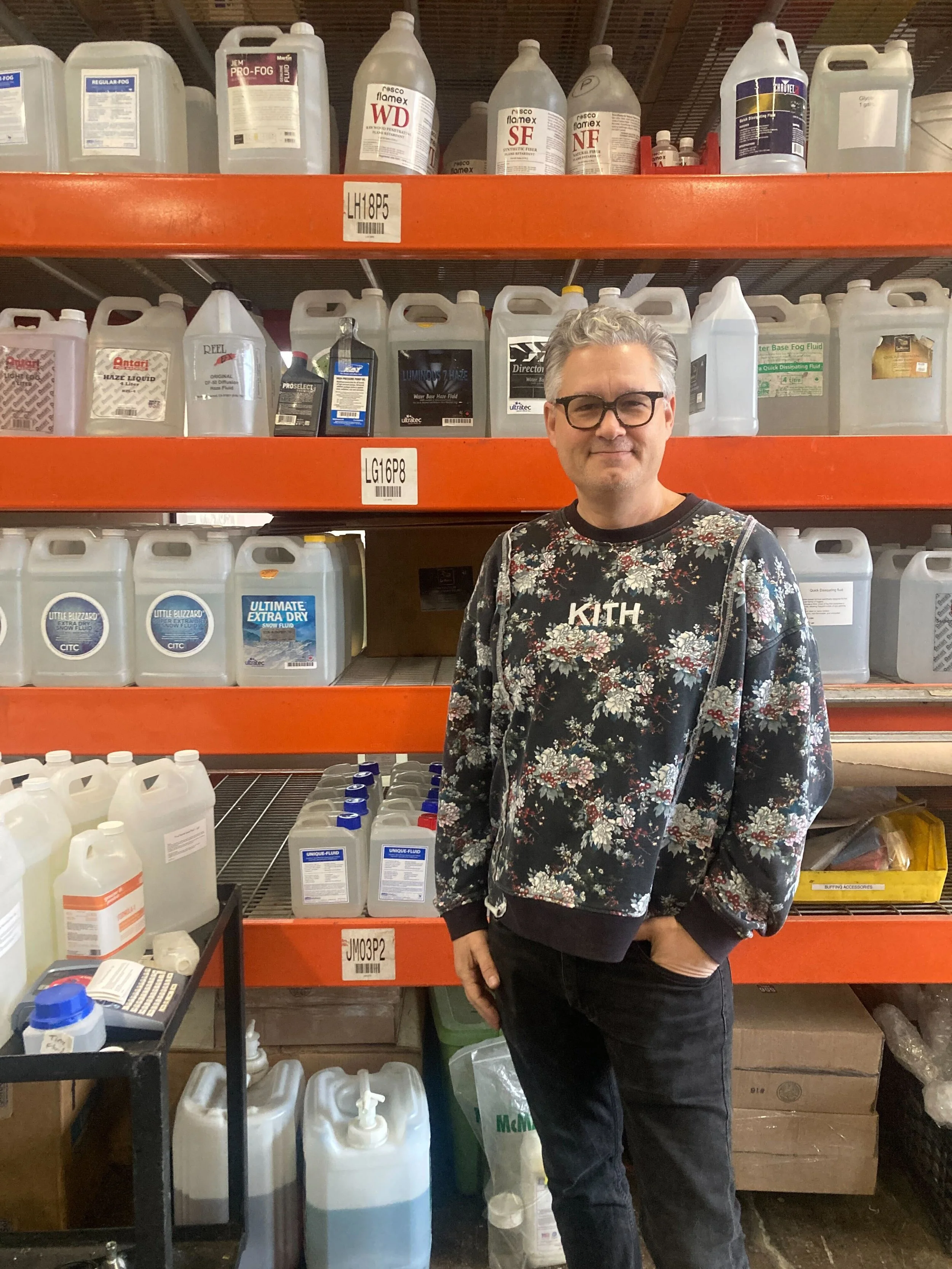
Taylor Quimby: This is outside in. I'm Taylor Quimby. Like a lot of podcasters, I'm a former theater kid. So while it's tempting to start this episode with something like December 24th, 9 p.m., or Marley was dead to begin with, I'm going to opt for the more standard route cutscene. Hello? Hi. I am here for Jeremy. Just inside a big boxy warehouse in Brooklyn, New York is a tall set of orange racks that look like they would belong in Home Depot. Across them are rows and rows of clear plastic jugs.
Jeremy Chernick: So yeah, we have regular fog. We have little blizzard, extra dry snow fluid. We have, uh, we have fake blood. Uh, we have bubble juice of all different kinds. So yeah, this is just nothing but fluid.
Taylor Quimby: This is the home of jams, special effects. It's part storage facility, part magician's workshop. And the Merlin of this place is designer Jeremy Chernick. I read that you consult with SNL.
Jeremy Chernick: Is that this building consults with SNL? Yes. If they need a squirt rig or for blood vomit, you name it, they might come here depending on whether they need that. They have their own equipment.
Taylor Quimby: Jeremy's job is to make the impossible possible. This warehouse, it's jam packed with all the ingredients necessary to dazzle, delight, and maybe even terrify audiences. But a lot of that is more mundane than you might realize.
Jeremy Chernick: There's a soldering station in front of us, so we have a welding station. We have a bunch of different types of grinders.
Taylor Quimby: Nice anvil.
Jeremy Chernick: Here we have a huge anvil.
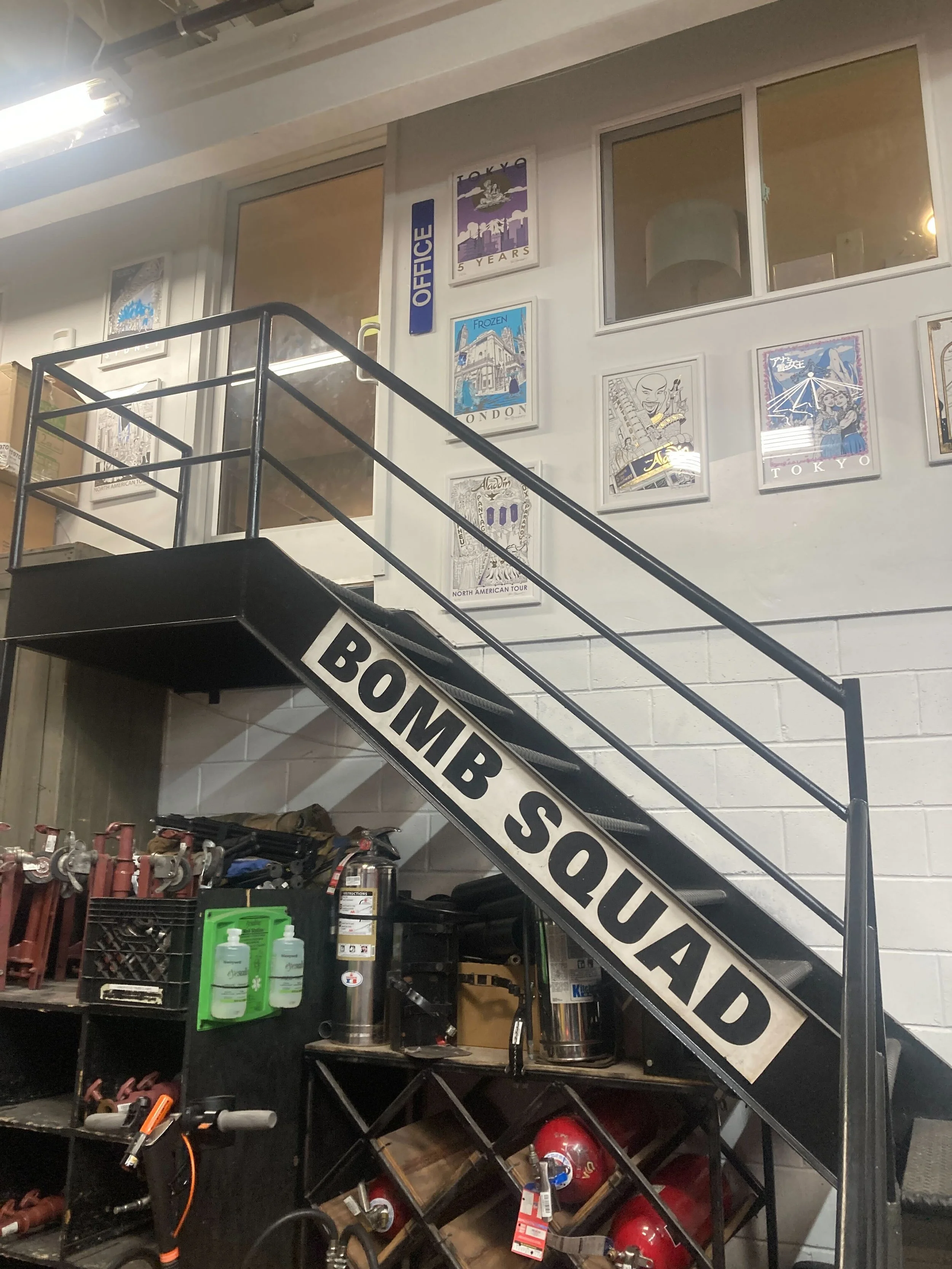
Taylor Quimby: Uh, don't be disappointed. There are areas here where the arcane ingredients are a little more thrilling to behold. Sign on the door that says Bomb Squad.
Jeremy Chernick: That's right.
Taylor Quimby: For example, in the back of the jam warehouse are two sections locked and surrounded by metal cages. Imagine this as something like the restricted section of the Hogwarts Library.
Jeremy Chernick: To my right is a flammable storage, so that would be any flammable liquids.
Taylor Quimby: This is where jam keeps the pyrotechnics, the sort of whiz bang sparkly effects that litter Broadway's adaptation of Aladdin.
Genie: Oh, my.
Taylor Quimby: Stop all that genie magic is really just a colorful form of combustion.
Jeremy Chernick: The kind you would use on movies and television or in a rock concert.
Taylor Quimby: And we got we got the prerequisite, almost an overabundance of signs. Flammable, dangerous. No smoking, no matches. Flammable. Storage. Danger, danger, danger. Towards the center of the warehouse is a miniature stage where they test some of the effects in progress. And this is where Jeremy weaves an even more occult form of illusion.
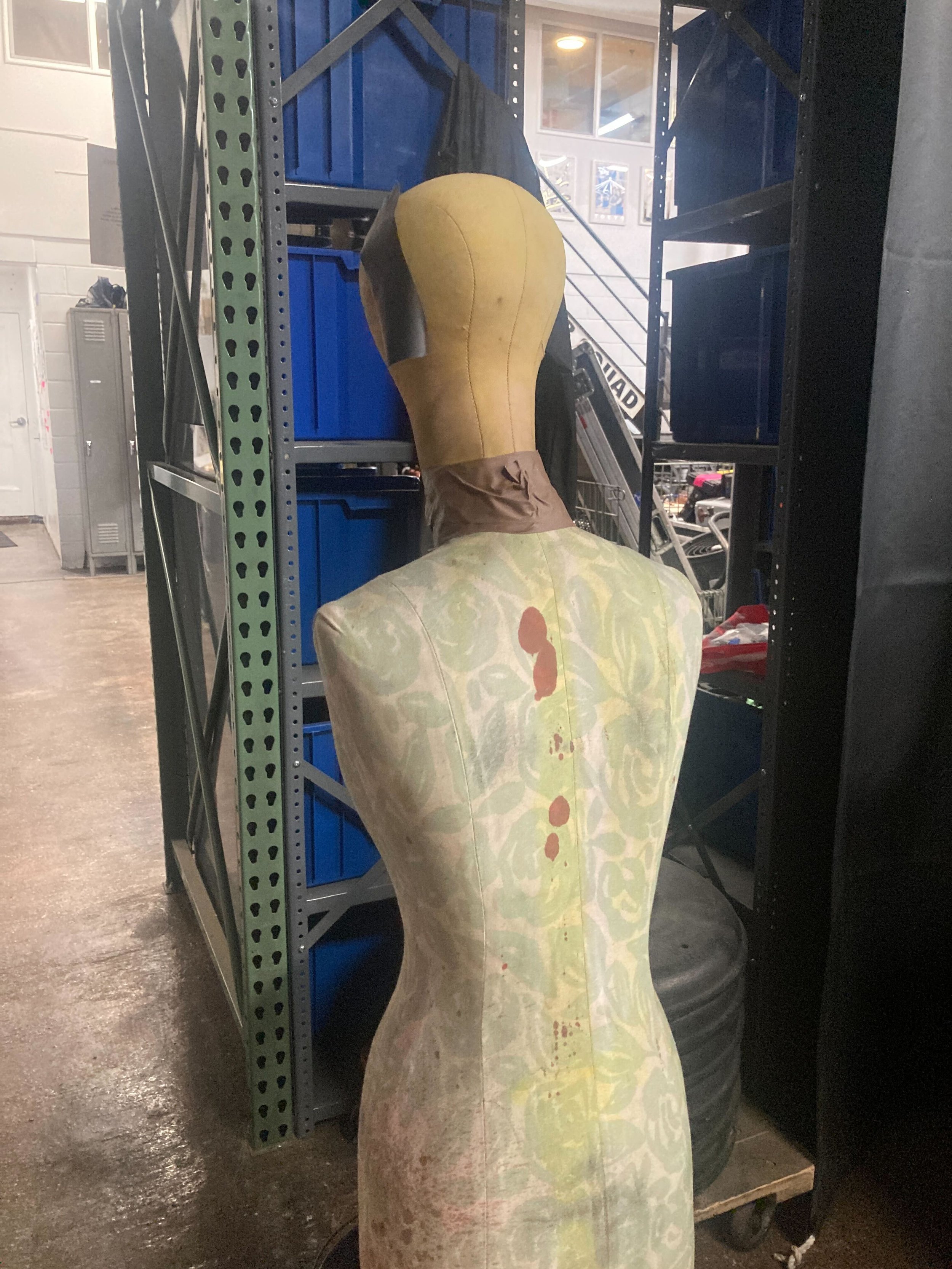
Jeremy Chernick: I see a dummy over here.
Taylor Quimby: Is that like the crash test dummy of the.
Jeremy Chernick: Yeah, that poor lady has been, uh, has had a lot of blood, uh, effects done to her that she. Yes, absolutely.
Taylor Quimby: Stage blood, by the way, usually made from corn sirup. Just one more reason the stuff isn't very good for you. Don't at me. Corn lobby. I mean, it's relatively clean, though. I only see a few stains on the back.
Jeremy Chernick: Yeah, we sometimes wrap her in a poncho.
Taylor Quimby: Squirting. Dripping. Splashing. Jeremy has helped commit on stage murders that range from the campy think Monty Python and the Holy Grail to the downright horrifying.
Jeremy Chernick: This is your right hand. You're going back.
Taylor Quimby: On his website, you'll find videos of Jeremy teaching how to slit throats while simultaneously squeezing a little blood pouch.
Taylor Quimby: This is for the 2023 revival of the Stephen Sondheim classic Sweeney Todd The Demon Barber of Fleet Street Swing. The guy in the video taking turns murdering and getting murdered is none other than Grammy Award winner Josh Groban.
Taylor Quimby: Not everything at J and M is quite that sensational. Jeremy estimates a full 20% of the warehouse is dedicated to the white, fluffy stuff of Christmas carols and wintry scenes.
Jeremy Chernick: So its floor to ceiling. Our ceilings are, I think, 16ft tall. Um, and we have stacks and stacks and stacks of different types of snow. The kind of snow you would use in a tiny little tabletop.
Taylor Quimby: Each box here is imprinted with a big white snowflake and a description coarse or fine. There are big bags of Epsom salt and way over my head, huge rolls of what looks like white insulation.
Jeremy Chernick: So we set up. We set up a lot of snowy environments in like August and September in order to get it into catalogs and into advertising in, you know, December. So it's a very strange thing to cover a house in snow, uh, in the middle of August. It's kind of like the cottony stuff that you.
Taylor Quimby: Would use for like Halloween spider webbing, but way, way.
Jeremy Chernick: Bigger, denser. And then you tend to have to fill in all the seams and cracks like it won't look good on its own. Then there's other, more fine products that you would layer. On top of that, you would do a roof. Yeah, it's a big project. It takes usually a day, um, if not more, and the cleanup is even longer.
Taylor Quimby: I'd love to see the secrets behind a good magic trick, but then afterwards, there can be that little bead of disappointment once you know, you know, you know. But in a world where CGI has taken over so many of the wonderful illusions of stage and screen. Call me old fashioned, but I love to see a special effect that's rooted in the real world. And it's no surprise that Jeremy is still working in this warehouse and not behind a computer. Because in theater, you can't just use digital wizardry. His effects use real actors in front of real audiences, and the work he creates here isn't just seen, it is literally felt.
Jeremy Chernick: If there's rain on stage, there might be people in the audience who actually feel some drops. If they're in the close to the rain, there is an environmental and humidity change that happens that may be slightly subliminal, but it's it's real.
Taylor Quimby: But the secret behind that magic is also what makes this kind of wizardry so hard to do. You can't have a rainstorm without having wet water. You can't have wind without blowing stuff around.
Jeremy Chernick: You can't have snow without understanding where it's going to go and how you might have to get rid of it.
Taylor Quimby: So how does one conjure the elements indoors? Let's start with snow. Do you ever use bubbles as snow?
Jeremy Chernick: I try not to. I bubbles and on stage are just slippery. This is a wonderful thing to put outside or at a party, but like. No. I've tried to put bubbles in shows a few times. They always get cut because the dancers don't like it.
Taylor Quimby: For Broadway's adaptation of the musical frozen. Jeremy didn't simply let it snow. Instead, he flooded the stage with tiny pieces of paper. Not very high tech, but they float down from above the stage, catching the light twinkling and floating in eddies as they drift. And best of all, they do not melt. Jeremy walks me over to these big, heavy looking tubes dotted with holes that line one rack of the warehouse. They are all painted jet black.
Jeremy Chernick: We have fans, we have confetti blowers, we have snow tumblers, which are like long tube perforated tubes that will you'd hang overhead and they rotate. And this is what you'd put like little pieces of paper, for example. Exactly, exactly. And so you can and you can line them up so that you can do 30 or 40ft of it across the stage. So if you go and see your nutcracker and it's and it's snowing on stage, it might be something like this.
Taylor Quimby: I see. And everything's painted black. Because if it's going to be backstage, if it's going to be hiding, you.
Jeremy Chernick: Needs to be invisible. Black. Black means invisible.
Taylor Quimby: But even these snowflakes, basically just white confetti can have unintended consequences. That whole not melting bit, it's a two way street.
Jeremy Chernick: Um, I've done many productions where it snows, and if it snows at the very end of the show, big deal. If it snows in the middle of a show, then your choices. Is there snow everywhere for the rest of the show? Where does it go? Is it getting blown around?
Taylor Quimby: Frozen is a musical that on stage involves a lot of puppetry. We're talking people on stilts, dancers zipping around the stage, big, sharp icicles that rise up from the ground. When this paper snow piles up, it could get slippery, just like the bubbles. And avoiding injury for your actors is kind of like special effects 101. So the production team figured out how to basically sweep the fake snow off the stage at key moments by having dancers in big hoop skirts brush them off with their clothes.
Jeremy Chernick: So there's lots of ways in which we can solve, uh, all sorts of environmental problems. But the problem solving is a huge part of the job.
Taylor Quimby: But if you think snow is hard to manage, try dumping more than 100 gallons of water on stage in just a few minutes.
Jeremy Chernick: Uh, special effects is a ton of plumbing.
Nate Hegyi: That's coming up in just a sec. But first, we want to exit stage left for a spell, and call back to one of our recent episodes about the role of nature in the movies. After we put it out, we heard from one listener about his favorite outdoor film settings. Here he is.
Aaron: Hi, my name is Aaron and I've always enjoyed movies set in the North. Like cold and dark places, like, um, like Nordic noir, Alaskan wilderness, that sort of thing. Growing up in Missouri, the winters were fairly mild, so seeing that contrast has always piqued my interest. And a lot of those are also survival films, which is interesting. But lately I've been really intrigued by the ocean. I recently learned how to swim, so I watched survivor now, and it makes me really wish I could swim in the clear blue waters of Fiji.
Nate Hegyi: Thank you so much Aaron. We love hearing from all of you, and you can always send us a voice memo to Outside In at npr.org. Or you can give us a call on our hotline, one 844 Go Otter. More outside in after the break.
BREAK
Nate Hegyi: Hey hey hey. This is outside in a show where curiosity and the natural world collide. I'm Nate hegy, and today, producer Taylor Quimby has been taking us on a tour of a Brooklyn warehouse where designers are tasked with bringing the elements inside on stage and, most importantly, under control.
Jeremy Chernick: Mist.
Taylor Quimby: Oh, yeah.
Jeremy Chernick: So, uh, we're gonna try and put this into a show. I don't know exactly why, but we are.
Taylor Quimby: I'm standing outside of Jam's special effects in Red hook, Brooklyn, and designer Jeremy Chernick is testing an unusual type of hose. He's a little test there.
Jeremy Chernick: Yep. That's what the outside is for.
Taylor Quimby: It looks like the kind of tube that hangs over the produce section of your grocery store, and occasionally sprays a fine mist on the veggies. It's hooked up to a tank of water. Air? I'm not sure, and I don't want to interrupt.
Jeremy Chernick: Loud noise. Thank you for that. Heads up. Yeah.
Taylor Quimby: When I was doing high school theater, the most advanced bit of special effects we ever did was when an actor got brained with a glass bottle made of sugar. I remember gleefully eating the shards backstage just to prove that you could. Which, by the way, I'm told you shouldn't. But you know, special effects like that. Easy one offs. They can get added at the very end of a production. But whether effects are so big they have to be built in from the get go. And what's more, they're all connected. Take wine, for example.
Jeremy Chernick: It really puts you in a place. It can imply all sorts of things, from like freedom to danger in terms of like, are you on top of a moving vehicle? Are you, you know, racing against time to, I would say like supernatural.
Taylor Quimby: But wind is something you feel if you're in the audience, you might want a little extra help to make the effect pop a little bit of atmospheric fog.
Jeremy Chernick: You can see it when hair blows, but if you add that little layer of atmospheric into it, you can really see it. So. So it's a very useful tool.
Taylor Quimby: The reverse is also true. Want to make your fog look extra creepy? Inject a little air movement.
Jeremy Chernick: Sometimes you just want to roll a whole bunch of that very low lying Uh, fog on stage.
Taylor Quimby: It's like the Sherlock Holmes scene.
Jeremy Chernick: Yes. Yeah. Like misty morning feel of, uh. You know, is there a show that's taking place in ye olde London?
Taylor Quimby: There are all sorts of different fog effects, by the way. Haze, smoke. Low fog, each one different. And each one reacts differently to light and movement. But most are still made from the same forms of glycol or glycerin. Basically, fog machines are giant vapes minus the nicotine.
Jeremy Chernick: So what you're seeing isn't necessarily smoke, but it's actually a vapor. So we wouldn't want actual smoke. We don't like actual smoke. We don't like actual smoke at all.
Taylor Quimby: Occasionally, Jeremy gets handed a project where he gets to bring all of his toys together the fans, the fog machines, all the razzle dazzle. Once he was asked to create an on stage tornado for Hercules the Musical in London's West End.
Performers: For Great Bolts of Thunder. The underworld has run amok.
Jeremy Chernick: I kind of love the nerdy engineering part. And we kept thinking about different ways in which we could do it. We could do it with like 6 or 8 big fans that pump through the stage and then have to be perfectly tuned with, like, blades and get the wind to go in exactly the same circular motion. And that didn't really fit, and we couldn't find a way to do it. And it has to be symmetrical or it doesn't work.
Taylor Quimby: Ultimately, they wound up embedding some 40 odd small fans under the floor of the stage for the effect.
Jeremy Chernick: And we put big pieces of silk into it. So they go swirling around so you can see it. We put fog into it so you can physically see the tornado. It's lit beautifully.
Taylor Quimby: But as complicated as all that may seem, conjuring a literal tornado on stage, it's nothing compared to harnessing something that in real life seems a lot less dangerous. Set fire aside because I think that's its own beast. And like you said, probably more complicated than we want to get into. If I think about wind, rain, snow, which which is the most challenging?
Jeremy Chernick: I think the answer is water. Water has a mind of its own based on gravity. So if there is a crack, if there is a hole, if there is anything, the water will find it. Special effects is a ton of plumbing.
Taylor Quimby: On a second floor of jam. Special effects is a wing that screams DIY home improvement, but like bigger.
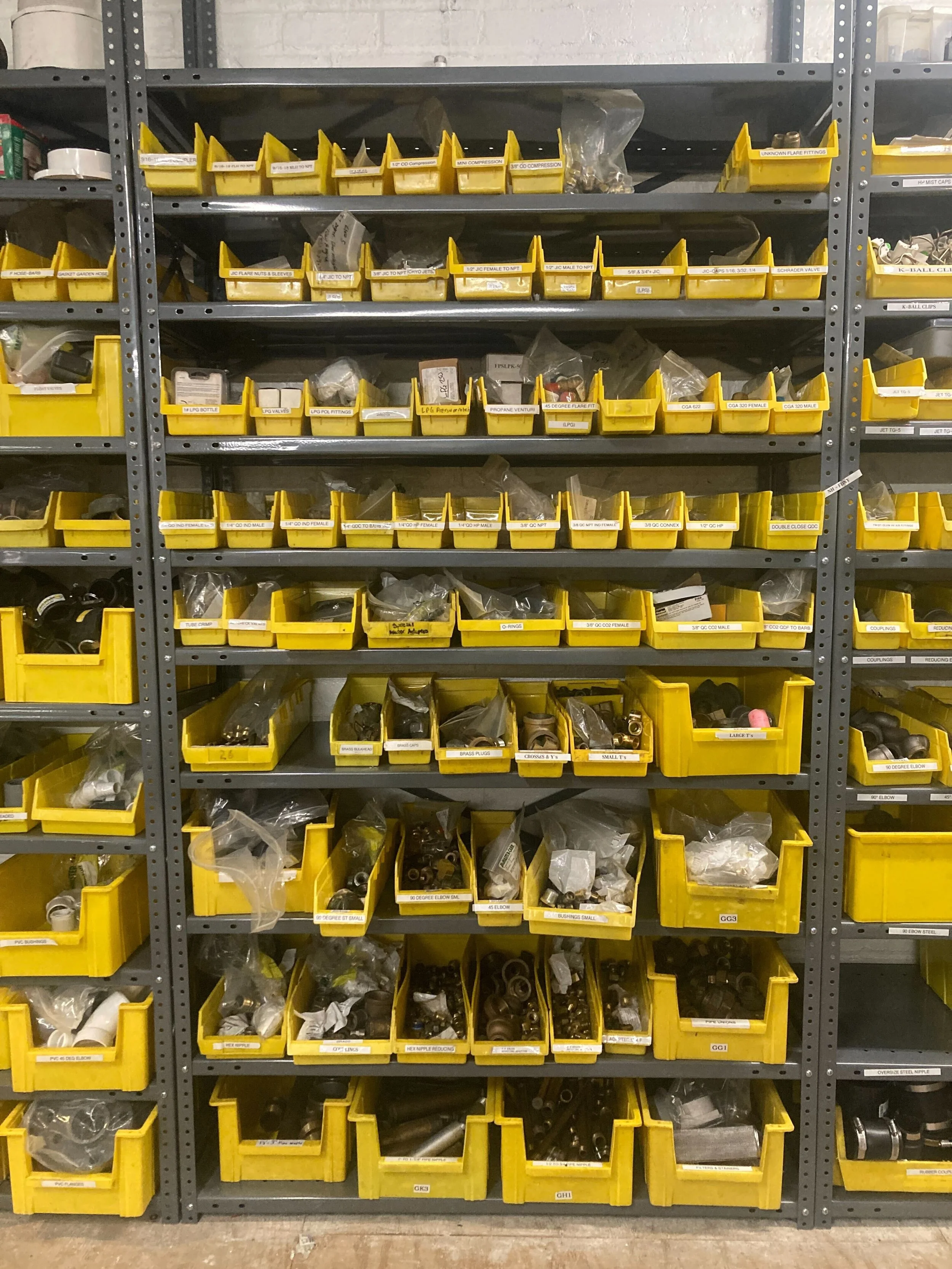
Jeremy Chernick: Uh, we're in, uh, the yellow bin area, um, because everything is in yellow bins, but it is basically a library of parts.
Taylor Quimby: Ace hardware could only dream of this selection a few feet away.
Jeremy Chernick: What we're standing in is essentially a wall of wrenches, a work table, a vise, and various ways of sealing pipes.
Taylor Quimby: Imagine a workshop designed to accommodate every type of fixing and faucet from every country and every era imaginable. Some of the wrenches here are the size of my arm, and if there's something they don't have.
Jeremy Chernick: A 3D printer.
Taylor Quimby: Oh, you gotta have a 3D printer these days.
Jeremy Chernick: 3d printer. We use that to make this to. That's because lots of times, uh, something comes out of this shaped hole, and we needed to get into a different shaped object.
Taylor Quimby: All of this just to get the right amount of water dispersed in just the right way. But water effects also have all the aforementioned problems on stage. There's an English play called Way Upstream, featuring a boat that floats on a flooded stage during a technical rehearsal during the 1980s, in one of London's historic Royal theaters, a 6000 gallon water tank split and actually flooded the stage, wrecking the floors and damaging a bunch of other equipment. When the show finally opened, one critic showed up in Wellington boots as a joke. But even if you don't have a catastrophic failure, you still have to contend with the sound.
Jeremy Chernick: These are these big boxes. Are pumping stations for rain. So these have been used on Broadway.
Taylor Quimby: Jeremy walks me over to a huge black cabinet on wheels. It's a mobile water pump. Like everything in theater, it needs to be invisible and quiet. Which, if you've ever used a sump pump on a flooded basement, you know is not easy. Yeah, so it looks like the inside has, like, foam paneling, just the same way that like a radio studio would to try and muffle the noise.
Jeremy Chernick: Open it up. We have three different beefy pumps. Uh.
Taylor Quimby: Beefy, because these pumps need to move a lot of water very fast.
Jeremy Chernick: We have water tanks. This is a 500 gallon water tank. I think this is like a 400 gallon water tank. We have a couple up here that are 100 gallons. We also have.
Taylor Quimby: One of Jeremy's biggest water effects was designed for a show that opened on Broadway in April of 2024.
Performer: Sometimes you make a choice and you have to live with it for the rest of your life. And whenever you think about it, you can taste it like something you're forced to eat. That taste never leaves the back of your throat.
Taylor Quimby: It's a tale in the style of West Side Story troubled teens, forbidden love, and it culminates at the end in a full on stage rumble. Yeah. And so this is Tony Award winning Broadway show, The Outsiders. And we're talking about a full on, big choreographed fight sequence with a massive downpour on stage. It's like, you know, crack of thunder. You're soaked in seconds. Kind of rain.
Jeremy Chernick: Yeah, it's it's it's it looks like a tremendous amount of water.
Taylor Quimby: Arguably it is a tremendous amount of water. Eight performances a week. A system of pipes sends somewhere between 100 and 180 gallons over the stage. Probably a lot less than gets flushed down the toilets during intermission. But still.
Jeremy Chernick: I think we are currently using not as much water as it looks like, because lighting is amazing and you can if you light the water in the air, it looks like a ton and it is a lot of water, but it's it's not hundreds and hundreds of gallons.
Taylor Quimby: When the scene starts, the water starts to pour through rows of invisible nozzles, first in a thin drizzle, then growing into a downpour. As the actors throw and take punches, the water whips off their hair like a music video. It bounces off the hood of an old car perched on the side of the set. They are soaked.
Jeremy Chernick: But the things that you don't see are that the water is around 98 degrees when it hits the actors, because a we have to protect them from illness and you know, if it's freezing, then and they're in the middle of doing a thing, it's really jarring.
Taylor Quimby: You also can't see that the stage has literally been built to capture all that falling water, so that it doesn't turn the theater into a moldy mess, and you can't see that this fake rainwater is filtered. I wouldn't use it to make iced tea or anything, but actors don't have to worry if they take an inadvertent gulp.
Jeremy Chernick: It is sanitized through a filtration system and through a UV system to really make sure that the, you know, the health and safety is maximized.
Taylor Quimby: There isn't a Tony for best special effects. The Tonys are Broadway's version of the Academy Awards, by the way. But The Outsiders won Best Lighting, best sound Design, and best musical last year. And Jeremy sees how all of it came together in the best way possible. In the onstage storm, he helped design.
Jeremy Chernick: The emotional poignancy of the story, the choreography, the way the costumes react to the rain, the way the set reacts to like, literally the way the rain is lit, the way that sound amplifies the sound of rain. Um, every, uh, department within the universe of creating that show is collaborating in a way that just like, really works.
Taylor Quimby: Towards the end of my tour, Jeremy walked me through one racket jams special effects that looks a little bit like the sort of storage you'd see at a fire station. Piles and piles of huge hoses snaked in coils big enough to screw into a city fire hydrant. It reminded me that as exciting as it is to see these magic tricks performed on stage, invisible and seamlessly tied into the narrative, the work that goes into them is shockingly real, tangible, and maybe, if I'm being honest, even a little humdrum. I have one of these jobs that everybody's like, oh, your job is so cool. You get to walk around and interview people, and I'm like, you know, a lot of it is just a job, too. Like, I have those things. And I was thinking the same thing about yours. I was like, man, designing special effects. So cool. And then you get to the hose portion of the tour. And I imagine that, like, there's parts of this that are just like, yeah, we've just got to get the hose to the place and.
Jeremy Chernick: Imagine that you also, when you're done, you have to actually like dry the hose out and make sure it's clean because water can turn into yuck quickly. So there is a lot of work in the setup and in the, you know, sort of maintenance of all of this equipment.
Taylor Quimby: Yeah, the jam hose cleaning department, not the most thrilling part of the job.
Jeremy Chernick: But they. Work hard and I appreciate it very much.
Taylor Quimby: In a sold out theater, under the lights, in the spell of a good story, the hope is that nobody in the audience is thinking about hoses or pumps or how all that water got there. That comes after. In the moment, Jeremy hopes all they see is the rain.
CREDITS
Nate Hegyi: That is it for today and from all of us at Outside In. We hope you have a happy 2026 with just the right amount of magic and mystery. This episode was reported, produced and mixed by Taylor Quimby. Our staff includes Felix Poon, Marina Henke, Justine Parady, and Jessica Hunt. Our executive producer is Taylor Quimby. Rebecca LaVoy is NPR's director of on demand audio music by blue Dot sessions. And don't forget we are a podcast. Subscribe wherever you get yours.
Taylor Quimby: (SINGS) Outside in is a production of New Hampshire Public Radio.
Nate Hegyi: Can you do the wicked. Can you do the wicked? (SINGS)
Taylor Quimby: No I can't.
Nate Hegyi: I just did it.
Taylor Quimby: Uh. Did you?
Nate Hegyi: Yeah, I nailed it. No notes, no notes.
Taylor Quimby: All right.