In Challenger's wake: The ethics of sending citizens to space
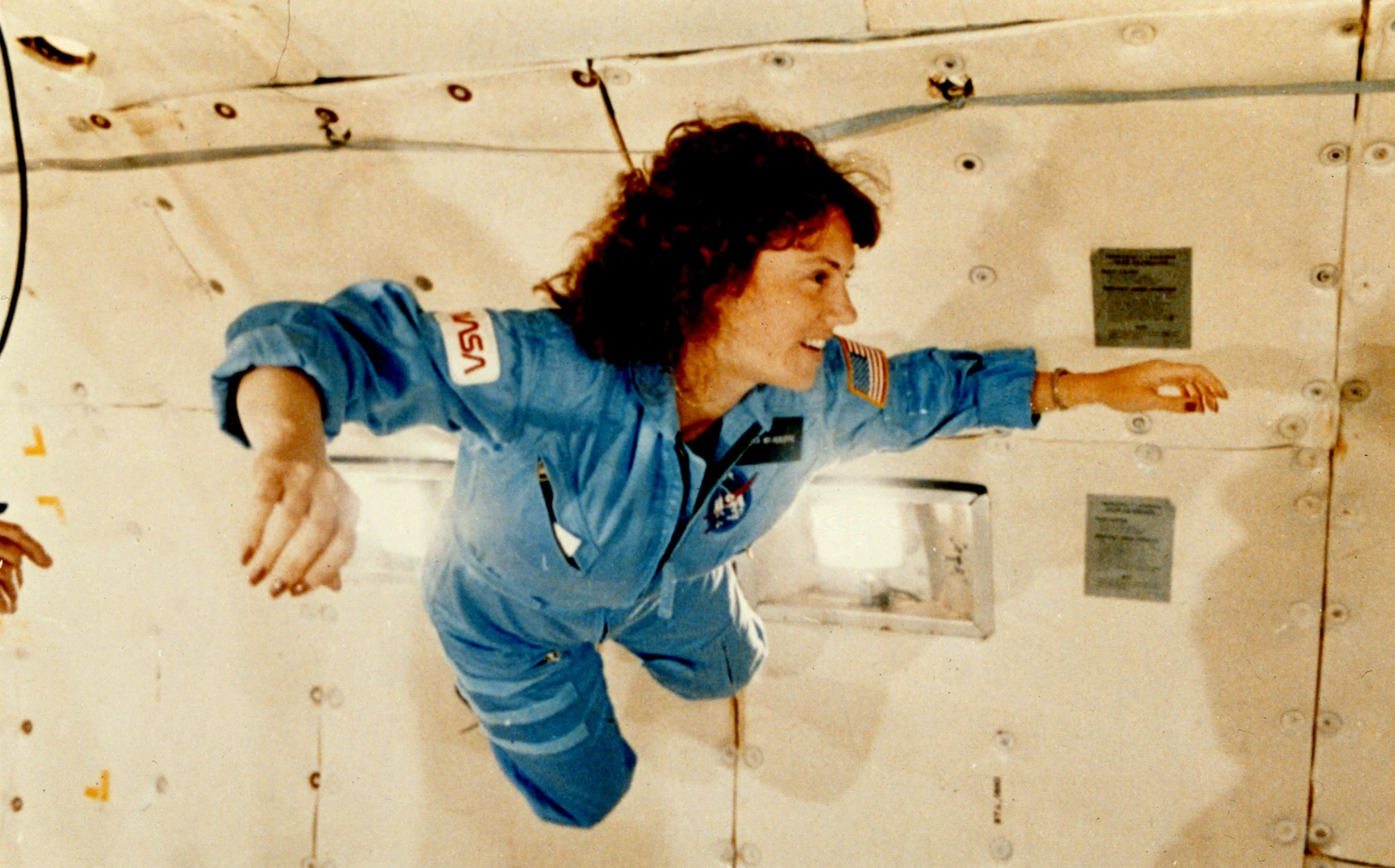
Christa McAuliffe gets a preview of microgravity during a special NASA training flight. Photo courtesy of NASA (Public domain)
In 1985, high school teacher Christa McAuliffe was selected to become the first private citizen to travel to space. After the Challenger explosion that killed her and 6 other astronauts, NASA scrapped its Teacher in Space Project; it was still too risky to send private citizens to space.
40 years later, things are looking very different.
Today, celebrities and billionaires are buying trips on commercial rockets. Private companies are designing new, private space stations. How is safety being regulated for these private space companies? And what happens if – or when – something goes wrong?
Featuring Kim Bleier, Ben Miller, Doug Ligor, Peggy Whitson, and Dana Tulodziecki.
Produced by Daniel Ackerman.


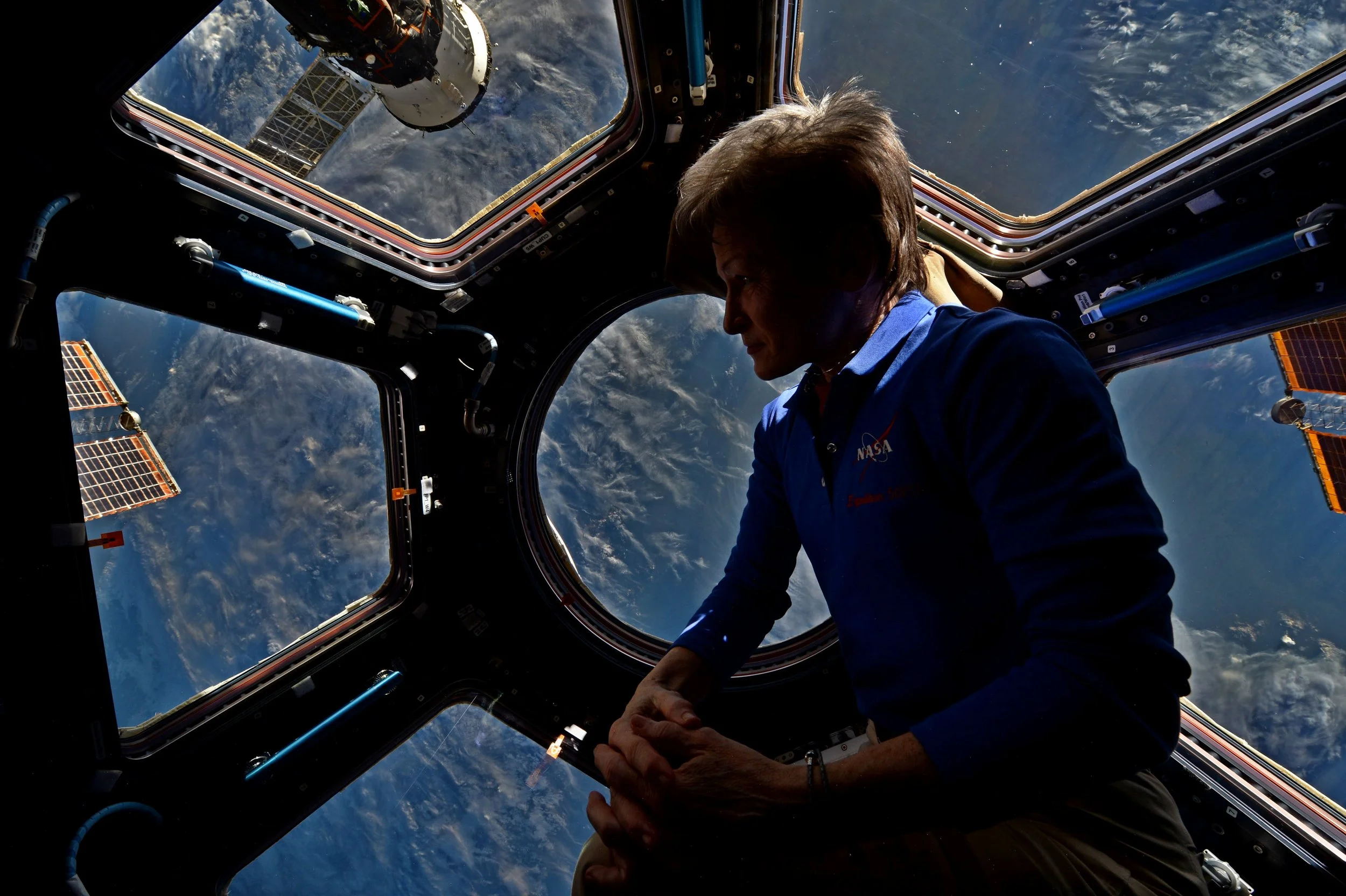
Astronaut Peggy Whitson pauses during a busy day on orbit to look out the International Space Station’s cupola at the Earth 250 miles below. (Photo by NASA CC BY-NC 2.0)
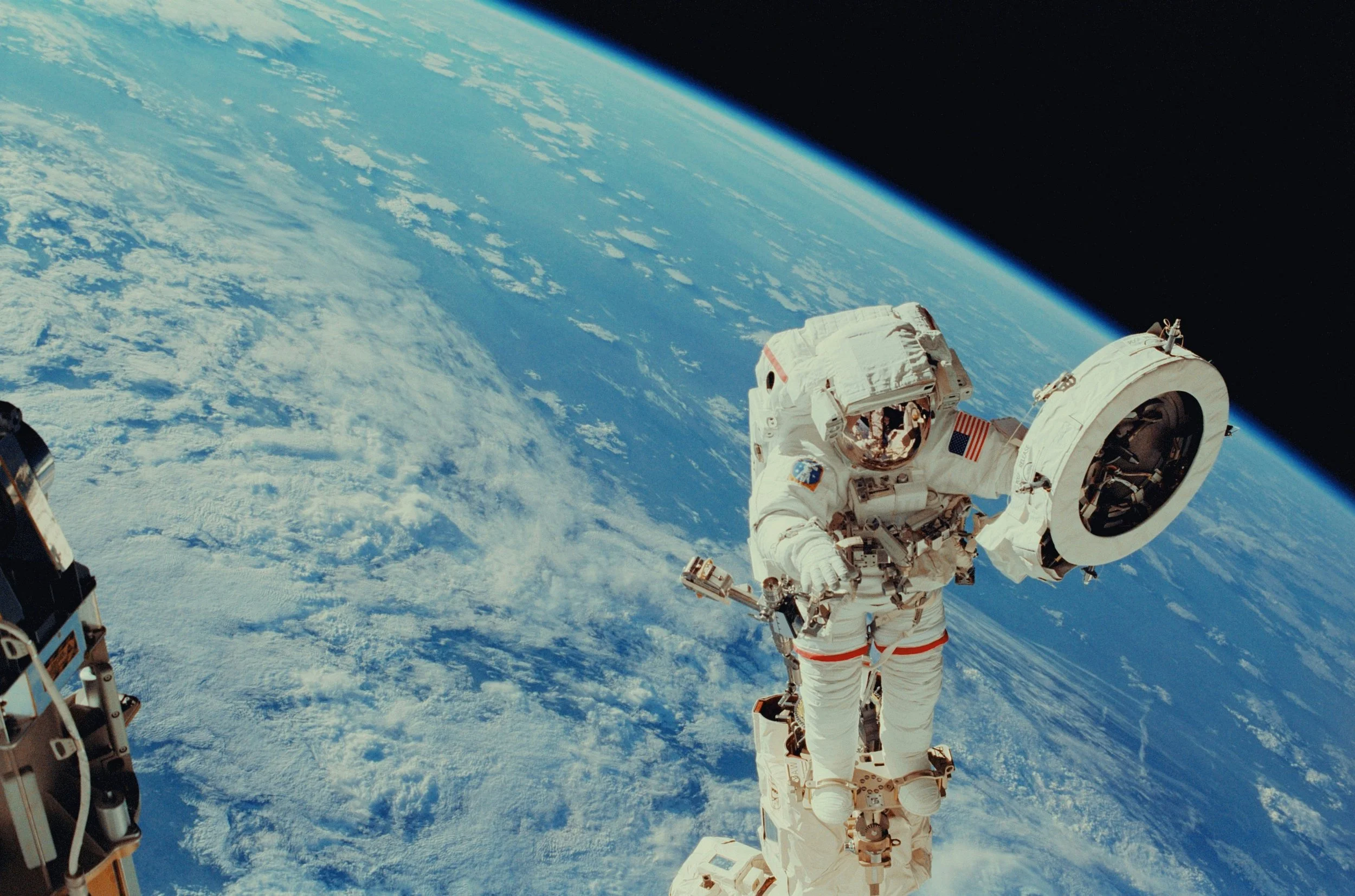
Astronaut Franklin R. Chang-Diaz works with a grapple fixture during extravehicular activity to perform work on the International Space Station. Photo by: NASA.
ADDITIONAL MATERIALS
SUPPORT
To share your questions and feedback with Outside/In, call the show’s hotline and leave us a voicemail. The number is 1-844-GO-OTTER. No question is too serious or too silly.
Outside/In is made possible with listener support. Click here to become a sustaining member of Outside/In.
Follow Outside/In on Instagram or join our private discussion group on Facebook.
CREDITS
Host: Nate Hegyi
Reported and produced by Daniel Ackerman
Mixed by Taylor Quimby and Felix Poon
Editing by Taylor Quimby, with help from Marina Henke and Felix Poon
Our staff includes Jessica Hunt, and Justine Paradis
Executive producer: Taylor Quimby
Rebecca Lavoie is NHPR’s Director of On-Demand Audio
Music by Blue Dot Sessions,
Our theme music is by Breakmaster Cylinder.
Outside/In is a production of New Hampshire Public Radio
Audio Transcript
Note: Episodes of Outside/In are made as pieces of audio, and some context and nuance may be lost on the page. Transcripts are generated using a combination of speech recognition software and human transcribers, and may contain errors.
Nate Hegyi: Kim Bleier has lived pretty much her entire life in Concord, the state capital of New Hampshire.
Kim Bleier: Concord is a little bit of a sleepy city. You know, it is a, a city. but it has a small town feel in some ways.
But in July of 1985, when Kim was just about to enter sixth grade… sleepy Concord was thrust into the national spotlight.
George H.W. Bush: [Well we’re here today to announce the first private citizen passenger in the history of spaceflight]
Here’s then-vice president George H.W. Bush.
George H.W. Bush: [The president said last August that this passenger would be one of America’s finest, a teacher.]
[MUX IN: BlueSun by Blue Dot Sessions]
Back then, NASA’s Space Shuttle program had been carrying astronauts to low earth orbit for four years.
But now, it was going to carry a school teacher.
More than 11,000 educators from across the country applied to the program.
George H.W. Bush: [And the winner, the teacher that will be going into space, Christa McAuliffe. Is that you? *laughs and applause*. Christa teaches in Concord High School in Concord, New Hampshire. She teaches high school social studies.]
Kim Bleier: for me, it was her charisma that drew me in, but also the, just the excitement. You know, here's this ordinary person from my city who is embarking on this extraordinary adventure.
[MUX OUT]
In the months leading up to her mission, Christa McAuliffe became a national celebrity.
Johnny Carson: How long will this mission be, do you have any idea?
Christa McAuliffe: Yeah, it’s gonna be six days.
Johnny Carson: Six Days!
Christa McAuliffe: Yeah. [Every 90 minutes I’m gonna be orbiting the earth at 17 thousand miles…]
Kim Bleier: So every day I'd run home from school, my parents would save the newspaper and whatever story it was from that day, we would cut it out and save it and put it into a, a photo album.
As a young girl in town, it’s not like space travel was something that was on my wish list, but it did give me the sense that whatever was on my wish list was achievable.
NASA Tape:we have main engine start… 4, 3, 2, 1…
[MUX IN: Cold and Hard by Blue Dot Sessions]
On January 28, 1986, the rocket carrying the Space Shuttle Challenger exploded.
[NASA SOUND]
Christa McAuliffe, and the six other astronauts aboard, were killed.
[MUX OUT]
Kim was one of millions of children who watched this happen on live television while at school. It was a shock. Kim stopped adding to her memory book.
Kim Bleier: After the tragedy, it sort of ended, you know, we continued to collect the articles for a period of time. But, you know, look, every article had the, you know, the smoke and the explosion and, and that became a thing that we didn't wanna look at anymore.
In New Hampshire, Christa McAuliffe’s legacy lives on. She’s still an inspiration for students.
But after the explosion, NASA scrapped its Teacher in Space Project. They decided it was still too risky to try and send private citizens to space.
40 years later, things are very different.
[MUX IN: Pxl Cray by Blue Dot Sessions]
News Clip: [Four space tourists are on the first flight of its kind carrying humans over the earth’s polar regions. The Fram 2 mission is privately funded by crypto billionaire…]
I’m Nate Hegyi, and this is Outside/In.
Today, celebrities and billionaires are buying trips to space.
Private companies are designing new, private space stations of their own.
The question is…are we ready for that? And what happens if… or when… something goes wrong?
SpaceX Launch video: [3…2…1…ignition]
Daniel Ackerman has the story, after a break.
[MUX OUT]
[PART I: A new industry is born]
Daniel Ackerman: This is Outside/In. I’m Daniel Ackerman.
Chances are, you have never looked at the Earth the way this guy has.
Blue Origin clip: [Look at the Earth, just look outside! Look at the Earth!]
These clips are from a promotional video for Blue Origin, the space company founded by Jeff Bezos. The people are floating in zero gravity – looking down at the curvature of the Earth from space.
Blue Origin clip: [Oh my word, I’m just spinning…That was, that was enlightenment. This is the best experiment of my life.]
The production is a little cheesy. …but I have to admit, I found myself tearing up watching these reactions. The raw emotion…the overwhelming sense of awe……it was contagious.
Blue Origin Clip: I just went to space as the first woman from Mexico!
But the fact is…very few people have had this experience. Only about 750 humans have been to space. Ten times that number have summited Mount Everest.
And of that 750, the vast majority have been highly trained professional astronauts, with government agencies like NASA.
Apollo 13 clip: Uh, this is Houston… say again please? “Houston, we have a problem.”
A lot of us grew up watching movies about space travel that portrayed astronauts as these elite athletes and technical geniuses…something close to superheroes.
Like soldiers, these were public servants -- putting their lives on the line for the sake of science and exploration."
But the voices in that promotion video? One of them was 90-year old William Shatner.
William Shatner, Blue Origin Clip: What you have given me is the most profound experience I can imagine.
These folks are among the few dozen private passengers that Blue Origin has sent beyond the Karman line, the invisible boundary that separates our planet from everything else.
And they are not necessarily “highly trained.”
Ben Miller: That said, there’s a reason industry is so keen on it. They see a lot of demand.
[MUX IN: Stirring Awake by Blue Dot Sessions]
This is Ben Miller. He’s an economist who researches space policy for the RAND Corporation.
Daniel Ackerman: Do you aspire to ever go to space yourself?
Ben Miller: I’ll leave that to others, I think. I enjoy researching the regulatory issues, but I’m good with my two feet on the ground.
Ben isn’t alone. But the other side is growing. A few years back, Pew surveyed Americans and asked if they’d be interested in traveling to space.
Ben Miller: 42% of people said they were definitely or probably interested. On the one hand that's, oh, that's less than half of people. But I look at that and go, 42%. That's, that's a very sufficient slice of the pie to, to build a company off of, you know, 42% of multimillionaires will give these companies more than enough customers to, to work with for a while.
According to its website, reserving a seat on a Blue Origin rocket requires a $150,000-dollar deposit. The full price of the mission isn’t public…but presumably, if you have to ask, you can’t afford it.
Blue Origin, by the way, didn’t make anyone available for interview.
[MUX SWELL AND OUT]
But what kind of assurances do those passengers have that they’re safe? What happens if something goes wrong?
To answer that, you have to go back to 2004.
News clip: [It was a near flawless mission on a beautiful morning. Thousands here showing up, watching in awe, their eyes glued to the sky, to witness this milestone in history.]
On June 21st of that year, the first ever privately built, privately piloted spacecraft traveled to space.
News clip: [This was but a stepping stone to take space travel out of the exclusive hands of government. Their goal: a tour bus to the stars.]
And the US government – they weren’t unhappy about this. Just the opposite – they wanted to encourage this burgeoning private space industry.
So, a few months later, a bipartisan group of lawmakers passed the Commercial Space Launch Amendments Act of 2004.
Doug Ligor: So from 2004 to now… it’s been a growth period.
This is Doug Ligor. He is a space lawyer. Which is a specialty he didn’t really anticipate back in his law school days.
Doug Ligor: No, I, and I don't think a lot of people do, um, uh, think about being a space lawyer, uh, when they're in law school. It's kind of a burgeoning field.
Doug says the 2004 Space Launch bill was meant to clear the way for private space companies.
One thing the bill did was set up the FAA to regulate spacecraft launch and re-entry.
Doug Ligor: If your vehicle is reentering the atmosphere, the FAA needs to ensure that the crew, uh, has certain safety protocols in place to protect the crew so they can operate the vehicle so they can maintain public safety and it doesn't crash into, you know, into a city or something like that.
But there was One thing the bill specifically forbade the FAA from doing, at least at first: and that is, requiring certain safety measures for spacecraft passengers.
Doug Ligor: There's a carve out for what they call space flight participants.
[MUX IN: Whiteout by Blue Dot Sessions]
So commercial for-hire individuals that go on those vehicles. Um. FAA doesn't have the authority to impose any standards, uh, safety standards. So, for example, if you wanna go to space and you say, well, you know, I'd like to be strapped into my seat. That's up to the company to decide, or you say, Hey, you know, I'd really like to be in a pressurized suit in case we lose oxygen in the cabin. FAA has nothing to say about that.
[MUX SWELL]
Lemme get this straight… The very same FAA that regulates seatbelts, smoking, and the weight of airplane seats…has nothing to say about passenger safety in space?
Doug says the idea here is that human space travel is still such a new industry…we don’t exactly know what the future will look like. And if we impose binding regulations now…it could stifle innovation.
One worker in the industry told me that regulating passenger safety, would be like strangling a baby in a crib.
Doug Ligor: The companies went to Congress and they said, we need this freedom. Um, uh, because we're gonna innovate all these different designs, and if you hamstring us with a rule, then it's gonna funnel our technology in one direction. We don't want that.
[MUX SWELL AND OUT]
This ban on safety regulation…sometimes called the ‘learning period,’ was originally supposed to expire in 2012. But Congress has extended that deadline again and again. Now, the private space industry has been “learning” for a full 20 years. The law is set to come under review once more in 2028.
Meanwhile, the number of private citizens getting shot into space is growing.
In 2021 –the year Blue Origin started taking paying customers into space – nearly 20 private citizens made the journey.
The number of NASA astronauts that flew that year? about ten.
[MUX IN: Vik Fenceta Lan by Blue Dot Sessions]
I'm not saying I share this opinion… but one could argue that the high-rollers who sign up for a private joyride in space know what they’re getting into.
And you could imagine a fair amount of online schadenfreude if it were a handful of billionaires killed in the first private space disaster – not unlike what happened when the titan submersible imploded in 2023.
YouTube video: He thought his submersible was one of the safest forms of transportation in the world. And he also said it was “unsinkable.” That’s the same thing they said about the Titanic!
[MUX SWELL AND OUT]
But it’s not just rich tourists heading to orbit on private spacecrafts.
Peggy Whitson: Launching is a thrill. I don’t get tired of that part. It’s a lot of fun. There’s some G forces involved, acceleration, so it’s pretty dramatic.
This is astronaut Peggy Whitson. She holds the American record for most days spent in space, at 695. Peggy has spent the better part of two years of her life, orbiting hundreds of miles above Earth’s surface.
Most of that was as a NASA astronaut in the International Space Station.
Peggy Whitson: I remember I'd been on orbit for almost three weeks on my first flight, and uh, I was in my crew sleep station, which is about the size of this little booth here. And, uh, you know, in the morning I floated outta my sleeping bag and floated down the laboratory. And I'm like, I live in space. This is so amazing.
When Peggy retired from NASA in 2018, she figured she’d spend the rest of her life stuck here on this big rock with the rest of us.
But then, a company called Axiom Space offered her a job – as a private sector astronaut. .
Peggy Whitson: I left in 2018 expecting never to fly again, and I've had two missions since then. Uh, that's faster flight rate than I got when I was at NASA.
[Mux in: Pxl Htra _ Heavy Beat by Blue Dot Sessions]
Peggy’s two commercial missions for Axiom were flights to her old stomping ground at the ISS, aboard a SpaceX capsule.
Peggy Whitson: We've done full missions, uh, done all the training, the preparation, the mission ops, uh, the interfaces with NASA. Uh, and it's actually an important stepping stone for us as we look forward to building Axiom Station.
Axiom Station. The ISS is already well beyond its intended lifespan. And it’ll be replaced by the privately built Axiom Station. Peggy says it’ll be constructed over time, piece by piece, starting in 2028.
Peggy Whitson: Initially the first module will be docked to the International Space Station.
Peggy Whitson: And then when our second module comes up, we'll detach from the space station. The two will join together and we will be capable of a four person crew with continuous human presence on orbit.
To Peggy – the upgraded space stations, that faster flight rate – it’s all evidence that the private space industry is innovating.
Peggy says Axiom Station will host science and medical research that just can’t be done here on Earth.
Some of that research already got started on one of Peggy’s previous Axiom missions to the ISS.
She transported cancer cells to space, for drug testing.
Peggy Whitson: Cancer tends to grow a lot faster in space, and so, and we don't necessarily understand why, but it becomes a great test bed for us, because in a week or two weeks we can tell, is this drug working?
but Axiom station isn’t just going to be used for research.
Because whereas NASA is bound by it’s mission – for space exploration and science – private companies have other interests too.
Peggy Whitson: We are gonna be developing an economy in space. We want to do in-space manufacturing, orbital data centers, uh, be part of mesh networks on orbit. All of these things I think are going to contribute, uh, to building that presence in space.
Daniel Ackerman: So Axiom is not a space tourism company?
Peggy Whitson: Uh, no.
[MUX OUT]
It’s not just Axiom. Other firms too are vying to create their own private industrial space stations.
And Peggy says realizing this vision of a thriving space economy that improves the fate of humankind here on Earth…it’s gonna take more than just highly trained career astronauts like her.
[MUX IN: Pxl Cray by Blue Dot Sessions]
Peggy Whitson: Space is changing. It is going to involve a lot of people who I, I might just be a welder. I might just be somebody who's going up to build something in space, uh, and or mine something in space.
On the one hand, this new future opens a world of possibilities. regular people, who would never qualify as nasa astronauts, may have a chance to go to space.
For example, Axiom is working to determine whether it’s safe for people with diabetes to travel to space. And Blue Origin recently launched someone who uses a wheelchair into space for the first time.
But it also raises a different set of ethical questions.
Rich tourists may choose to accept the dangers of space, and pay the consequences if something goes wrong.
But what if you’re an employee, sent to space by your boss?
[MUX]
Dana Tulodziecki: We know it’s dangerous but we don’t know how dangerous it is for people who are not trained astronauts
BREAK
Daniel Ackerman: This is Outside/In. I’m Daniel Ackerman.
Dana Tulodziecki: That is Mr. Spock, uh, a life-size cardboard standup that's been with me for almost 35 years now.
This is Dana Tulodziecki. Dr. Spock loomed over her desk at Purdue University, where she works as a space ethicist.
Daniel Ackerman: Would you ever travel to space if you were offered a seat?
Dana Tulodziecki: Yes, absolutely. Um, I dunno how long I would make it because, uh, space, you are gonna feel quite hot in space and I like cold weather. Um, but absolutely yes, I would be extremely excited.
[MUX IN: Whiteout by Blue Dot Sessions]
I wanted to talk to Dana to better understand what the FAA’s “learning period” means for everyday people who might wind up in space, either as tourists, or as workers in a futuristic orbital economy.
And she started by reminding me just how few people have actually been there.
Dana Tulodziecki: We know it's dangerous, but we really don't know how dangerous, and we don't know how dangerous it is for people who are not, um, elite trained astronauts.
Dana says being in space does some very strange things to the human body.
Dana Tulodziecki: We do know that microgravity, uh, results in rapid muscle loss. We've got bone thinning, cardiovascular deconditioning.
That's why NASA astronauts on the ISS do at least two hours of exercise every day.
There are lots of fluid shifts that basically, um, affect vision, balance.
That last one – fluid shifts – you can actually see this in images of astronauts. Their faces puff up, as the lack of gravity causes blood to move from lower in the body up to the head.
This can cause swelling in the brain and eyes. In space, the heart even changes shape…going from something like an oval…to something more circular.
Dana Tulodziecki: People who stay in space for longer periods of time are very prone to certain kinds of medical conditions. UTIs which turn out to be very difficult to treat, so they can be quite dangerous in space. But there’s also radiation.
Dana Tulodziecki: That increases cancer risk. It can damage the nervous system.
[MUX OUT]
And this stuff may not be a huge deal for brief, minutes-long space tourism flights.
But Dana says it would certainly come into play with workers on longer, private missions in the future.
Workers who might manage a research lab, or do construction and maintenance on a private space station.
Dana Tulodziecki: It's one thing if people, uh, voluntarily decide, you know, to do certain things that are quite risky. And it's a different thing for an employer to demand that the employees actually do this.. I mean, one thing is also, um, um, that you can't just go home if you don't feel well. Um, but there are questions here about cumulative radiation exposure, um, you know, various other, um, uh, kinds of health issues that, again, NASA is regulating very stringently. And right now this is not regulated for the, uh, potential commercial, um, employees.
[MUX IN: Vik Fence Haflak by Blue Dot Sessions]
Under the FAA "learning period” on safety regulations…firms could send pretty much anyone to space…as long as they sign a waiver, acknowledging that yes, I know space travel is risky. And if something bad happens…my family won’t sue.
That’s even more lax than rules about climbing Mount Everest, by the way. For that, you need approval from Nepal’s government, certifying that you’re healthy enough to make a summit attempt.
[MUX SWELL AND OUT]
Peggy Whitson – the NASA retiree turned private space sector astronaut – says, even without that regulation, private companies have very good reason to make sure they’re keeping everyone onboard safe.
Just because the FAA doesn’t require certain safety measures, doesn’t mean they’re not happening.
Peggy Whitson: You're not gonna have customers if, you know, you're blowing up vehicles. So you have to care. Everyone has to care about the safety of the crew in order to be successful. And so it's, it's important how you go about it. Might be new and different. And that's the thing that I think commercial industry gives us now is we can look at new options. Uh, we don't have to be, uh, stuck in the same path that's been used over and over again for many, many years.
It’s hard to dispute that since private companies got interested in space, technology has advanced at a rapid clip.
And despite winning the so-called space race, NASA isn’t exactly known for moving at breakneck speeds.
To Peggy, extending the “learning period” makes sense. The industry is still in its relative infancy.
Peggy Whitson: I think we're all still new enough now that we still need some of that flexibility. Uh, you know, and if we want to drive that innovation, we need to not have too many restrictions, um, at this phase. So I think, I think that flexibility is important right now.
Suffice it to say, though, not everyone agrees.
Doug Ligor: I mean, you can bleep this out, but that’s complete bullshit.
This is Doug Ligor, again. The space lawyer. He says some private firms rely on what he calls a “mythology…”
Doug Ligor: That regulation is gonna kill the industry and kill innovation. And really what it's about, it's about them wanting to continue to avoid liability.
Doug says if something were to go wrong…if a passenger were to die aboard one of these spacecraft…the company would likely face no civil or criminal liability.
Because it can’t be in violation of safety regulations…if there aren’t any safety regulations.
Doug Ligor: If something happens to you on an airplane, if something happens to you on a train, a bus, an Uber, um, even driving your own car and, and the, uh, the automaker is at fault, there you have, you have, um, ways of getting justice, um, that you simply do not have in space. And so I think we're setting ourselves up for a catastrophe. I think people will die. And it’s a shame. We don’t have to wait for people die.
[MUX IN: Cold and Hard by Blue Dot Sessions]
We know how to do this NOW.
[NASA tape: Flight controller’s here looking very carefully at the situation. Obviously a major malfunction.
Doug says if that happens – a private version of the Challenger disaster – it’s likely that the government would suddenly change its tune. Rush in with performative regulations that might not make a lot of sense.
Doug Ligor: What typically happens in a, in a catastrophic incidence is yes, you get regulation quickly. In many cases, those regulations are suboptimal because congress is acting very quickly.
And there’s another argument for proactive regulation. Ben Miller, the space economist we heard from earlier… He says the idea that regulation is bad for industry…that’s not actually supported by the evidence.
Ben Miller: And in fact, usually it's the opposite. Usually regulation either has no harm to the industry growth at all, or sometimes it's even helpful to the industry, 'cause it establishes a baseline set of ground rules that everybody operates under.
Well If I'm a multimillionaire that wants to go to space, well I'm gonna come do that with the, in the US, with the US company, because I'm confident that I'm not gonna die on the US ship because I know the US uh, system, it's regulated, it's structured, it's safe."
[MUX SWELL AND OUT]
Safety, of course, is relative. The industry is so new, with so few launches…it’s impossible to calculate the risk of private spaceflight. Economists like Ben told me that. And so did insurance brokers…who’s job it literally is…to calculate these risks. There’s just not enough data.
But if you take NASA’s Space Shuttle as an indicator…that program launched people into space 135 times. Of those, two were catastrophic failures.
The most recent, in 2003, was the Space Shuttle Columbia explosion, which killed all seven astronauts aboard.
[MUX IN: BlueSun by Blue Dot Sessions]
And before that, in 1986, was the Space Shuttle Challenger. The one carrying Concord High School teacher Christa McAuliffe.
Christa McAuliffe: I still can’t believe I’m going to be going into that shuttle. It still doesn’t really seem possible. Maybe when I’m on the launch pad it will.
Interviewer: [What are you most excited about? …
Christa McAuliffe: Seeing the Earth from that perspective of that small planet. You know, it’s such a big place here. But being able to look at it from a new perspective…
A lot of us grew up thinking of space travel as something close to an impossible dream. But that’s becoming less true. We’re moving toward a future where space could be a research lab. An industrial worksite. A tourist destination.
New technologies often emerge faster than we have the ability or political will to regulate.
But it’s still early days for private human space travel. And we still have the chance to decide if this time should be different.
Interviewer: Maybe just a little bit of fright too?
Christa McAuliffe: Not yet… maybe when I’m strapped in and those rockets are going off underneath me. But space flight today really seems safe, we had a good example of that… [fades out]
[MUX SWELL AND OUT]
[MUX IN: Pxl Htra _ Heavy Beat]
-END-
For the 40th anniversary of the Challenger disaster, my colleagues at NHPR have put together some other, really amazing stories about Christa McAuliffe, and her legacy – we’ll put a link in the notes, and we’ll be dropping them in the feed later this month.
That’s it for today. I’m your host Nate Hegyi. This episode was reported and produced by Daniel Ackerman. It was edited by Taylor Quimby, with help from Marina Henke and Felix Poon. It was mixed by Taylor Quimby and Felix Poon. Our staff includes Jessica Hunt, and Justine Paradis.
Special thanks to: Neil Stevens, Tom LaTourrette, Bruce McClintock, Oscar Garcia, Andrew Nelson, H.R. Zucker, and Anna Mathis.
Also, if you are listening to this on the radio and missed any part of the show – you can always listen back to this episode, or ANY episode of Outside/In, by subscribing to the podcast and hitting play whenever the heck you feel like it. Check it out.
Taylor Quimby is our Executive Producer.
Rebecca Lavoie is NHPR’s Director of ON-Demand Audio.
Music by Blue Dot Sessions.
Outside/In is a production of New Hampshire Public Radio.