Fiasco al fresco
At the height of summer, when so many of us are grabbing picnic blankets, hitting the beach, and embracing an al fresco lifestyle, a tale of two outdoor events gone spectacularly wrong.
Featuring Anika Krause, Samuel Edward-Cook, Eloise Barker, Simon Vargas, and Stephen Deng.


ADDITIONAL MATERIALS
You can watch the 2014 production of “Titus Andronicus” on the Globe’s website. As discussed, it’s incredibly bloody.
SUPPORT
Outside/In is made possible with listener support. Click here to join our Patreon and get ad-free episodes of the podcast.
Follow Outside/In on Instagram, TikTok, or join our private discussion group on Facebook.
CREDITS
Host: Nate Hegyi
Reported, produced and mixed by Marina Henke
Editing by Taylor Quimby
Our staff also includes Justine Paradis, Felix Poon, and Jessica Hunt
Executive producer: Taylor Quimby
Rebecca Lavoie is NHPR’s Director of On-Demand Audio
Music by Blue Dot Sessions, ProleteR, and Lennon Hutton.
Outside/In is a production of New Hampshire Public Radio
Submit a question to the “Outside/Inbox.” We answer queries about the natural world, climate change, sustainability, and human evolution. You can send a voice memo to outsidein@nhpr.org or leave a message on our hotline, 1-844-GO-OTTER (844-466-8837).
Audio Transcript
Note: Episodes of Outside/In are made as pieces of audio, and some context and nuance may be lost on the page. Transcripts are generated using a combination of speech recognition software and human transcribers, and may contain errors.
Fiasco al fresco FINAL TRANSCRIPT
Nate Hegyi: So, the other day one of our producers, Marina Henke, asked me to jump on a call. She needed to get something off her chest.
Marina Henke: Yeah, I’ve got a take that I've realized is really not popular when I bring it up. And that is that I hate to eat outside.
[MUX IN, Arroz con Leche]
Nate Hegyi: You hate to eat outside. Like no picnics for you.
Marina Henke: I hate it.
Nate Hegyi: Now at first, I thought Marina was just talking about picnics. And on that point like, I could find some common ground. I mean there can be ants. Maybe the ground is super lumpy. But pretty quickly, I realized that we were actually speaking an entirely different language.
Marina Henke: Maybe I should even be more specific here. Actually what's like, I hate even more is eating outside at restaurants.
Nate Hegyi: Ooooh okay, I can't, I don't know if I can agree with you there.
[MUX SWELLS AND FADES]
Nate Hegyi: This runs deep for Marina.
Nate Hegyi: What are you worried about? What's the concern about eating outside, like at a restaurant?
Marina Henke: I think there are so many! You go outside and if it's too hot or it's too cold, you're immediately consumed by that.
Nate Hegyi: It’s callllled a sweater! Put a little beanie on if it's too cold and if it's too hot, it's called an umbrella.
Marina Henke: Whoa whoa whoa I feel like let's say there's four people walking out to an outdoor seat. I feel like there's always one seat that is technically not under the shade
Nate Hegyi: Yes that’s true.
Marina Henke: And there's always one person who says, it's totally fine. I don't mind it. It's always me.
Nate Hegyi: Okay see, that's your problem is you're being too nice. You got to be like, I will not be the one sitting in the sun. That's called self-care.
Marina Henke: I see so I need to solve the problem that way.
Nate Hegyi: Yeah uh huh this is a you problem
Marina Henke: But the other one that’s compelling… The only way I can describe it is the vibe that comes with outdoor dining… where you get to a restaurant and you walk in and you’re like “this is such a cool restaurant!” The seating is cool, the lights are dim…and then in these moments I’ll hear my friends and they’re like “what if we sat outside. You know what the ambiance is? It’s the STREET.”
[Nate laughs]
[MUX IN, Curses, ProleteR]
NH: From NHPR this is Outside/In. I’m Nate Hegyi. And today we are taking the inside, outside. At the height of summer, while we’re all packing picnic baskets, hitting the beach, and generally embracing that al fresco lifestyle – Marina’s got two stories of outdoor events gone spectacularly wrong. She’s going to take it from here. Good luck everyone.
Marina Henke: I do love the outdoors, right? This isn't that I hate to be outside. Nate Heygi: No, of course.
Marina Henke: I just, I think there are those like specific events that are made worse when being outdoors. And outdoor dining… it is the cross I will bear.
Nate Hegyi: Okay. All right. That's the hill you're going to die on. I think you're gonna find that most people disagree with you. And you can send your emails to mhenke@nhpr.org.
[Both laugh]
[MUX FADES]
AD BREAK
Marina Henke: From NHPR, this is Outside/In. I’m Marina Henke. I guess, the show’s resident indoor diner. Anika Krause was teaching 7th grade at a charter school in East Boston. The curriculum there tried to be pretty innovative … hands on learning, in real life scenarios.
Anika Krause: We were really big on field trips. I feel like we were always taking the kids on field trips.
Marina Henke: In general, Anika was a big fan of these field trips. Some of her favorite memories…
Anika Krause: Taking a kid on his first ever roller coaster… teaching a young man how to bowl.
Marina Henke: … came from days spent outside the classroom. To me, this is a sign of a teacher who genuinely loves this age group. Because as a former middle school teacher myself, I’ll tell you, taking 13-year-olds on field trips is not for the faint of heart. This is an age group that is not famous for taking instruction. Leave the four walls of a classroom, the routines of a school day, and… there’s a lot of room for things to go wrong. Before we pulled up anywhere, I used to tell my students that classic line: “When you leave this bus, you’re not just representing yourself, you’re representing our whole entire school.” It may have sounded like an instruction, but really? It was a plea.
[MUX IN, Languistina]
Marina Henke: And despite her normal enthusiasm, on a Friday in the spring of 2019 Anika found herself dreading a field trip. The plan was pretty straightforward: load up about 50 seventh graders onto buses and drive to the ocean.
Anika Krause: I think it was a beach cleanup. It was like checking out the nature, cleaning up the beach, team building, having a good time.
Marina Henke: If conditions were right, it’d be that perfect balance of some school stuff, some adventure, and probably just hanging out on the beach. The only problem was, the conditions weren’t right.
Anika Krause: This was, I think, in like March or April. And that morning it was raining and like 50 degrees.
Marina Henke: Yikes.
Anika Krause: It just sounded like a kind of miserable day, right? It's cold. It's rainy… and we were all like, please, please, for the love of God, call off the field trip. We will figure something out. We can do anything else. Let's not take them.
Marina Henke: But nobody called it off. Anika and her seventh graders board the bus.
[MUX UP AND OUT]
Marina Henke: By the time they arrive the rain hasn’t let up in the slightest.
Anika Krause: We get there, we get off the bus. Kids are immediately miserable.
Marina Henke: Everybody divides into groups, about 10 kids per adult. One of those adults is a teacher who, despite the rain and cold, has managed to maintain a genuinely joyful attitude.
Anika Krause: God bless this guy. He was an awesome gym teacher… he's like, ‘I'm taking my young men, we're doing team building. We're really going to do some really meaningful heart to heart stuff.’
Marina Henke: I have both been this unflappably positive teacher and been witness to it. I can’t say it naturally propels one out of a grumpy mood. But, Anika and the rest of her less-than-enthused coworkers step in line.
Anika Krause: We're trying to, like, hype it up and be like, we're gonna make it fun. It's so great…. you know, really trying to, trying to make it fun for them.
[MUX IN, Sprig Leaf]
Marina Henke: Anika’s group starts hiking up some sand dunes, where things go off the rails pretty quickly. The kids' lunches – which are all packed in those classic brown paper bags – immediately get wet.
Anika Krause: They're like tucking their chips inside their jackets and their pockets and stuff.
Marina Henke: Do have raincoats?
Anika Krause: No.
Marina Henke: No! I was, I was, I was not expecting you to say that. No raincoats.
Anika Krause: No. All the kids were in their school uniforms that they had to wear. So it was just like fleeces that were getting soaked.
Marina Henke: One of these kids eventually starts to cry. The rain running down her face has mixed with her hair gel and has gotten into her eyes. She starts having a mild allergic reaction.
Anika Krause: But she was one of those kids that was so shy that like wouldn't speak up for anything. So by the time she was like, ‘Miss, please,’ like she was in so much pain.
[MUX FADES]
Marina Henke: Anika is now standing on top of a sand dune, looking through her bag to see if there are any eye drops. Basically, this field trip could not be going worse.
Anika Krause: And so then at some point I check my phone, hoping one other sane adult that has more power than I do was like, ‘This is crazy. Let's get out of here.”
Marina Henke: And as if in a moment of divine intervention… Anika sees a text on her phone
Anika Krause: Everybody get back to the buses now.
[MUX IN, Starlight Corps]
Anika Krause: And I was like, ‘Hallelujah, we're good to go. Let's get all these poor kids back to school. Dry them off.’ Like we we finally made the right call.
Marina Henke: They head down the dunes, with their mushy paper bags, and pockets full of potato chips, the wet fleece and the itchy hair gel covered eyes. The bus comes into view. And that’s when it happens. Five boys from another group run up to Anika, screaming the same sentence over and over again.
Anika Krause: ‘We found a hand, we found a hand!!’
[MUX PULSES]
Marina Henke: A human hand. Let me back up. Remember the optimistic gym teacher?
Anika Krause: He's like, ‘I'm taking my young men, we're doing team building. We're really going to do some really meaningful heart to heart stuff.’
Marina Henke: Maybe to be expected, his group had started with the trash cleanup part of the trip. To his credit, things were going pretty well. The boys were goofing off, playing in the sand, and… you know… probably picking up at least some trash.
Anika Krause: And then up by like the water's edge as they're kind of messing around, they're like, ‘Mr. What is this?’ And it is a human hand.
Marina Henke: A severed body part bobbing right on the shoreline. The coach called 911.
Anika Krause: And then it was like, oh, now this is an active crime scene and it's raining and it's 50 degrees and it's gross. We 100% need to get out of here so… we could not have been there for 40 or 45 minutes.
[MUX FADES OVER NEXT GRAF]
Marina Henke: A good teacher knows when to make the best of a bad situation. But a truly gifted teacher knows when to accept defeat. After a bus ride back, the students changed into old school uniforms Anika found stored in a closet. Another teacher ran to the store and picked up snacks. They turned on a movie.
Anika Krause: We watched Black Panther and had some popcorn and tried to make it a slightly less miserable day
[MUX IN, Sermon Bellow Boy]
Marina Henke: Over the next few months, Anika would occasionally poke around the internet, trying to find out where the hand had come from. A murder? A boating accident? Nothing ever came up and to this day she has no idea what happened. Meanwhile, the beach field trip with the severed hand became the stuff of legend amidst staff. Even teachers who weren’t there started to tell the story as their own. Later that year, Anika and her colleagues planned another outdoor field trip – a kayaking adventure. When it got close, the weather forecast looked grim. Anika and the others didn’t miss a beat.
Anika Krause: And we were all like, ‘Remember the hand? We're not doing that again.’
Marina Henke: They went to the arcade instead.
[MUX BEAT]
Nate Hegyi: Anika and her co-teachers may have learned from their mistakes. But what happens when an outdoor event goes wrong night after night, and nobody does anything about it? That story (which, amazingly, also involves a severed hand) after a quick break.
AD BREAK
Marina Henke: From NHPR, this is Outside/In a show were curiosity and the natural world collide, I’m Marina Henke. My family spent the summer of 2014 in London. We were tagging along with my dad who, every other year, taught a Shakespeare class at the Globe Theatre. I was seventeen years old, a little miffed to be missing summer back at home, and – truly a teenager not winning any popularity contests – had a calendar full of Shakespeare plays. That summer we saw “Julius Caesar,” “The Comedy of Errors,” “Anthony & Cleopatra.” But there was also a fourth production on the lineup. One I didn’t see. One that, depending on how you look at it, people remember as either a legendary disaster… or a legendary success.
[MUX IN, Sunday Lights]
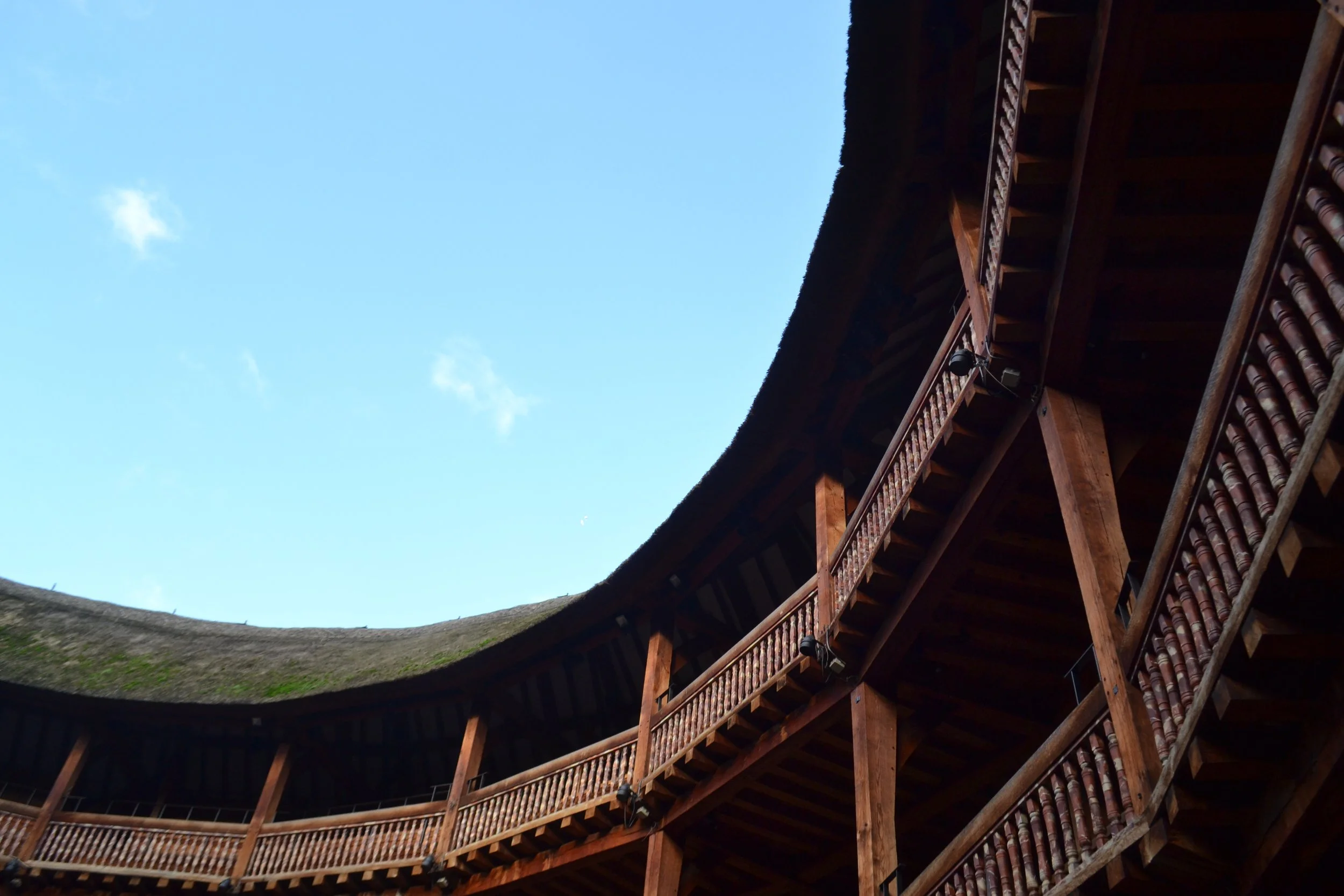
Marina Henke: The Globe is to Shakespeare lovers what Dollywood is to Dolly Parton fans. It’s a meticulous re-creation of the original Globe Theatre, where Shakespeare directed and performed in his very own plays. That theater burned down in 1613 when a canon from a Henry VIII performance lit the roof on fire – but the current Globe looks nearly identical. The theater even got special permission from the city to install a very fire-prone thatched roof. But probably the most iconic fact about the Globe – and central to this story – is that it’s open air. Imagine a miniature colosseum, with a narrow roof running around the edges, and blue sky above.
Sam Edward-Cook: It’s a real privilege. Anybody that wants to perform in a Shakespeare play, the Globe is right up there. It's one of the venues you want to work at.
[MUX UP AND OUT]
Marina Henke: This is Sam Edward-Cook. He’s an English actor who's performed at the Globe before. (For any Peaky Blinders fans out there, he was Danny Whizz-Bang in the first season).
Marina Henke: The open-airness of the Globe makes for a pretty unique theatrical experience. On rainy days, patrons are encouraged to bring ponchos. If it’s hot there’s little fans for sale, but good luck, ‘cause there’s practically no circulation. In these conditions, the actors have to work extra hard. Planes can drown out dialogue, boats floating down the nearby river interrupt monologues, and pigeons have been known to land on the stage during inopportune times.
Sam Edward-Cook: You need to absolutely make sure that you’re on voice in the correct way. You're, you're really engaging your diaphragm, you know, and you're doing all the technical things that you need to do.
[MUX IN, Window Weepin’]
Marina Henke: You can hear what Sam is talking about when you listen to past Globe performances…
Prospero (CLIP): “Dost though forget from what a torment I did free thee?”
Marina Henke: I mean, imagine a helicopter passing by at your character’s most climactic moment?
Juliet (CLIP): Romeo!! where forth art though Romeo.
Marina Henke: What, you thought I wasn’t going to play ONE classic?
[MUX FADES]
Marina Henke: Seeing a play at the Globe is… just a wildly visceral experience. Something that feels so different from a stuffy theater with curtains and fancy lights. You can see sweat drip off actors' foreheads, or spit flying between cast members during scenes.And as if that doesn’t sound intimate enough, what if I told you that many audience members at the Globe ARE STANDING.
Marina Henke: About half the theater’s seats are reserved for those who are affectionately called “groundlings” – as in literally standing on the ground, shoulder to shoulder, as if they were at a packed summer concert. It can feel a little bit like being in a mosh pit. People are spilling bits of beer, everybody's nudging to the front to lean their elbows on the edge of the stage.
Sam Edward-Cook: And the audience love that, you know, the audience want to feel like, you know, ‘Wow, this is really happening live. This is, this is this moment it's never happened before. And it may never happen again.’
Marina Henkke: Sam is right. A lot of people love to be groundlings. But, this level of intensity has some risks. Namely, that every now and then, audience members faint.
Eloise: So I previously fainted once before, but I didn't consider myself a fainter.
Marina Henke: Meet Eloise. In 2006, she and her family headed in from the London suburbs to catch a show.
Eloise: it was just so cheap to stand. That's why we always did it. I think back then it was like 5 pounds.
[MUX IN, Sandpiper in Motion]
Marina Henke: It was ultimately the violence that got her. An hour into the play they were seeing, a character got attacked on the stage. There was a ton of fake blood – and remember – this is happening just feet away from Eloise.
Eloise: And that's when I fainted… and I just went. I think the attendants were incredibly used to people fainting. And so there was a real protocol that happened and I was carried out.
Marina Henke: The show Eloise saw that summer, the one that prompted this memorable fainting, was called “Titus Andronicus.” Eight years later, the Globe ran this play again. And that became the legendary run of performances that I’ve heard about ever since.
[MUX UP AND OUT]
Marina Henke: Titus follows the downfall of a Roman general. Although, when I say it like that, it sounds pretty benign.
Sam Edward-Cook: There's a lot of, um, there's a lot of blood and guts in this one. Shakespeare really went to town on it
Marina Henke: It is – by far – Shakespeare’s most violent play. 14 people die over the course of the roughly 2 and half hour production. A nurse is skewered to death, a man is buried alive, and at one point Titus’ hand is chopped off in front of the audience. Sam – if you haven’t guessed it – was in this 2014 production. He played a character named Demetrius, the son of a kidnapped queen.
Sam Edward-Cook: Yeah, he’s not a a very, he's not a particularly nice, nice character in the play.
Marina Henke: And here’s where I’ll say, if you’re squeamish about the very mention of blood, this play… and this story… might not be for you. Titus’ most famous scene comes when a character named Lavinia’s hands and tongue are cut off. Sam’s character, Demetrius, is the instigator here. Afterwards he’s murdered… and then cooked into a pie that is eaten by his mother. Adaptations of Titus have done a horrifying and spectacular job at bringing this violence to life. Until a few nudity scenes were cut, a 1999 movie starring Anthony Hopkins was almost given an NC-17 rating.
Anthony Hopkins (CLIP): Why foolish Lucius dost thou not perceive that Roman is but a wilderness of tigers?
[MUX IN, Langustina]
Marina Hekne: But, nudity aside, the Globe’s 2014 rendition of Titus outdid everything that came before it. What resulted was a performance that would go down in history at the Globe. One that I wasn’t there for.
Sam Edward-Cook: I remember distinctly somebody comparing this particular production to a Tarantino movie, um, that sort of level of, of, you know, unapologetic violence.
[SHORT SWELL]
Marina Henke: I may not have been to this production, but I have now talked to all kinds of people who were involved in this play. Audience members. Actors. I even managed to get the official show report where they logged every medical event. The show I had described to me and the reactions to it – honestly, they put Tarantino to shame.
[MUX FADE]
Marina Henke: First up, was the gore. To set the literal scene, the play was staged in a notoriously violent era.
Sam Edward-Cook: We set it in sort of like a Roman Colosseum…
Marian Henke: Think big helmets and armor. Lots of swords. Actors entered the theater being pushed on these wheeled scaffolds, which rammed against audience members, physically pushing them out of the way.
Sam Edward-Cook: You really had this sort of, this sort of gladiatorial pit.
Marina Henke: Excluding the scaffolding and some witchy smelling incense, the actual stage design was pretty bare bones. But, any money that was saved there went straight to another budget line.
Sam Edward-Cook: It was an incredible amount of blood and some very sort of realistic amputated limbs and that kind of thing.
Marina Henke: There was one scene that came up a lot. It’s after Sam’s character Demetrius has cut off the hands and tongue of Lavinia. What happened next was actually the moment that caused Eloise to faint a few years earlier.
Eloise: Lavinia… she comes onto the stage silently, then another character gives a very long Shakespearean speech. And then at the end of this very long speech, she opens her mouth and this torrent of blood came pouring down over her.
[MUX IN, La Naranja Borriana Alt]
Marina Henke: Once this scene happens, the brutality sort of doesn’t stop. When Titus’ hand gets chopped off, blood squirts from his arteries across the stage.One audience member I talked to, a guy named Simon, can still picture the cleanup at intermission.
Simon: They had to bring out a whole crew, they were like steaming the stage or something just because there were so many, you know, fake blood stains everywhere from the effects they'd been using.
Marina Henke: I’ve since watched a recording of the show. The only experience I can compare it to is watching a live taping of ‘The Pitt.’ But at least when I watched the Pitt I was sitting in an air conditioned room. The next important fact I learned about this production was the weather.
Sam Edward-Cook: This was literally across June, July, August time, I believe in 2014. And you know, London gets hot.
Marina Henke: That summer was warm. And the Globe – with its funky shape – has a way of trapping heat.
Simon: It was definitely warm enough that I think if I’d been standing it would have been a little uncomfortable
Marina Henke: The show report highlights the weather with, I dare say, a Shakespearean flair: July 14, for example, was “horrendously hot and humid.” On June 8th, a staff member noted complaints made about the persistent smell of barbecue from a nearby restaurant wafting its way into the yard. For a play that involves cannibalism, I can see the problem.
[MUX fades under]
Sam Edward-Cook: They were, they were hot. They were being moved a lot. They were seeing lots of violence and blood and guts. For the groundlings especially, it was hard work. Like they were made to work to watch this production.
Marina Henke: Work is one way to put it. I mentioned that fainting sometimes happens at the Globe. But for this production of Titus, it was practically part of the show.
Simon: I remember the first one that fainted was when Lavinia comes out… and I think it was just because that was the first instance in which the play really upped, like the way that like the blood effects would be used and the violence of the story.
Steve: You saw the ushers around with wheelchairs and that's not usual, right? Typically ushers don't have wheelchairs.
Eloise: My brother didn't come out with me. So he says that he remembers just hearing like thuds, occasional thuds through that performance.
[MUX IN, Bossa Boa]
Marina Henke: Fainting became so commonplace it was impossible for the actors not to notice as well.
Sam Edward-Cook: You'd look out into the pit and occasionally you just see sort of pairs of legs just up in the air.
Marina Henke: A few times during the performance Sam had to exit the theater, and run around its perimeter so he could enter the stage from the other side. Out in the courtyard an entirely different fiasco was taking shape.
Sam Edward-Cook: Yeah, yeah, yeah. It would literally be like some sort of war zone. They'd be just like 5 or 6 people kind of laid just on the concrete on the, on the, on the pavings in the courtyard… By the end of the run, it just became normal. You just sort of run past and whatever. But at the beginning of the run, you know, it was yeah, it was, it was quite shocking
Marina Henke: The first aid portion of the show report reads like diary entries from a disaster zone. Here are some high lights:
“On May 21 11 people fainted in the yard between 3 and 3:30pm. Yoga mats were put outside the first aid room to accommodate the numbers.”
A few weeks later there was a July performance where, 22 people in total either vomited, fainted, or had to leave the yard. The report that night included a special thank you for “all those that helped collect patrons from the theatre, collect sick buckets, clean vomit or fetch glasses of water.” All told, over 50 performances an estimated 275 audience members fainted.
[MUX fades]
Marina Henke: And finally, tucked into the 65 page report, a detail I found I had to bring up during one of my interviews.
Marina Henke: You get, um, you get called out in the, in one of the show reports and you'll have to fact check me if this happened. But, on July 8th, it says “a steward came out at 20:45 quite upset, as Mr. Edward Cook's ‘projectile vomit’ had got in her mouth.”
Sam Edward-Cook: No way.
Marina Henke: Yeah. Is that… did that happen?
Sam Edward-Cook: Well, I’d forgotten… this incident… it’s that Demetrius vomits and it actually landed on an audience member. That's amazing.
[MUX IN, Crisper]
Sam Edward-Cook: That's probably one of my, um, crowning achievements as an actor is that I’ve managed to aim my vomit perfectly.
Marina Henke: If the definition of insanity is doing the same thing over and over and expecting different results, then this run of Titus Andronicus was that.
Marina Henke: I mean, I have to say that this is my like enduring question about this play is like in another world, you could hear this story and you could say, ‘Oh my gosh,” you know, “11 people fainted, ten people had to be taken out. We need to tone it down, you know, for tomorrow night.” Was there ever that conversation of maybe we need to pull it back?
Sam Edward Cook: Um no…
[MUX SWELLS AND FADES]
Sam Edward-Cook: I was about to say, I think if there was genuine concern of people's safety or health in some respects, but in a sort of weird, wonderful sort of Brechtian way, you know, theater should be shocking. And, you know, it should be, it should move people in all sorts of ways. But like I said, that's what Shakespeare had written. He'd written this incredible level of violence. So I don't know… no conversations I've ever had about how can we dial this down or turn it down? It was very much, if anything, let's dial it up. Let's do more.
[MUX IN, Mencher and Polk]
Marian Henke: The insanity of this show, this stubbornness to not tone it down, even against the backdrop of a hot summer in London, has seared it into people’s memories. And while audience members might point to the gore, had this been indoors, had the audience been seated, had there been no hot sun or mosh pit of people… I’m not sure people would remember it like they do now. In that way, the unpredictability of the outdoors is such a reliable ingredient to memory making. Whether it’s a field trip or… a very bloody Shakespeare play.
Eloise: I mean, I… this is it… Like this is, it's 2026 now. It's 20 years on. I still like vividly remember this and love trotting out as a story, you know, it's become something we all laugh about.
Marina Henke: This is Eloise again, the woman who fainted during the 2006 run of Titus.
Eloise: Surely it's every theater director's dream to provoke that kind of reaction from someone.
Marina Henke: Whether you see it as a legendary success or a legendary failure, either way, it was legendary. So much so that after she recovered…
Eloise: I went back in, I was able to go back in.
Marina Henke: And you were willing to go back in, you were like, ‘I just saw that terrible thing…’
Eloise: Yeah! I didn't want to miss it!
[MUX FADES]
[MUX IN, Curses, ProleteR]
CREDITS
Nate Hegyi: Okay. That does it for this episode of Outside/In.
If you’ve got a tale of some outdoor catastrophe we wanna hear it! You can email us at outsidein@nhpr.org or call our hotline at 1-844-GO-OTTER.
And remember, we are now on Patreon – where you can also get ad-free episodes of the podcast for just $5 a month.
This episode was mixed, reported, and produced by Marina Henke.
It was edited by our executive producer Taylor Quimby.
Rebecca Lavoie is Director of On Demand Audio. Our team also includes Justine Paradis, Felix Poon and Jessica Hunt.
I’m your host Nate Hegyi.
Special thanks to Ryan Garrett.
Music in this episode was by Blue Dot Sessions, ProleteR, Lennon Hutton.
Outside/In is a production of New Hampshire Public Radio.