Audio Transcript
Note: Episodes of Outside/In are made as pieces of audio, and some context and nuance may be lost on the page. Transcripts are generated using a combination of speech recognition software and human transcribers, and may contain errors.
Sam Evans-Brown: Hello Outside/ In listeners, this is Sam Evans-Brown. Officially, totally back from paternity leave now.
Justine Paradis: Totally back!?
Sam Evans-Brown: I mean, I do have double the number of children at home as I had previously, so I would say my attention is divided. But I'm here in the studio with producer Taylor Quimby and Justine Paradise, mostly because it's lonely in the pandemic times and I would like someone to talk to. Just kidding. Uh, I have you here because this episode will require a bit of talking it out. Some discussions of moral quandaries. Okay.
Sam Evans-Brown: So, so why don't, can we just start with a, with a quick introduction and sort of like what it says on your business card?
Kirsten Turner Dolby: Sure. Am I supposed to know what's on my business card?
Sam Evans-Brown: I mean, someone's someone's --
Kirsten Turner Dolby: Can I pull it out?
Sam Evans-Brown: So that is Kirsten Turner Dolby. Kirsten was a literature major as an undergrad, and she started out, very predictably, working for environment and conservation nonprofits.
Justine Paradis: Do you mean that predictably literature majors often go into the environment nonprofits?
Sam Evans-Brown: Well, I mean, if they're people that I interview.
Kirsten Turner Dolby: It was really, I think, because I wanted to be Edward Abbey.
Taylor Quimby: Is he the Monkey Wrench Guy? The guy who wrote Monkey Wrench?
Justine Paradis: Yes.
Sam Evans-Brown: Right. Monkey Wrench Gang, Desert Solitaire. He's like. He was like, 60s and 70s decades environmental writer.
Justine Paradis: So how did she want to be him? Like, be a writer. Be a park ranger?
Sam Evans-Brown: I, I didn't ask that question. I assume that it's just the way that everyone who reads Desert Solitaire wants to go out and, like, live in a national park for a year. But working for environmental NGOs wound up being not that.
Kirsten Turner Dolby: Fundraising was exhausting, to be honest.
Sam Evans-Brown: She got kind of burnt out with the grind of just like going after grants and donations, which is why she went to grad school. She got a master's in forestry, got an MBA and started working in this other world of big money timber investments.
Kirsten Turner Dolby: And I am the senior vice president for the Forest Land Group, which is what is known in the sector as a timberland investment management organization.
Sam Evans-Brown: Or TIMO for short.
Taylor Quimby: What!?
Sam Evans-Brown: TIMOs... so they're kind of like a private equity fund, which do you know what that means?
Taylor Quimby: Uh, it sounds banky.
Sam Evans-Brown: I had to Google this because I had heard the phrase, but, like, didn't quite actually grok it. Um, private equity funds are they tend to be either for really, really rich people or like endowments or pension funds. There's like a minimum floor that's usually like a couple hundred thousand dollars if you want to put your money into one. Um, and a TIMO is like that, but for the woods.
Kirsten Turner Dolby: The difference is that some private equity funds might invest in real estate. We invest exclusively in timberland, so we buy large tracts of land and we manage them for our investors.
Taylor Quimby: Weird.
Kirsten Turner Dolby: It's super niche and it's super boutique.
Sam Evans-Brown: TIMOs make money off the value of the timber. They don't necessarily cut it themselves, though they can and do sometimes. But sometimes they're just buying and holding and reselling land based on the presumption that someone will cut the trees. So the question one might ask is, how does someone who wanted to be Edward Abbey wind up working for a TIMO?
Sam Evans-Brown: How much are you sort of mission driven here? How much is it? How much are you about the conservation part of this work?
Kirsten Turner Dolby: Yeah. So my heart is absolutely mission driven, but I acknowledge that I am in a capital market. And so where I have an opportunity to get really creative about ways to merge and blend those two worlds and make money while doing good, that's when I feel like a professional basketball player.
Justine Paradis: Whoa.
Sam Evans-Brown: She says that because starting back in 2012, they started selling something else out of their forests. Kirsten leads the Forest Land Group's carbon offset projects. They take huge tracts of forests, often thousands of acres, that have been purchased based on the value of the trees on that land if you were to cut them down. And then she gets paid to sign a very complicated promise that they won't get cut down, or at least that some of them won't get cut down. And that's something that in her industry gets her a little bit of side eye.
Kirsten Turner Dolby: It even happens with us internally as a company. You know, we have, we have meetings and we and Kirsten takes the mic to talk about the offset projects. And, you know, the boys get pissed.
Sam Evans-Brown: Right. Eye rolls in the back of the room.
Kirsten Turner Dolby: Oh, God. Yeah. And I'm like, okay, but, but PS our carbon program generated more than our timber harvesting program in 2017, right. So all you all need to sit down and hear what we're talking about when we say we're not going to cut those trees. It scares the crap out of them.
Justine Paradis: She's fun.
Sam Evans-Brown: So who pays for this? Who is paying Kirsten to keep these trees standing? In her specific case, they are selling credits that companies regulated by California's carbon cap and trade law can buy. The companies that buy these offsets that fund the saving of trees are fossil fuel companies. They're like, you know, coal or gas burning electric utilities. And Kirsten loves that fact.
Kirsten Turner Dolby: There's something about watching the man have to write a check that, you know, that's making something good happen.
Sam Evans-Brown: Yeah.
Kirsten Turner Dolby: That just you kind of go, "Yeaaah."
Sam Evans-Brown: That's -- that’s a slam dunk.
Kirsten Turner Dolby: "Right on."
Sam Evans-Brown: So what do you all know about offsets?
Taylor Quimby: Oh well so much um (laughs).
Justine Paradis: Where to begin!
Taylor Quimby: Let's see...
Justine Paradis: I feel like I have like a vague sense that, like, it's just like, not real.
Sam Evans-Brown: Thaaaaat's the sentiment I was fishing for. Yes.
Justine Paradis: That. Yeah. That. It's sort of a scam. And it's a way for like BP to be like, we're carbon neutral and it's like, are you?
Sam Evans-Brown: This is where the somber Outside/In music slowly rises in the background.
Justine Paradis: Always with the somber theme these days.
Sam Evans-Brown: But no, no, I refuse to go with the somber theme. We are going to spend this episode talking about carbon offsets. And yes, they are problematic, but by God, not every episode in 2020 needs a somber theme music.
Justine Paradis: We need a break from the somber theme.
Taylor Quimby: Cue the optimistic, jangly music.
Sam Evans-Brown: This is Outside/In, a show about the natural world and how we use it. I'm Sam Evans-brown. A carbon offset is a simple premise. A ton of carbon dioxide is a ton of carbon dioxide. So if you can reduce a ton for cheaper than I can, why not let me pay you to do it for me? But if you have a vague sense that there's something fishy about this idea you're not wrong. So what's the deal with carbon offsets? Do they work or are they worthless?
Justine Paradis: The carbon offset is a simple present. A great idea for Christmas. (Laughs)
Sam Evans-Brown: Okay. All right. Can we just talk about, like, your your working understanding of a carbon offset, like, where have you in your everyday life encountered carbon offsetting?
Justine Paradis: I'm not sure I have... i'm wondering if I've ever, like, encountered it, like when I'm buying a plane ticket or something where like, you have the option to, like, offset your carbon.
Sam Evans-Brown: That's exactly what I was gonna say, that a lot of airlines, there's like a button on the website where you can be, like, offset the carbon of this flight.
Taylor Quimby: Really? Is that something? I would, I would have paid more for? Like it would --
Sam Evans-Brown: Yeah I mean, it would, it would be like less than ten bucks for almost any domestic flight. Like, like if you want to offset all of your carbon dioxide for a year of your life, it would be under $200. And and the the sort of uncharitable analysis that people often roll out about, about them is that they're like the indulgences that the Catholic Church sold, you know, the which were these things like, oh, you can sin in advance because you bought this piece of paper that says it's the equivalent of saying, like a thousand "ave Marias." The more charitable way of describing them is that either through regulation or through voluntary donations, that it's a way of starting with the low hanging fruit. Right? Like, like it's really expensive -- like we don't even really know how to, uh, get fossil fuels out of flying an airplane across the Atlantic. But we do know how to plant trees and you know, if the atmosphere doesn't care about a ton of carbon, why not start with the cheap one? And I will say this is mostly about trees. Either planting them or not cutting them. In the last five years it's been like 42% of all carbon offsets sold around the world go for trees. So that's mostly what I'll be talking about today.
Taylor Quimby: Well, what I mean, just just very briefly, like, what kind of other possible ways could you offset emissions?
Sam Evans-Brown: Oh, there's a million. There's a million. So actually the, the most common one in the beginning, in the early days was capturing fugitive emissions. So like catching refrigerants before they leak, because refrigerants are really powerful greenhouse gases or like, you know, converting cow manure into fuel instead of letting it just turn into methane and float into the atmosphere or -- and there's literally like, there's literally hundreds of protocols for different types of offsets.
Jim Shallow: How far are we going, Charlie?
Charlie Sobolewski: Probably half a mile, I can tell you almost exactly.
Sam Evans-Brown: But because we're mostly talking about trees, that's why we're going to start in the woods at the birth of a carbon credit.
Justine Paradis: With an acorn.
Sam Evans-Brown: Actually, this is like the birth of more like 240,000 carbon credits.
Charlie Sobolewski: That's a hummingbird there yeah.
Sam Evans-Brown: So about a year and a half ago, I visited a forest in northern Vermont that is currently owned by the largest conservation organization in the United States, The Nature Conservancy. And Heather Furman is the state director.
Heather Fuhrman: Yeah so we are on the 5500 acre Burnt Mountain property. The Nature Conservancy purchased this property together with Vermont Land Trust over 20 years ago.
Sam Evans-Brown: Actually, this was part of a huge land purchase. Tens of thousands of acres from this big timber company. And over the years, they've been selling off small pieces of this, subject to conservation easements, which are restrictions that say you're not allowed to build anything on this land, but you are still allowed to harvest the trees if you do it in a sustainable way. But this tract that we are walking on, they decided to do something else. They're going to make it something called a forever wild preserve, which is a place where you can hunt and you can fish, but there will be no logging allowed. And the reason for that is that the carbon in the trees will have been sold already.
Heather Fuhrman: We anticipate that we will see about $2 million in carbon revenue over the lifetime of this project, and we will be able to invest that money back into more forest land conservation. So it's a great new revenue stream for doing conservation in Vermont.
Taylor Quimby: And it's just all of this is so weird. It reminds me of like, you know, the sort of banking and lending industry in which, like, I just don't understand because these sort of non tangible things are just trading back and forth for money, that I don't understand how it's being made.
Sam Evans-Brown: Well, to try to make this a little more concrete, I want to dwell for a second on the details of what it takes to sell a ton of carbon.
Charlie Sobolewski: We're going to have to start bushwhacking now, a little over a 10th of a mile...
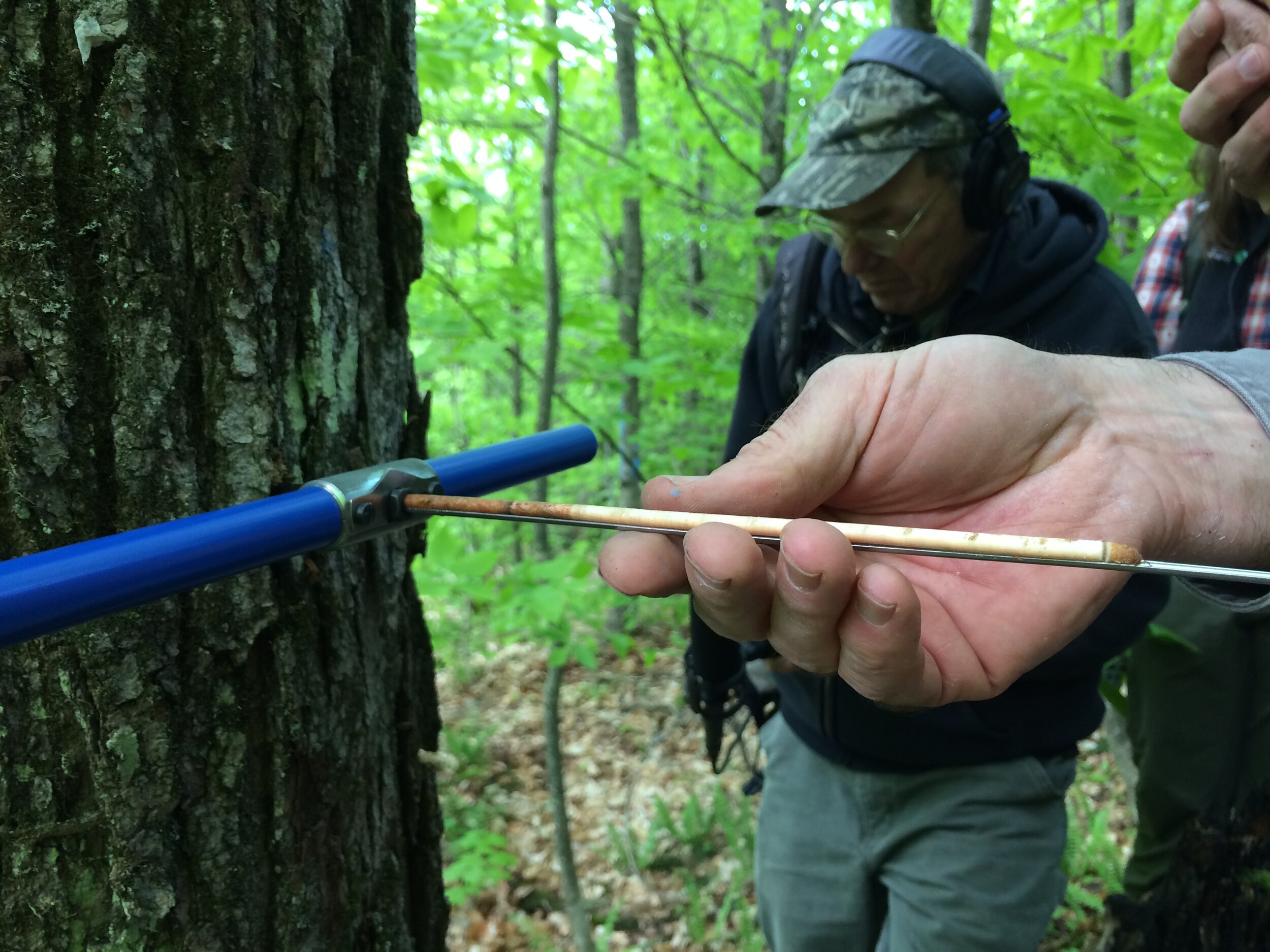
Sam Evans-Brown: Because when I was there, the Nature Conservancy was doing this, this very scientific initial stock assessment. They had hired this gentleman named Charlie Sobolewski, whose job was to measure how much carbon was in that forest. And we were walking to the first of 200 randomly assigned GPS points.
Charlie Sobolewski: I'm within three feet of what the GPS is showing me, but it's a handheld...
Sam Evans-Brown: When we got there, he pounded this stake into the ground and starts by measuring every tree that was in a 30 foot radius from that stake.
Charlie Sobolewski: It's 30.4ft, it's a 15th acre. I'm measuring everything...
Sam Evans-Brown: Every tree that's more than 15ft tall, alive or dead. And let's remember why this is like trees when they photosynthesize they pull CO2 out of the air, they fuze it with water from their roots that makes sugars, and they turn that into cellulose. And every molecule of cellulose has six carbon atoms in it, which is locked up, pulled out of the atmosphere. So even dead trees, you know, even bushes in the understory, all of those represent carbon that isn't out in the atmosphere warming the planet. And so they go out into the woods with this big binder full of methodologies to account for all that carbon.
Sam Evans-Brown: Methodology of blowdowns, methodology for trees that are missing their bark, methodology for trees forked below 4.5ft, double forked...
Taylor Quimby: Man binders full of carbon.
Justine Paradis: I know! (Laughs). So wait, wait, hold on a second. But when you cut down a tree, like if you burn it, the carbon would go back into the atmosphere. But let's say like some of the wood turns into, like a beautiful sea chest, you know, that you keep your linens in...
Sam Evans-Brown: Yeah. You can you can still log in a forest that has had credits sold out of it, as long as more carbon is stored than like the baseline. And if you do cut the trees, you do get credit for the carbon stored in lumber and sea chests and and even some credit for paper products that get thrown out and wind up in the landfill because that still doesn't immediately go back into the atmosphere.
Taylor Quimby: Okay, but so say you're looking at this plot of trees, like what happens if you sell the property?
Sam Evans-Brown: The new owner has to buy the commitment to save the carbon, which runs for decades, and you can suffer financial penalties from the regulators if you do cut the trees. But for sure, if you're not planning on selling, it's way easier. Which is why, like indigenous nations do these forest projects and organizations like The Nature Conservancy, which is actually setting aside an endowment in part to keep the carbon monitoring going on this property.
Heather Fuhrman: So our total endowment that we'll need to manage this property long term is closer on the order of half $1 million.
Sam Evans-Brown: And like the impression that you get while while watching this gargantuan undertaking is that it's all very precise.
Charlie Sobolewski: Every tree is measured as precise as we can.
Sam Evans-Brown: No biltmore sticks on a...
Charlie Sobolewski: No biltmore sticks. No. Lasers!
Sam Evans-Brown: Biltmore sticks is a little, it's a little forestry joke.
Justine Paradis: What's a Biltmore stick?
Taylor Quimby: Yeah. What's a Biltmore stick?
Sam Evans-Brown: Biltmore sticks are these things that they used to be on the bottoms of ax handles? And so you stand, like, away from a tree and you hold up the ax and, like, squint at it and look at the tree, and it lets you estimate how much wood is in the tree.
Taylor Quimby: I gotta say, forestry jokes don't land well with forestry people. I'm gonna be sure to try that one though, with some other folks and see how it does.
Justine Paradis: There's no biltmore stick! (Laughs).
Sam Evans-Brown: So having witnessed this process, I think that the Nature Conservancy can credibly claim to have documented how many tons of carbon are in that forest that they own with as much scientific rigor as we currently know how to bring to bear. And what happens next is they submit all these measurements to an independent certifier, which issues them the credits, and then they have to find a buyer for every ton of carbon that's on the land above and beyond. What would be there if they were to sell this property to someone else, like they're selling the promise to do nothing and just let the trees soak up the carbon.
Taylor Quimby: Okay
Sam Evans-Brown: So that's 240,000 carbon credits. That's how much they will generate over the life of this project.
Taylor Quimby: Yeah.
Justine Paradis: How much is like a flight?
Sam Evans-Brown: Uh, that's an excellent question.
Justine Paradis: Like a cross country flight?
Sam Evans-Brown: I think it's I think it's like less than one, like a half ton per person. So. So it's like, you know, a little less than 200 tons for the whole plane.
Taylor Quimby: And just to think, like, how many thousands of flights there are every day just in the US.
Sam Evans-Brown: Yeah, yeah. No, I actually googled this. So so the FAA says that at peak travel times, there are more than 5000 planes in the air over the United States simultaneously.
Taylor Quimby: So over many decades, this forest accumulates like less than a day's worth of carbon emissions from the airline industry.
Sam Evans-Brown: When you say it like that, Taylor, it doesn't sound very impressive. You should not write marketing materials for The Nature Conservancy on their carbon offset projects. I'm just going to throw that out there.
Taylor Quimby: I don't think they'll hire me.
Sam Evans-Brown: So here's the question. Is this cool? Like, is this all right? Is it cool to sell off each of these credits to someone who gets to either claim, like the social or actual regulatory license to emit a ton of carbon?
Taylor Quimby: Can I jump in and ask a question because like, doesn't it only matter if, hypothetically, the other option was that that forest was going to get cut down and used for timber and the carbon, you know what I mean? Like, like it's you're only actually storing carbon if it wasn't going to get stored.
Sam Evans-Brown: You are asking the exact right question. And we'll talk about that after a break.
Taylor Quimby: After a break. I'm talking about right now!
Justine Paradis: We'll be here, Sam.
Sam Evans-Brown: I'd like to introduce you to Barbara Haya. So Barbara is a researcher at Berkeley, and she is a very prominent critic of carbon offsets.
Barbara Haya: Most forest land owners are getting paid to manage the lands the way that they have for many years, without needing to change their forest management practice.
Sam Evans-Brown: So I'm going to teach you a term. Additionality. Which is what you were just sort of grasping at there. Taylor. So to define that term, we're going to dodge out of forests for a second and talk about a different kind of carbon offset. Barbara got her PhD by going to India and looking at...
Barbara Haya: One promising renewable energy technology. And that is the generation of electricity and steam from sugarcane waste.
Sam Evans-Brown: So sugarcane after it's harvested, it's and this is actually true of a lot of crops there's like leftover stuff in the field, like the stalks of sugarcane plants. And a lot of times that's just piled up and burned out in the open air. And that's like a huge part of why air quality is sometimes terrible in parts of India. Really dramatic impacts both on human health and climate change. And so if you were to gather up those stalks and instead of just burning them in a pile, burn them in like a modern, efficient electricity plant with like pollution controls, that would be better for both climate and for people's lungs.
Barbara Haya: Exactly. And this was a technology that the Indian government really was supporting.
Sam Evans-Brown: But it takes a lot of capital to build a power plant. And like burning stalks in the field is essentially free. So under the Kyoto Protocol, which was that first somewhat famous international climate agreement, there was something called the Clean Development Mechanism. It was the first carbon offsets scheme, and it was a way for rich governments to send money to poor governments in order to cut carbon emissions. And a bunch of that money was going to these, these, you know, crop residue electricity plants.
Barbara Haya: But in this early research, I started finding a real scam. In these early interviews with sugar factory owners they would say something very curious.
Sam Evans-Brown: Barbara would ask them, why are you building this facility? And they would say, well, because it's good business. It makes us money! Which is not what offsets are supposed to do. These offsets were supposed to be paying for projects that would not have happened otherwise without the offset money. Because remember, in exchange for the offsets, some rich country somewhere was claiming the right to run their coal plants for longer. And there was this financial test meant to measure if these power plants deserve the subsidy. But...
Barbara Haya: So I spoke with a consultant in India who worked with wind power developers, and he said that he has at times produced two different balance sheets for the same project. One balance sheet he sent to the bank showing that the project is cost effective on its own. And then the other one that he sent to the UN as an offset project, showing that the project is not cost effective on its own and it needed the offset income to be built.
Sam Evans-Brown: (Laughs). Right. So it's almost like some consultant came along and was like "weren't you aware that you could have gotten paid?" And they're like, "oh my gosh, let's get paid."
Barbara Haya: Exactly.
Taylor Quimby: So they were building new, new power plants --
Sam Evans-Brown: -- yes. That they were already planning to build. But when they learned that they could also get paid for carbon credits, they signed up to get carbon credits as well. And that's additionality. Is this something that wouldn't have happened if it weren't for carbon credits?
Sam Evans-Brown: So let's just ask ourselves something. The Nature Conservancy back in Vermont, they bought this property 20 years prior to the decision to sell the offsets. They are a conservation organization. Do we really think they were going to cut down all the trees on the property as if they were like a lumber company?
Justine Paradis: Well, probably not like cut them all down, but like, isn't there like logging that happens in places that are conserved?
Sam Evans-Brown: Yes. And so that's like one thing that you could point to. You could point to the fact that the other pieces of this property have been sold with easements that say you can only do sustainable timber harvesting. And so it's like that could be the baseline. But that's not how the carbon credits work. The carbon credits work, as if you were to sell it to somebody who would just log like a normal lumber company, not like the Nature Conservancy Lumber Company, LLC.
Justine Paradis: Gotcha.
Sam Evans-Brown: I'm going to play you some tape. I'm going to play you this tape because I asked this question about additionality to Heather Furman, the state director of the Nature Conservancy in Vermont. And I, before playing it, I just want to cut her a little bit of slack in advance, because this is a little bit of a gotcha type question.
Sam Evans-Brown: Would would this forever wild project have happened if it weren't for the revenue from the carbon markets?
Heather Fuhrman: Yeah. Yeah. I think based on what we learned about the ecology of this place and the natural communities here, our decision to own and manage this as a forever wild property, um, was kind of our first and foremost decision. Carbon was just, uh, an opportunity that we saw to to do even more. And so it was kind of too good to pass up.
Sam Evans-Brown: Doesn't that then beg a question of, uh, does, you know, isn't this kind of like, double dipping? If you were going to do this anyway, why get paid as well?
Heather Fuhrman: Uh, I don't really know how to answer that question. I don't --
Jim Shallow: -- think about the strategy.
Charlie Sobolewski: -- I don't think about it --
Sam Evans-Brown: So what you're hearing here is a bunch of people jumping in to answer my question, and there's a guy on that trip named Jim Shallow, who is the Nature Conservancy employee who actually developed the whole carbon offset project and who actually has studied the offset rules. And so this is why this is kind of a gotcha situation. Like Heather wasn't, she wasn't the primary on this project, and she was just there because the press had come. So she wasn't prepared to have the philosophical debate about the fine points of offsetting. So Jim Shallow, though, was and that's why he jumps in.
Jim Shallow: And so think about it. You know, Forever Wild is a management strategy, much like, uh, the other carbon projects that you'll see around our improved forest management is what they call it. So it tends to be management that maybe is less intensive than you would do under a, you know, a full maximization of the timber value on the property. So I would say no, we're, we're actually by going -- our making the decision to do Forever Wild is creating a carbon opportunity that's additional carbon that wouldn't be there if some other buyer purchased this property.
Justine Paradis: I mean, I also like sympathize. It's like, okay, we were going to do this anyway. We're a conservation organization and most of them are like trying to, you know, fight what they consider to be the good fight. And it's like, take this opportunity to like get some revenue if you can.
Taylor Quimby: Right. And then take that money and put it into another project that maybe really wouldn't have existed right otherwise. You know, maybe you can buy another land that previously just wasn't in conservation at all.
Sam Evans-Brown: Okay, so I'm playing this tape because it just shows how hard it is to know, like we weren't in the room when the Nature Conservancy made this decision. We kind of just have to take them at their word when they say, they wouldn't have done this if it weren't for the money that the carbon offsets make available. But this debate about additionality is precisely why the offset certifiers have tried to get around the problem. They've said in recent years, okay, we're never going to be able to figure out which of these projects actually needed that extra bit of money and which didn't. So we're going to try to do this like the way an insurance company would figure this all out. Like an insurance company doesn't know who's going to get into a car accident, but they know the overall risk, so they just try to make everything expensive enough to cover all the wrecks. And that's what the carbon offsets have tried to do as well. Here's Barbara Haya again.
Barbara Haya: They don't require project by project additionality testing. Instead, what they aim to do is to identify whole categories of projects that are not likely to have gone forward on their own and are, as a category, considered additional, and then estimating emissions reductions conservatively from each of those projects.
Sam Evans-Brown: So what they do now is they have these like fudge factors. And so let me give you an example. Uh, forest fires. Right? Real problem if your whole plan for reducing emissions is to store carbon in forests. Well, so California has one of these offset protocols and they require every project to take a bunch of their credits and set them aside as like a buffer, so that if a bunch of the trees burn down or are killed by insects or drought, or are logged illegally, and all these things collectively are called reversals, you've got this buffer pool set aside to just like account for that. There's a similar effect called leakage, which is okay, say say we don't cut down all these trees in this one spot in Vermont. There's still demand for like two by fours to build houses. Does it mean that us not cutting down trees right here just means that trees will get cut down somewhere else?
Justine Paradis: This just sounds like it sounds like the carbon sequestration or logging version of NIMBY or something.
Sam Evans-Brown: And again, so what the offsets do is they just take like a discount. They like take a percentage right off the top, like okay, you have X number of tons of carbon in your forest, but like 20% of that is going towards this like leakage discount. And this is where this debate is on carbon offsets. Right now it's like these technocratic details, and there are these incredibly fierce debates about what percentage the leakage should be or how big the buffer pool should be, and what it all really amounts to is just uncertainty. We have this like very precise accounting of like how many trees are in this one forest that gives this illusion that we know, you know, how many tons of carbon we're saving. But really like those trees are still attached to, you know, like the rest of the world.
Barbara Haya: That's the core challenge of offsets, right? Is that what you're doing with an offset program is you're trading known emissions, right? We know how to estimate the emissions from a country: how much is being burned in cars and and power plants. It's much harder to estimate emissions reductions because reductions have to be measured against a counterfactual scenario that never happened. I mean, it's impossible to know.
Sam Evans-Brown: To me, to me, offsets are this like perfect distillation of what happens when an economist looks at climate change as a challenge? They're like, they're like, oh, every ton of greenhouse gas emissions influences the atmosphere in the same way. And I see what this is. It's a commodity and we can price it and we can trade it. It's very like macroeconomics 101.
Justine Paradis: If we just make it a market, then it will solve it.
Sam Evans-Brown: It's like the whole carbon offset world is just enthralled by the elegance of that basic idea. So they've created this whole complicated measurement edifice with formulas and fudge factors that just can't live up to the, like, textbook version of the theory.
Taylor Quimby: Yeah, yeah.
Sam Evans-Brown: But there's a part of me that just wants to ask about all this, like, who cares, right? Like, these offsets are essentially a subsidy, but all subsidies have a lot of these problems. Like think about the mortgage income tax deduction. That's claimed by a lot of people who still would have bought a house. But the reason that we care with a carbon offset is that it's like an indulgence, like it's supposed to represent one ton of carbon, like one sin. And we don't like the idea that it might not.
Justine Paradis: Well, because greenwashing, the idea that you can sort of claim if people are claiming things that are sort of transparently not true, that also just creates a world in which there's a lot of, um, distrust. And I don't like that world.
Taylor Quimby: I -- like part of me just thinks, like, maybe this is a good idea in theory, but in practice, when you're actually trying to create a system like it just doesn't work. And given the urgency of climate change, any waste of time is like bad and deleterious because we need to be doing effective things immediately.
Sam Evans-Brown: And these are two, I think, very fertile areas to criticize carbon offsets.
Sam Evans-Brown: Okay, let's take a little imaginary radio trip to a place in eastern Nigeria called the Cross River State. It's the part of the country that has most of its rainforest. I learned about the Cross River state from Adeniyi Asiyanbi, who's currently at the Department of Geography at the University of Calgary, and he told me that while environmental groups focus on the biodiversity of the rainforest in Cross River, it's also full of people. This forested Nigerian state that's about the size of New Hampshire has around double the population of New Hampshire.
Adeniyi Asiyanbi: In fact, some would argue that it's one of the most diverse areas in terms of, you know, languages and dialects, you know, in the whole of West Africa, if not Africa. So you move from one village to the other and you find people speaking languages that they wouldn't be able to, you know, um, to, to interact.
Sam Evans-Brown: Adeniyi says back in the 70s and 80s, international environmental NGOs were worried about deforestation in Cross River and the survival of the critically endangered Cross River gorilla, which meant when the idea of carbon offsets started to come into vogue toward the end of the 90s Cross River was immediately a place that environmentalists thought of. And specifically, it attracted the attention of a particularly fraught type of offsetting called Red Plus. It's this program developed by the United Nations that lets countries trade offset money for preserving forests, mostly tropical rainforests. And it's how carbon credits work in the Paris Accords, because it's government to government, it has occasionally been associated with government abuses. Part of the program is something called a readiness period, where the government shows that it's building the capacity to do these complicated carbon offset projects. And in Cross River state, as part of that readiness phase, the governor imposed a total moratorium on logging, which was enforced by this anti-deforestation task force.
Adeniyi Asiyanbi: Composed of conservation guys working alongside the military. They had the Navy also who were sort of patrolling the waterways. So you had this group of actors who were sort of enforcing the ban in the forest and essentially stopping people from doing anything at all in the forest.
Sam Evans-Brown: But the enforcement was really spotty. Adeniyi documented how locals who live in the forest were prohibited not just from cutting trees, but also gathering, you know, small like non-timber resources out of the forest. But meanwhile, the rate of deforestation actually increased during the logging ban, mostly because of illegal logging done by multinational companies that own palm oil plantations.
Adeniyi Asiyanbi: The industrial actors were clearing the forest are often left off in the discourse, while local communities are easily picked upon as scapegoats.
Justine Paradis: Ah sounds familiar.
Sam Evans-Brown: After ten years of working on Red Plus, there are just a handful of carbon offset projects in the state. So Adeniyi has two critiques of the general idea of carbon offsetting. The first is that the basic concept that one ton of carbon is being traded for another ton, has led to this whole complicated system of measurement and formulas and consultants that almost guarantee that these projects will be small and not actually up to the job of halting deforestation.
Adeniyi Asiyanbi: Trying to overcome all of these complexities, you know, leakage, you know, permanence, additionality, verification. So you're trying to go around all of those almost impossible complexities in order to demonstrate that carbon is being saved when you could very easily, you know, just stop the carbon at source, you know.
Taylor Quimby: Stop that carbon at the source. That's what I'm talking about.
Sam Evans-Brown: Adeniyi's second main critique is that it gives people and institutions and companies an out, an excuse to not be working on the harder problems like stopping the burning of fossil fuels.
Adeniyi Asiyanbi: Carbon offsetting is worse than doing nothing. You know, you know that it worsens things than they would otherwise have been. Because when you give yourself the impression that you're actually addressing climate change, you know, um, when you do that, you're basically telling yourself that you're doing something and you don't need to take other kind of actions that would have, you know, um, reduce emissions essentially. So only to find that down the line that what you thought you were doing was just, you know, was empty and hollow.
Sam Evans-Brown: I think in particular, you can see this when it comes to carbon offsets that are used as substitutes for cutting emissions to comply with laws or treaties or other regulatory programs. So, like California allows offsets to substitute for cutting emissions under their cap and trade law, and the Kyoto Protocol created offsets to make it easier for countries to meet their treaty obligations. And over and over and over, offsetting is asked to be included in these programs by the people that are doing the emitting -- the countries or companies that have high carbon emissions.
Adeniyi Asiyanbi: If climate change is what you're concerned about, then don't do offsets. Do something more serious about it. If climate change is what you're concerned about, don't do offsetting. Do something else.
Sam Evans-Brown: If climate change is what you're concerned about don't do offsetting. Do something else.
Sam Evans-Brown: But like, you know, there's something to me that about that conclusion that doesn't sit quite right. You know, after having been out on walking that property with the Nature Conservancy because like when you zoom down that, that close to an individual project, it does seem like they're doing something, you know, like the Nature Conservancy got that money and they are conservation group, and they're probably going to use it to do some more conservation. And you know, and I also got that from Kirsten Turner Dolby who again works selling carbon for the TIMO, the Forest Land Group. They're in the business of buying these trees to cut them down.
Kirsten Turner Dolby: People checking and double checking make you do things better. They just do. I mean, without a doubt. You may say, you may greenwash it and say, oh, “We are managing this land sustainably. We -- our trees are growing -- we cut less than growth.” Okay, well guess what? We're going to have auditors come out every time you want to sell that offset that one metric equivalent tonne of carbon to an emitter, and make damn sure that that really is one metric tonne of carbon and you're going to do it differently. You just are. You just are going to make different decisions.
Sam Evans-Brown: And so it's like maybe we can't be sure given like the uncertainties of a globalized market, like exactly how much each project is keeping out of the atmosphere. But it does feel to me like it's better than nothing. Like while the accounting for an offset is is obviously imperfect, that like the real problem is this using of them as, as an indulgence and and using them to try to avoid having to do the hard stuff.
Justine Paradis: I do, I do just want to note that we are focusing on kind of the carbon credit aspect of forests here, but obviously the forest has all of these other benefits too, like intangibles like habitat for birds or or insects or lack of erosion because the tree roots are holding it in or, you know, all of these other things that forests do just by being themselves. So as far as conservation, I'm really not, in this case, not. I don't have a problem with it at all. That's not what we're like, what's giving me pause here. It's really the PR campaign about it.
Sam Evans-Brown: Well, and like part of the reason that I think we will need all of this is, is because Barbara Haya, the oft cited critic of offsetting, is helping the University of California System in their effort to reach carbon neutrality by 2025. And to meet that goal, they're starting by doing everything they can on their campus, like energy efficiency and electrifying things and building new renewable energy on and off site. But the UC system also opted to buy some offsets when it comes to the emissions they can't eliminate five years down the line, and Barbara is helping them to buy the best offsets possible.
Barbara Haya: Right. So, um, yeah, we're we at the UC system are not claiming to solve tropical deforestation.
Sam Evans-Brown: And essentially what they're doing is like they're doing their own due diligence, like they're buying credits only when they personally have followed up with the individual project and feel that they have verified it's a high quality offset, and they're also creating their own projects.
Barbara Haya: What we did was we released a request for ideas UC wide to faculty, staff, students, um, for ideas for projects that UC can support that reduces emissions or removes carbon from the atmosphere. And we got a wonderful, wonderful set of, um, more than 80 projects back. And we provided pilot awards to 12 of them.
Sam Evans-Brown: So offsets are a flawed tool, but also in a way, they're kind of the only tool we've got.
Sam Evans-Brown: Outside/In was produced this week by me, Sam Evans-Brown, with help from Taylor Quimby and Justine Paradise. Erica Janik is our executive producer. Maureen McMurray is director of Intraoffice Indulgence Issuance. Thank you to all of the experts who talked to me to explain forest carbon dynamics and carbon crediting rules David Publicover, Karen Bothwell, Stuart Hale, Mark Ducey, John Gunn, Charles Levesque, Mindy Crandall, Bill Keaton, Eric Kingsley, Tom Pugh, Mariko Yamasaki, Fiona Jevin, and Loren Gifford. Reminder we are now accepting votes for our first selection for the Outside/In Book Club. You can vote on our Facebook page. That's the closed group that you have to ask for permission to join. Or you can subscribe to our newsletter, which will have a link to the poll in it. You can do that at outsideinradio.org Music. In this episode by Blue Dot Sessions, our theme music was made by Breakmaster Cylinder. Outside/In is a production of New Hampshire Public Radio.