The Haudenosaunee Thanksgiving Address
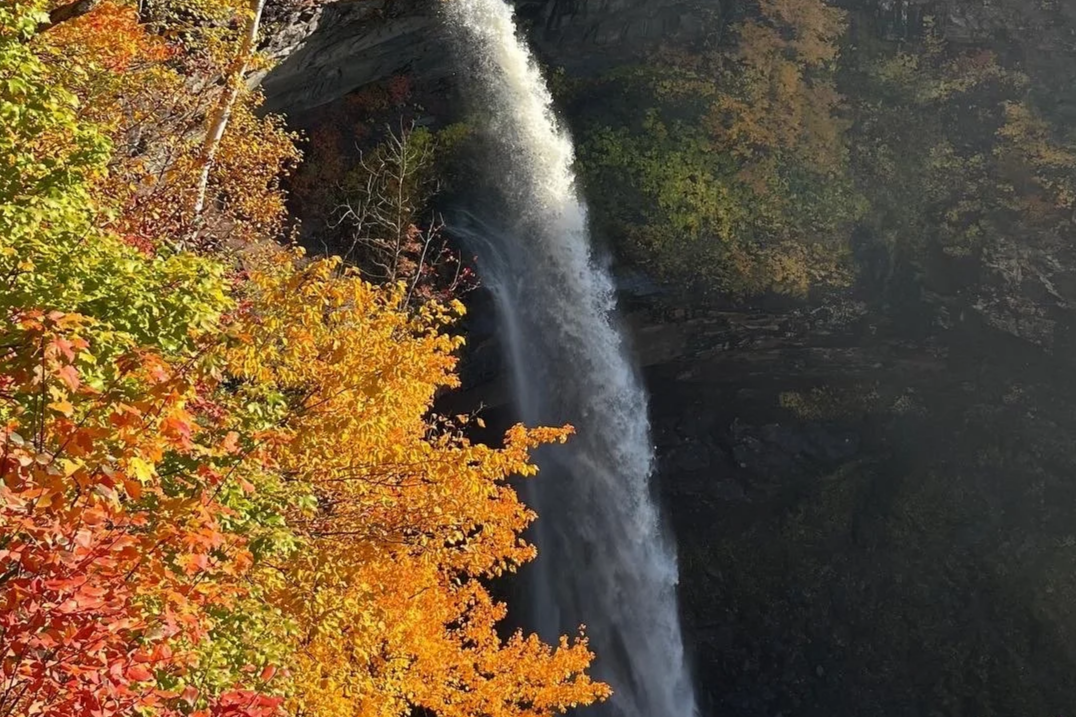
Kaaterskill Falls in upstate New York. Credit: Justine Paradis
When we gather around the table for the Thanksgiving holiday, we might offer a moment of gratitude, expressing thanks for our meal, our health, our family, our country.
But today, we’re sharing a perspective on another practice of gratitude: one that focuses not on our blessings, but on our relationships as people with the more-than-human world. We’re taking a moment with the Haudenosaunee Thanksgiving Address.
Featuring Jennifer Wemigwans. Special thanks to Krista Spence, Oren Lyons, Margaret Kanatiiosta LaFrance, and Jay Allison.


ADDITIONAL MATERIALS
Jennifer Wemigwans co-authored a paper, “The Haudenosaunee Ohén:ton Karihwatéhkwen Thanksgiving Address: Moving Beyond the Havoc of Land Acknowledgements,” exploring both practices as educational tools at the Dr. Eric Jackman Institute of Child Study
Haudenosaunee Thanksgiving Address: Greetings to the Natural World, translated by John Stokes.
Chief Jake Swamp’s children’s book, Giving Thanks: A Native American Morning Message.
Instructional materials for K-12 students about the Haudenosaunee Thanksgiving Address in New York state (under development at time of publication).
CONNECT WITH US
To share your questions and feedback with Outside/In, call the show’s hotline and leave us a voicemail. The number is 1-844-GO-OTTER. No question is too serious or too silly.
Outside/In is made possible with listener support. Click here to join our Patreon and get ad-free episodes of the podcast.
Follow Outside/In on Instagram, TikTok, or join our private discussion group on Facebook.
CREDITS
Host: Nate Hegyi
Reported and mixed by Justine Paradis.
Editing by Taylor Quimby
Our staff also includes Marina Henke, Felix Poon, and Jessica Hunt.
Taylor Quimby is NHPR’s Director of Podcasts
Special thanks to Krista Spence, Oren Lyons, Margaret Kanatiiosta LaFrance, and Jay Allison.
Music by Cody High, Aaron Ximm, and Blue Dot Sessions.
Field recordings by Justine Paradis, except thunder and rain in Guangzhou, China, 2014, by cdrk on FreeSound. License: Attribution 4.0.
Outside/In is a production of New Hampshire Public Radio
Audio Transcript
Note: Episodes of Outside/In are made as pieces of audio, and some context and nuance may be lost on the page. Transcripts are generated using a combination of speech recognition software and human transcribers, and may contain errors.
Nate Hegyi: From NHPR, this is Outside/In, a show where curiosity and the natural world collide. I’m Nate Hegyi. And today, I am joined by one of the producers of our show, Justine Paradis.
Justine Paradis: Hey Nate. So we are releasing this episode on the week of Thanksgiving.
Nate Hegyi: Yes.
Justine Paradis: And to start us off: I’m curious about the way the giving thanks part of this holiday, or just in general, happens in your family. What does that look like in your life?
Nate Hegyi: Honestly, it doesn’t really because we’re Canadian. Thanksgiving just wasn’t like a big deal. Also we’re not very religious. So going around doing a prayer before dinner and, you know, public thanking of things just didn’t really happen in my family. Like, for me, giving thanks has always been very personal and spontaneous. Like if I shoot a deer...
Justine Paradis: Mhm.
Nate Hegyi: I will quietly give thanks to the life of that animal. That’s how I've kinda done it.
Justine Paradis: But it’s not really in a group in a kind of ritual.
Nate Hegyi: No. I honestly actually get uncomfortable in group gratitude circles and that kind of thing. I don't love them.
Justine Paradis: You know, I actually grew up with more religion in my life. We would sometimes do a prayer at the beginning of a meal. Later in my life with friends I would do the go around the room —
Nate Hegyi: Sure.
Justine Paradis: And say what we were all thankful for. But even with that background, I also feel some discomfort, or like, I have to let down my guard a little bit to be open to that level of vulnerability. It feels vulnerable.
Nate Hegyi: Yeah. Yeah. I don’t like it. [laughs]
MUSIC: Bedroll, Blue Dot Sessions
Justine Paradis: But recently, I had a conversion with someone, who really challenged me to think differently about giving thanks. Because she said even in this ritual where we go around and say what we’re giving thanks for, like, our home, our health, our family, even the food on the table — she argued that we’re fundamentally still focused on what we have… it’s our home, our health, our food, our country.
Nate Hegyi: Yeah, it’s a little self centered. Like not to be judgy, but a little centered on the self.
Jennifer Wemigwans: And that's a Western way of looking at nature, the dominant, to dominate nature, to put man at top, to be the ruler. Indigenous philosophy and knowledge is no, we're merely part of the circle.
Justine Paradis: And this person talked about another way of expressing gratitude, one which intentionally focuses not on what we have, but on our relationships with the more-than-human world.
Jennifer Wemigwans: Everything that's alive around us. The water is living. The trees are alive. The land, the soil, the plants, the oxygen we breathe. Everything is alive.
Nate Hegyi: So, we’re talking way beyond home, health, family, that kind of thing.
Justine Paradis: We’re talking way beyond that.
Nate Hegyi: So, today on a special episode of Outside/In, we are sharing a story about thanks — giving. Not the holiday, but the practice. Producer Justine Paradis takes it from here.
PREROLL
Justine Paradis: From NHPR, this is Outside/In, a show where curiosity and the natural world collide. I’m Justine Paradis. In the United States, many schools begin the day with a ritual. The Pledge of Allegiance. When Jennifer Wemigwans was in elementary school, just outside of Toronto, Canada, her day began with the national anthem.
Jennifer Wemigwans: They would start the day with O Canada… and so they would sing O Canada and everyone would have to stand.
[O Canada]
Justine Paradis: But by the time she was in high school, Jennifer was done.
MUSIC: Borough, Piano Solo, Blue Dot Sessions
Jennifer Wemigwans: I would just sit and I wouldn't stand. I kind of, um, you know, was a very problematic high school student, uh, because I questioned a lot of things in geography and history and wanted to know certain content that the teachers didn't know anything about. I was often losing grades, sent out of class for being disruptive. … to this day, I'm eight credits short of a high school diploma… so I guess blame it on, Oh Canada!
Justine Paradis: Despite technically being a high school drop out – she was still actually a good student.
Jennifer Wemigwans: I tried to pick courses where I knew I wasn't going to argue too much with the teachers, and I ended up on the honor roll
Justine Paradis: And eventually, she became an educator herself. Today, Jennifer teaches courses in Indigenous Knowledge Education at the University of Toronto, or U of T.
Jennifer Wemigwans: I work as an associate professor. Yay! I got tenure! [laughs]
MUSIC FADE
Justine Paradis: Jennifer is Anishinaabe, an enrolled member of the Wiikwemkoong Unceded First Nation, which is on Manitoulin Island in Ontario, Canada. And that is of course a huge part of her identity.
Jennifer Wemigwans: I asked an elder and language teacher, well, how do we call, like, what is the name for a helper in Anishinaabemowin? And we don't use a lot of nouns. It's more verb-based. So they told me it's naa-di-maa-ge, “one who is helping.” So if you ask me what I've been doing, that's, that's my role. I've been helping, naa-di-maa-ge.
Justine Paradis: Jennifer is also a parent. And so, in some ways, her role as a teacher and helper starts with her son.
Jennifer Wemigwans: We have expressly made… his education focused on Anishinaabe knowledge, on Anishinaabe values and ways. And so when he was seven years old, he went into a lodge up in Wiikwemkoong, so on Manitoulin Island, and he fasted from morning until night. And he was only seven years old.
MUSIC: Engine, Blue Dot Sessions
And during that time of fasting in the lodge and being by the fire with his father, he was taught the Seven Grandfather teachings. You know, he was taught about truth, humility, respect, love, honesty, courage, and wisdom.
And when we all gathered at the end of his fast… he had to, um, go around in the lodge with a bowl of berries and offer it to everyone else… go offer it to this person. They represent hungry children. Go offer it to this person. They represent the animals… And finally, after he was done, all of that, the elders said, now you can have a berry. You know, that's a really profound teaching for a seven year old.
Justine Paradis: By this point, Jennifer’s son was also attending his own elementary school. Which is kind of a unique place. Housed at the University of Toronto, the Dr. Eric Jackman Institute of Child Study, or JICS, is a lab school — basically, a school which is also designed for researchers to study how children learn.
There are no bells or loudspeakers, and no anthem, either. So, Jennifer’s son didn’t have to worry about singing “Oh Canada” every morning. But one thing the school would often do is open assemblies with a land acknowledgement.
MUSIC: Pintle, Blue Dot Sessions
Justine Paradis: Land acknowledgements entered the broader mainstream starting around 2015. You might hear them today at a college graduation ceremony…
We are gathered on the ancestral territory of the Massachusett people
Justine Paradis: …at a city council meeting, or to open a hockey game. There was even a land acknowledgement at the 2025 Oscar ceremony.
We gather in celebration of the Oscars on the ancestral lands of the Tonga, Tatavium, and Chumash peoples…
The Chicago Blackhawks acknowledge that the team, its foundation, and the spaces we maintain, work, and compete within stand upon the traditional homelands of the Miami, Sauk, Meskwaki, Ho-Chunk, Menominee…
Justine Paradis: But their use in some of these settings has led to critiques of land acknowledgments as performative, or overly simplistic, sometimes flattening the very experience they’re supposed to be acknowledging.
But at JICS anyway, at least for the youngest kids, reading land acknowledgements seemed somehow intuitive.
Jennifer Wemigwans: What they found was, you know, the younger kids, like the primary children, they, they hear land. Okay, so let's acknowledge the land, let's thank the water… And so that's where they naturally, their little minds gravitated to, right?... and that's really beautiful.
Justine Paradis: It’s worth putting land acknowledgements into context, especially in Canada. Land acknowledgements there grew widespread largely in response to the release of a pretty high-profile report from the Canadian government, out of something called the Truth and Reconciliation Commission.
Jennifer Wemigwans: The, um, Truth and Reconciliation Commission was a commission that looked into the residential schools. Right. The history of the residential schools in Canada.
Justine Paradis: Canadian residential schools were church or government funded boarding schools for Indigenous children. But that doesn’t really communicate what they were. As Jennifer put it, these were terrible places.
Jennifer Wemigwans: What they were doing was taking children from their families from age five and up. Could you imagine someone coming into your home and grabbing your five year old child and taking them away until they're 16? You know, a lot of these children never returned home. They died from sickness. They died from abuse… like, I think that it's really hard for people to hear this, but they were murdered in those institutions.
MUSIC: Bedroll, Blue Dot Sessions
Justine Paradis: Tens of thousands of Indigenous children were put through these residential schools, for more than 150 years. And we’re not talking about the distant past here. The last one only shut its doors in 1997.
Justine Paradis: The Truth and Reconciliation Commission, or TRC, attempted to document and address this harm. They collected testimonies from survivors of residential schools, and concluded that what happened there amounted to cultural genocide.
Also included in their massive 2015 report were 94 separate calls to action, many of which pushed for broader education about indigenous history throughout Canadian society.
So imagine what a big change all this was. Jennifer’s grandmother went to a residential school. When she was a kid, she was told to stand and sing O Canada. Now her son’s school was reading land acknowledgments at assemblies.
Jennifer Wemigwans: I don't know how you would say this. There was like a real sense of like hope when the TRC launched its report. Right? … Here is education on the residential school and what, you know, generations of indigenous families had suffered, and that was all erased and hidden for like centuries. Right? So the fact that it was like,… coming to light and there was a report and people were having conversations about it. And then there was a land acknowledgment. It felt very hopeful.
MUSIC FADE
Justine Paradis: At JICS, the students learned about indigenous history in other ways too – like, the younger kids learned about broken promises. And older kids learned about the residential schools and other aspects in more detail. Land acknowledgments were just one part of the curriculum – one group of students even worked with a teacher to write their own, and that’s the version on the school website.
But then covid hit.
Classes got split up, and everything went remote. Zoom felt like the wrong platform for heavy conversations about residential schools. And so those lessons fell to the wayside.
By the time they returned to in-person teaching, Jennifer’s son was in sixth grade, his final year of elementary school. And there was one day that Jennifer remembers very well.
Jennifer Wemigwans: So. [sighs] We were at an event at JICS and it was in the auditorium and some of the grade sixes took turns um breaking up, um, you know, to say different sentences of the land acknowledgment. And they're just up there all giddy and happy to be on the stage in front of, you know, they’re young kids. And they're all saying their part and kind of giggling and, you know, moving around and being hyper and excited.
Justine Paradis: Jennifer was in the audience with her son. Who, as he watched the kids on stage…
Jennifer Wemigwans: … just shook his head and just gave this long sigh. And he was so upset... And he said, mum, they don't even know what they're saying.
MUSIC: Rainy Day Drones (glass bowls), Blue Dot Sessions
Jennifer Wemigwans: Like they're just, this is just nothing to them. It's a joke. And I said, I know, I know, sweetie. And then I said, well, you know, let's, let's talk about this. And I'm sorry that this is happening. I understand how you feel. And I see exactly what you're saying ... So when we went home, we talked about it. And, um, you know, I think he's like, why, why even do like, why are those kids getting up and doing a land acknowledgment if they have no understanding of the history of what's happened to indigenous people? And he said, like, I don't think that they should be doing that…
Even as I'm recalling this, I feel very sad. I feel very teary. Right. And I think it's because yeah, it's just. It's ongoing. It's it's what, you know, I'm, I'm not using all the fancy academic language, like the micro assaults and rah rah rah, but it is it's just these ongoing feelings of always, you know, never really being understood, never really being seen… they get up and they say the words and we're standing right there, but we might as well not like we're see through. We're invisible to them.
MUSIC: Matte Sangria, Blue Dot Sessions
Justine Paradis: After the assembly, Jennifer emailed her son’s teachers and arranged a meeting. And she told them what had happened.
Jennifer Wemigwans: They listened and they were quite responsive… and so, they said to me, you know, what could we do? Like what would you suggest? Because they were saying, are you saying not to do land acknowledgments? … I said, you know, I think that … we need to look at the Thanksgiving address.
Justine Paradis: Outside/In will return after a short break.
BREAK
Justine Paradis: From NHPR, this is Outside/In, a show where curiosity and the natural world collide. I’m Justine Paradis.
The Haudenosaunee Thanksgiving Address has nothing to do with the holiday of Thanksgiving. It’s also known as the word that come before all else –
It’s a statement, spoken to open gatherings.
Jennifer Wemigwans: it's enacted with all indigenous nations. So the Anishinaabe have some form of it, the Haudenosaunee. Um, I've been to Colombia. I've met with the Kogi, the Kogi do it — like everyone has a form of this kind of… acknowledging all of our relations and giving thanks.
Justine Paradis: How old is the address?
Jennifer Wemigwans: Oh my God. Very old. [laughs] Yes. I couldn't even answer that.
MUSIC: Sticktop, Blue Dot Sessions
Justine Paradis: There are a lot of different versions and the text actually varies on the speaker. But the basic structure is: One by one, the speaker greets and thanks each of our relations.
Jennifer Wemigwans: it's like we give thanks to the plants. Now our mind is one. We give thanks to the fish. Now our mind is one. We give thanks to the water. Now our mind is one…
Audrey Shenandoah: [1993 UN Cry of the Earth conference] We are given the waters, the good clean waters, which our life depends upon. And the fruits and vegetables
Justine Paradis: Speaking here are two Onondaga leaders, Tadadaho Leon Shenandoah and Clan Mother Audrey Shenandoah, translating into English. This is at the UN in 1993.
Audrey Shenandoah: the food that we use to sustain our lives, we take from our Mother, the Earth.
Justine Paradis: There are many Indigenous practices that are not meant to be co-opted by the broader public. But this address was intentionally shared as a “gift to the world,” offered by elders from the Haudenosaunee Confederacy. Haudenosaunee translates to “People of the Long House,” and this confederacy is a union of Six Nations: Mohawk, Oneida, Onondaga, Cayuga, Seneca, and Tuscarora.
Their address has been translated into dozens of languages, and shared across the world. And it’s offered to be read and recited by anybody – as long as it’s done with respect and proper citation.
And so after Jennifer’s son got upset, watching his classmates read a land acknowledgement, she suggested they consider the Thanksgiving Address.
Jennifer told the school, it’s up to them to do the research, to honor the people it comes from, and do something that made sense for their students.
And they did.
JICS Student: We give thanks to our mother the earth. Thank you for gifting us with all that we need to live…
Justine Paradis: This is a group of students, reading a version of the address together recently in the school gym. This version was adapted by Michelle Corneau (Mohawk Turtle Clan).
JISC: Thank you for all the food and nutrients and for keeping the waters clean. We give thanks to the sacred plants, sage cedar, sweetgrass, and tobacco. Thank you for helping us to feel better.
Justine Paradis: The Thanksgiving Address may sound simple — but it’s more than just the words. It’s been described as a political document, a social contract, an example of Native science, and an educational model. It’s a teaching.
It’s also a tool of diplomacy. The Haudenosaunee Confederacy is comprised of Six Nations. Over the centuries, negotiations between them involved conflict, tensions, political ambitions.
But imagine opening a peace talk with this.
Jennifer Wemigwans: When we do these kinds of, um, relational teachings, that it brings everyone into a good space brings in what we call the good mind, right? That you want people to come into talks with a good mind, not with an agenda, not with, you know, a way to shout everybody else down and be the only one who's heard. Right. The good mind asks for reciprocity. It asks for mutual respect.
Justine Paradis: The Thanksgiving Address isn’t necessarily immune to the same thing that broadly happened with land acknowledgements. Anything can become wrote if it’s done without understanding or care.
But, most fundamentally, the address is an articulation and a grounding into a worldview. It is in the present tense – and it literally lists everything that we as humans depend on. And that list isn’t short.
What might it do to us as individuals and collectively – if we elevated that with each other, every day? If we really let ourselves feel that?
Jennifer Wemigwans: When you think about that teaching, ask yourself: if all the trees disappeared tomorrow — we woke up and there were no more trees to help process the oxygen we breathe, all of them dead — what would happen to us?
… all of that is to say that as human beings, we are dependent on everything. We need everything. And that's the truth. That's the humility. That's the respect.
MUSIC FADE
Justine Paradis: So – I want to bring back our host, Nate Hegyi. Nate, hey.
Nate Hegyi: Hey.
Justine Paradis: I want to invite you and our audience to listen to a reading of the Haudenosaunee Thanksgiving Address.
Nate Hegyi: Cool.
Justine Paradis: Sometimes this can be just a few minutes long, sometimes the address will last an hour and a half.
Nate Hegyi: Wow.
Justine Paradis: It really depends on the speaker. This is not going to be an hour and a half – but it’s a few minutes long, and I think there’s something about opening ourselves to the experience of listening to the whole thing. Um. What do you think?
Nate Hegyi: I’m down, let’s do it!
Justine Paradis: So to do this, Jennifer told me proper citation is important. So let’s acknowledge the people who made this available to us.
Nate Hegyi: Okay.
Justine Paradis: This is a translation from the Mohawk by John Stokes and David Benedict - Mohawk Turtle Clan. Mohawk version comes from Dan Thompson, Wolf Clan/Mohawk. The original inspiration came from Chief Jake Swamp, Wolf Clan/Mohawk. And Jake Swamp was part of that 1993 UN delegation and shared the address around the world as part of his life’s work.
Nate Hegyi: Okay.
Justine Paradis: It was developed and published in 1993, and provided courtesy of the Six Nations Indian Museum and The Tracking Project. I also asked my friend and teacher Jay Allison to help me read this.
Nate Hegyi: Alright, let’s hear it.
Justine Paradis: So, without further ado, here is the Haudenosaunee Thanksgiving Address: Greetings to the Natural World.
MUSIC: Aaron Ximm, Hang-centric Hanghalo Improvision
[Read by Justine Paradis and Jay Allison]
Today we have gathered and we see that the cycles of life continue. We have been given the duty to live in balance and harmony with each other and all living things. So now, we bring our minds together as one as we give greetings and thanks to each other as people.
Now our minds are one.
We are all thankful to our Mother, the Earth, for she gives us all that we need for life. She supports our feet as we walk about upon her. It gives us joy that she continues to care for us as she has from the beginning of time. To our mother, we send greetings and thanks.
Now our minds are one.
We give thanks to all the waters of the world for quenching our thirst and providing us with strength. Water is life. We know its power in many forms — waterfalls and rain, mists and streams, rivers and oceans. With one mind, we send greetings and thanks to the spirit of
Water.
Now our minds are one.
Justine’s beach recording
We turn our minds to the all the Fish life in the water. They were instructed to cleanse and purify the water. They also give themselves to us as food. We are grateful that we can still find pure water. So, we turn now to the Fish and send our greetings and thanks.
Now our minds are one.
Now we turn toward the vast fields of Plant life. As far as the eye can see, the Plants grow, working many wonders. They sustain many life forms. With our minds gathered together, we give thanks and look forward to seeing Plant life for many generations to come.
Now our minds are one.
With one mind, we turn to honor and thank all the Food Plants we harvest from the garden. Since the beginning of time, the grains, vegetables, beans and berries have helped the people survive. Many other living things draw strength from them too. We gather all the Plant Foods together as one and send them a greeting of thanks.
Now our minds are one.
Now we turn to all the Medicine herbs of the world. From the beginning they were instructed to take away sickness. They are always waiting and ready to heal us. We are happy there are still among us those special few who remember how to use these plants for healing. With one
mind, we send greetings and thanks to the Medicines and to the keepers of the Medicines.
Now our minds are one.
We gather our minds together to send greetings and thanks to all the Animal life in the world. They have many things to teach us as people. We are honored by them when they give up their lives so we may use their bodies as food for our people. We see them near our homes
and in the deep forests. We are glad they are still here and we hope that it will always be so.
Now our minds are one.
We now turn our thoughts to the Trees. The Earth has many families of Trees who have their own instructions and uses. Some provide us with shelter and shade, others with fruit, beauty and other useful things. Many people of the world use a Tree as a symbol of peace and
strength. With one mind, we greet and thank the Tree life.
Now our minds are one.
We put our minds together as one and thank all the Birds who move and fly about over our heads. The Creator gave them beautiful songs. Each day they remind us to enjoy and appreciate life. The Eagle was chosen to be their leader. To all the Birds-from the smallest to
the largest-we send our joyful greetings and thanks.
Now our minds are one.
Justine’s bird recordings
We are all thankful to the powers we know as the Four Winds. We hear their voices in the moving air as they refresh us and purify the air we breathe. They help us to bring the change of seasons. From the four directions they come, bringing us messages and giving us strength.
With one mind, we send our greetings and thanks to the Four Winds.
Now our minds are one.
Justine’s Vermont wind tape
Now we turn to the west where our grandfathers, the Thunder Beings, live. With lightning and thundering voices, they bring with them the water that renews life. We are thankful that they keep those evil things made by Okwiseres underground. We bring our minds together as one to send greetings and thanks to our Grandfathers, the Thunderers.
Thunder and rain in Guangzhou, China, 2014, by cdrk on FreeSound. License: Attribution 4.0.
Now our minds are one.
We now send greetings and thanks to our eldest Brother, the Sun. Each day without fail he travels the sky from east to west, bringing the light of a new day. He is the source of all the fires of life. With one mind, we send greetings and thanks to our Brother, the Sun.
Now our minds are one.
We put our minds together to give thanks to our oldest Grandmother, the Moon, who lights the night-time sky. She is the leader of woman all over the world, and she governs the movement of the ocean tides. BY her changing face we measure time, and it is the Moon who watches over the arrival of children here on Earth. With one mind, we send greetings and thanks to our
Grandmother, the Moon.
Now our minds are one.
We give thanks to the Stars who are spread across the sky like jewelry. We see them in the night, helping the Moon to light the darkness and bringing dew to the gardens and growing things. When we travel at night, they guide us home. With our minds gathered together as
one, we send greetings and thanks to the Stars.
Now our minds are one.
We gather our minds to greet and thank the enlightened Teachers who have come to help throughout the ages. When we forget how to live in harmony, they remind us of the way we were instructed to live as people. With one mind, we send greetings and thanks to these caring teachers.
Now our minds are one.
Now we turn our thoughts to the Creator, or Great Spirit, and send greetings and thanks for all the gifts of Creation. Everything we need to live a good life is here on this Mother Earth. For all the love that is still around us, we gather our minds together as one and send our choicest words of greetings and thanks to the Creator.
Now our minds are one.
We have now arrived at the place where we end our words. Of all the things we have named, it was not our intention to leave anything out. If something was forgotten, we leave it to each individual to send such greetings and thanks in their own way.
Now our minds are one.
MUSIC: JR Nara, Blue Dot Sessions
Nate Hegyi: Outside/In was reported and mixed this week by Justine Paradis and edited by NHPR’s Director of Podcasts, Taylor Quimby. I’m your host, Nate Hegyi. Our staff also includes Marina Henke, Felix Poon, and Jessica Hunt.
Trivia time: so – last week’s question – what is the nickname of the most abundant salmon species in the world? Answer! Is the pink salmon… which grows a distinctive hump during spawning, giving it the nickname… Humpy.
Justine Paradis: Humpy!
Nate Hegyi: Kinda sound slike a Disney name.
Justine Paradis: It really does.
Nate Hegyi: Shoutout to Paige who got the answer right.
Justine Paradis: Can I give the question for next week?
Nate Hegyi: Yes absolutely.
Justine Paradis: What is the English name of the oral constitution for the Haudenosaunee Confederacy?
Nate Hegyi: No google!
Justine Paradis: No google!
Nate Hegyi: Shoot us an email at outsidein@nhpr.org. First person to answer gets a shoutout in the credits!
Justine Paradis: Extra special thanks to Krista Spence at JICS, Oren Lyons and Margaret Kanatiiosta LaFrance. . And, if you’d like to check out the text of the address we read today, or an adaptation of the Haudenosaunee Thanksgiving Address as a children’s book – we’ve linked to both in the show notes.
Nate Hegyi: Also, shout out to Meghan. Meghan supports the show as a Raven member on Outside/In’s Patreon. If you join Meghan, you’ll be able to listen to Outside/In WITH. NO. ADS! Patreon membership starts at 5 bucks a month. Check out the link in the show notes. And once again, thank you, Meghan.
Justine Paradis: Music today came from Cody High, Aaron Ximm, and Blue Dot Sessions.
Nate Hegyi: Outside/In is a production of NHPR.