
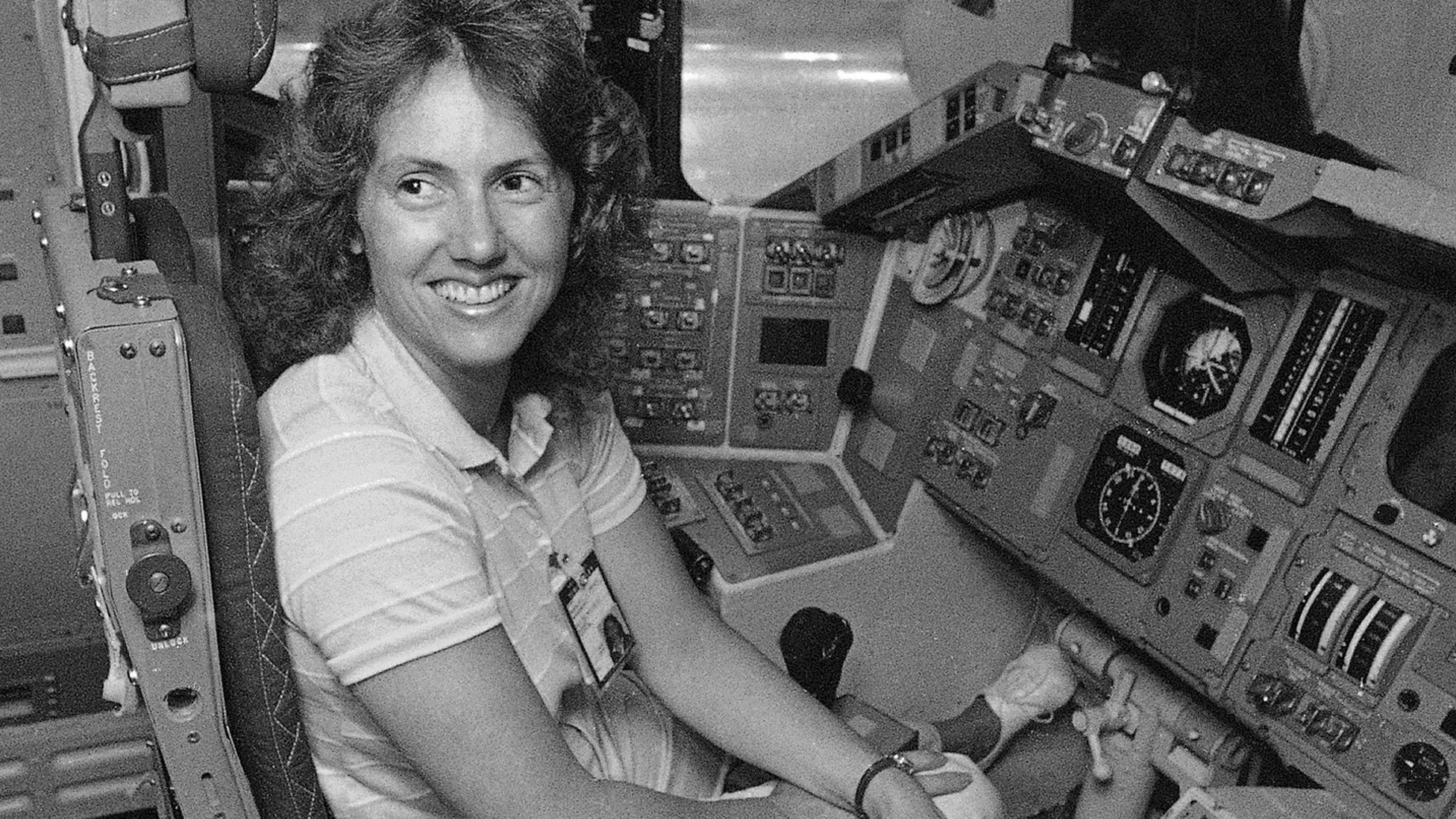
Remembering Christa
Last week, we talked about the ethics and regulations around sending private citizens to space, but one thing we didn’t linger on much was the lasting impact of Christa McAuliffe; the teacher slated to become the first private citizen to space before she was killed in the Challenger disaster.
So today, we’ve got a series of stories and interviews that are all part of NHPR’s series “Remembering Christa: 40 Years After the Challenger.”
We’ll hear from a local journalist that covered her story, the students she mentored, and the community charged with remembering her legacy.


CREDITS
These stories were reported and produced by Patrick McNameeKing
Editing by Mary McIntyre.
Our staff includes Felix Poon, Marina Henke, Justine Paradis, and Jessica Hunt.
The host of Outside/In is Nate Hegy
Executive producer: Taylor Quimby
Rebecca Lavoie is NHPR’s Director of On-Demand Audio
Music by Blue Dot Sessions
Outside/In is a production of New Hampshire Public Radio
Submit a question to the “Outside/Inbox.” We answer queries about the natural world, climate change, sustainability, and human evolution. You can send a voice memo to outsidein@nhpr.org or leave a message on our hotline, 1-844-GO-OTTER (844-466-8837).
Audio Transcript
Note: Episodes of Outside/In are made as pieces of audio, and some context and nuance may be lost on the page. Transcripts are generated using a combination of speech recognition software and human transcribers, and may contain errors.
Nate Hegyi: This is Outside/In. I’m Nate Hegyi.
Forty years ago this week, the Challenger space shuttle broke apart. It claimed the life of Concord High School teacher Christa McAuliffe as well as the six other astronauts aboard.
We talked about that day in our last episode – and how it might impact the way we think about sending people to space in the future.
But what we didn’t really do is linger on Christa herself.
Christa McAuliffe in archival interview: …the space program, as a science or math or technological, um, adventure right now. I want the students to get a little bit of ownership, I want them to feel that they're part of the space age because they're the future, and their children or grandchildren are going to be pioneering that…
Nate Hegyi: Her death was a big national story, but it was an especially big deal here. The station where we make Outside/In is just a couple miles from Concord High, where Christa taught social studies.
So today, we’ve got a series of stories and interviews that are all part of NHPR’s series “Remembering Christa.”
We’ll hear from a local journalist that covered her story…
Roger Wood: We walked in and I observed other reporters… weeping.
…the students who knew her best….
Rick St. Hilaire The poor decisionmaking that was made at NASA – this could be a topic that I could easily see her teaching.
…and the community charged with remembering her legacy.
Laurie MacKenzie Gordon: She was a feminist empowering women and girls. She was a pioneer.
Stay tuned.
[mux into break]
Nate Hegyi: I’m Nate Hegyi, and this is Outside/In. Today, we’re hearing stories and interviews about the life and legacy of Christa McAuliffe, who died forty years ago this week in the space shuttle Challenger disaster.
Our first story is one that really resonates with me as a journalist. I’ve had to cover some tough stories before – but I can’t really imagine documenting a national celebration, only to have it turn into a national tragedy.
Roger Wood had to do just that.
He was working as a radio news reporter in January 1986 for WOKQ, a small country music station based in New Hampshire, when he was sent to Florida ahead of the launch.
Here he is.
Roger Wood: My name is Roger wood. My job, of course, was being a news reporter on air. When I learned that Christa McAuliffe was picked to be the first teacher in space, I went to Concord. They had a kind of a congratulations parade.
Roger Wood archival audio: This is most certainly Christa McAuliffe weekend in her hometown of Concord. The photogenic 36 year old teacher, wife and mother of two riding in an open car through downtown capital city Concord in the Lions Club parade, the photographers and citizens alike acknowledging her newfound celebrity status. America's first teacher in space. Christa McAuliffe, social studies teacher from Concord High School.
Roger Wood: I got one quick question.
Roger Wood archival audio: Do you ever think you'd be like an instant media celeb?
Christa McAuliffe archival audio: Well, I had thought about that when I was one of the ten. We got a lot of attention, so I knew it was probably going to increase, but I'm enjoying it.
Roger Wood: Then her car pulled away. I decided that it would be good to actually be there in Florida at Cape Canaveral during the liftoff of the challenger spacecraft. I also traveled with my friend Jim Van Dongen. Jim was the news director at NHPR. On that flight, were a number of people that were involved with the Concord schools.
Jim Van Dongen, archival audio: I'm Jim van Dongen for WEVO. Concord School. Superintendent Mark Beauvais says:
Mark Beauvais: Just looking at the palm trees and feeling the heat. It's become a lot more real. When the airplane was landing, I looked out the window on my left and I saw this giant structure to my left, and I assume that has something to do with the NASA center down here. Uh, that that made me excited.
Roger Wood: We checked into the hotel and figured that the next morning would be the launch day.
Roger Wood archival audio: Timing of the weather front. Arriving here at the Cape is going to determine whether the shuttle can go off on time...
Roger Wood: But it wasn't. It was postponed.
Roger Wood archival audio: Grace and Corrigan are Christa McAuliffe parents. But this weekend, just two of the thousands of New Englanders getting ready to watch the shuttle launch of the first teacher in space, their daughter Christa. They told reporters they're not concerned about their daughter's safety and that she isn't worried either.
Corrigan McAuliffe: She's fine. She's very comfortable with the whole thing. She's not concerned, worried or nervous. She's just anxious to go.
Roger Wood: It was postponed on a day to day basis. Several days we went back and the weather forecast was bad.
New reporter, archival audio: It's very cold, especially for Florida. 25 degrees woke. Roger Wood is with me live. Roger.
Roger Wood archival audio: Weather expert Colonel Robert Nicholson is calling for only light winds and scattered high clouds with cold, subfreezing temperatures at lunchtime.
Roger Wood: So I wandered into the, uh, the actual media center. And, uh, there was a NASA weather person. So I asked this person on tape.
Roger Wood archival audio: Have you seen temperatures ever this cold for a shuttle launch, though?
NASA person, archival audio: Well, we had, uh, temperatures about this low last year at this time when the first DoD payload, uh, shuttle went up, uh, we we lost the launch date by one day. Then because of freezing conditions on the pad, it looks like they're ahead of that problem this year. And, uh, that we're a go for launch.
Roger Wood: And basically dismissed my question.
Roger Wood archival audio : The sky is bright and blue and, uh, not a cloud in it as far as, uh, would interfere with the shuttle launch. And it looks like right now all systems are go.
Roger Wood: We traveled over to, uh, grandstand, which had some audio connectors on it, and we plugged our recorders into that. We were hearing the chatter from the space center. We just sat there and they were counting down. Suddenly it launched.
[Archival NASA sound]
Announcer: And liftoff! Brilliant. [indicipherable radio chatter]
Announcer: We can now start to hear the roar at the grandstand. Smoke billowing out from below.
Roger Wood: Sound was unbelievable and was five miles away from the actual space shuttle.
Archival Audio, voice 1: Ground is literally shaking with the power that's coming out of that engine. Smoke of white. Brown can still see a small bit of flame from our position. Jim, the sound is starting to die out, but the spectacle is amazing. You can still see quite a bit of flame coming off the back of it. Now we've lost it in the in the smoke. There's sort of an orange flame in the middle of that cloud.
Archival Audio, voice 2: So it's happened, Jim. New Hampshire's Christa McAuliffe is on her way.
Roger Wood: We were off the air because we had made an announcement that the shuttle was aloft.
NASA radio chatter: Copy.
NASA radio chatter: Flight final RSO reports Vvehicle exploded.
NASA radio chatter: Copy.
Roger Wood: We walked over to the media center. We walked in and I observed other reporters weeping. And one one reporter from New Hampshire said, I can't go on.
Archival audio: Describe the scene as best you can. Well, when, uh, the countdown began reaching zero, the crowd showed signs of smiles and happiness. Because the delay had taken such a long time, everybody thought they were going to go back to Concord without seeing the shuttle launch. The rocket took off, and I don't think the crowd knew what was going on right away. It took a while when they didn't notice that the shuttle had continued to go up. And then, uh, I think the first person who noticed what was going on was Christa's mother, her, uh… I was focused on the parents and the brother and sister, and I noticed that she showed the first signs of fear and looked towards her husband. And by then everybody had realized what had happened.
Roger Wood: So it was extremely, extremely sad in there.
Nate Hegyi: That was Roger Wood.
[mux fades]
If you walk around Concord today, you’ll see a statue of Christa McAuliffe on the lawn of the state capitol building, decked out in her NASA suit.
And, a few minutes walk away, you’ll pass Christa McAuliffe Middle School.
Her name is everywhere here.
But for this next story, we wanted to hear from the kids who knew her when she was their high school social studies teacher.
Rick St. Hilaire: She supervised an independent study for me. I had an internship at the statehouse down the street. So she was in charge of that.
Rick St. Hilaire is a lawyer – but in 1986, he was one of Christa’s students at Concord High School.
By the way, you’ll hear him mention the “O-ring” – that was a rubber seal on the Challenger that investigators determined caused the explosion. It failed because of the cold weather, and allowed combustible gasses to escape and blow up the rocket.
Rick St. Hilaire: What I really remember is that she's the kind of person that used to stir that kind of independent interest. She was extremely enthusiastic. You know, that's one of the hallmarks of her teaching style, that enthusiasm, her cheerfulness to be able to support students in a very happy and kind way.
My last encounter with her, I think, is just an illustration of her general personality. This was about the time that she was doing the anti-gravity testing. You know, when they go up in the plane and down and up and down so that they get to float in the plane? And I ran into her in the hallway. We were talking about this, and her personality just really showed – big smile on her face, extremely enthusiastic about what it is that she was doing, and trying to communicate this great adventure that she had to a student to myself so that it's transmitted.
You know, she was one of those great teachers that really just passed on, not just knowledge, but it's the kind of appreciation for learning. And you don't even know that you're learning. You know, when you hear from somebody who's so, so enthused about what it is that they're doing. She was the ultimate student, which made her the ultimate teacher.
The challenger disaster is a failure of decision making, more than a failure of hardware. When you're 17 years old, as I was, and you see this disaster occur and starting to understand, you're not just dealing with an O-ring, you're dealing with somebody who made a decision that overrode other people who had better knowledge of not to launch.
And so that has stuck with me throughout my entire career, that it's entirely possible to be in positions of authority and not be armed with the kind of information that you need to make the right decision, where it's important to defer to others who have better knowledge than you do, to be able to make better judgment calls, and it's stuck with me in all kinds of executive decision making that I've made throughout the years of remembering that a really bad decision was made that had tragic results to it.
And I have to say to that, Mrs. McAuliffe, in terms of her teaching about civics and social studies and history, you know, she was always very reflective about decision making that occurred over time. History wasn't simply a sequence of events. She was always talking about how things all worked together, how all the pieces fit together.
So, you know, it's kind of fitting. As I reflect back on Mrs. McAuliffe as a teacher and the decision making, the poor decision making that was made at NASA, that this would be a topic that I could easily see her teaching about, that you have a historical moment that led into a tragedy. How did that happen? And can we learn lessons from that that are still applicable today? And you know, the answer, of course, is yes. Absolutely.
And so that's part of the legacy that we need to remember that her ability to teach critical thinking is something that's still alive today, certainly something that lives with me.
Nate Hegyi: That was Rick St. Hilaire. Today, Rick says McAuliffe’s mentorship and the tragedy of the Challenger disaster continues to shape his decision-making.
[mux swells and fades]
Andrea Rice was a senior at Concord High School in 1986. And like a lot of kids in 1986, she remembers watching the launch live from school.
Andrea Rice: My senior year was very unique, and I feel like by the end of it, a lot of the walls in between the different groups of people really came down.
They were wiring up all the rooms with cable. So every classroom could watch it. You know, we were getting really high tech stuff. This was specifically so they could wheel those TVs in on those big carts.
I happen to be in the cafeteria, though, on the day of the event. We had those long Formica kind of laminate tables with the round seats, and everyone was just kind of sitting there in front of the TV, the back of the cafeteria, standing up against the wall were all the teachers, and everyone was sitting there.
What I remember most about that day is turning around the moment of the explosion and seeing all the teachers in the back and seeing their faces and just having, like, this real epiphany that they weren't just teachers, that they were human beings. And that was their friend and that was their people. That was their family. And that, I think, broke me almost more. It was like there was this whole new reality of just seeing them in a totally different light, and it was heartbreaking.
I think I became closer to the people who were close to me. But you also had a lot of empathy towards other people in the school, like you weren't alone going through this, and it wasn't just your classmates, it was your teachers, and it was the people who worked in the office. And we all went through this together, and we had this shared experience, and it created a tie that I don't know that other high school senior classes had.
I'm a nurse, and I took care of our vice principal in the hospital, and it was so lovely to reconnect with him as an adult and just have some conversations talking to him about that. I just felt this extra level of love and like, and I'm going to take care of you because you took care of us when we were struggling and when all this horrible stuff was going on. And in my childhood, you took care of me, and now I'm going to take care of you.
Nate Hegyi: That was Andrea Rice. More stories from Remembering Christa – after a break.
[break]
Nate Hegyi: This is Outside/In, I’m Nate Hegyi.
A year after Christa McAuliffe died in the Challenger explosion, Laurie MacKenzie Gordon began teaching at Concord High. One of her courses was American Women’s History, which was originally developed and taught by Christa.
Laurie Mackenzie Gordon: It wasn't revolutionary, but the late 70s and early 80s having a women's history class. That was unusual. She was a pioneer.
Nate Hegyi: We asked MacKenzie to reflect on teaching that class, and on the lessons we can learn from Christa today.
Here she is.
Laurie Mackenzie Gordon: Seeing the extraordinary and the ordinary. To me, that's a big piece of Christa's mission.
She was a feminist, empowering women and girls. Absolutely part of her mission. And she did that through the study of history, primary documents, primarily diaries, journals, that kind of thing.
For example, Martha Ballard was a midwife in Maine, and she just lived such a rich life. It would have been the 18th century, and every day she would take copious notes in this journal. And not only did she deliver a life, but she was a mom. She was a wife. She, you know, lived in this town. She was a citizen. She just was. All these things that each of us does every single day. You had to keep the fires burning. There was no DoorDash. You had to go, like, cook the food. You had to get the food. The history is just so profoundly rich. But the gift that she gave us was that she just wrote it all down.
I would take the American women students to the Concord Birthing Center. That was one of the field trips that I took that Christa was sort of famous for. And we talked about giving birth, which, again, is so ordinary and yet profoundly extraordinary.
Archival audio, interviewer: Please describe the project you outlined in your application for your time in the Space Shuttle.
Archival audio, Christa McAuliffe: Having been a history teacher for quite a few years, I've been very aware of the fact that social history or the history for the majority is often unknown or forgotten.
When I was thinking about doing a project for the space shuttle, I felt that doing a diary or a journal in keeping these notes would help personalize the space program.
The students and the teachers and others who I would speak to would have somebody else's viewpoint other than an astronaut's to look through.
Laurie Mackenzie Gordon: There's another sort of legend about something she said to one of her astronaut mates about being a footnote in history or becoming a question on Trivial Pursuit or something.
She was so ordinary and then did this extraordinary thing, and what would have happened if things hadn't happened the way they did? It just all went according to plan? And she did her journal and then went on… What would her legacy have looked like were she her own ambassador?
Obviously, you know, we don't know the answer to. I think it's worth thinking about. She became bigger than she was, but then I think that would be her point. We have to find the extraordinary in the everyday.
Nate Hegyi: That was Laurie MacKenzie Gordon, who taught at Concord High after Christa McAuliffe’s death.
[mux swells and fades]
Christa McAuliffe was selected to be the first teacher in space aboard the fated Challenger mission.
But Phil Browne was a runner-up.
Here he is.
Phil Browne: Why did I want to go to space? I had seen images from satellites without any geopolitical borders, and just the beauty of this blue sphere and the background of blackness. And I wanted to get a feeling of what that was all about. I just thought, I want to do this.
I picked up newspapers at Goffstown High School at the time back in ‘84, and then I would use them to start fires in in my wood stove in the basement. And there was an article that, uh, where President Reagan had declared in August of ‘84.
Archival audio, President Reagan: ...Today I am directing NASA to begin a search in all of our elementary and secondary schools and to choose as the first citizen passenger in the history of our space program, one of America's finest, a teacher.
Phil Browne: It was going to be a teacher in space. As I was crumpling up the newspaper to put it in the fire, and I said, I'm going to try for this. New Hampshire's a small state and I have a good chance.
Sometime in the winter of ‘85, I got notification that I was one of the six finalists and I, along with those finalists, met at a Department of Education building, and we presented to a committee that was the first and only time that I ever met Christa. And she was just effusive, you know, she was happy and charming.
You know, we were all sitting six of us in this room, right? And I was like, really serious because I, you know, I wouldn't have all my ideas that I presented in my application ready and at the front of my brain. But she was just happy. And the beauty of hers was… She was going to keep a diary. She was just going to share her feelings and what those feelings meant to her and how they might be able to impact students. The beauty of it was its simplicity.
[mux swells]
The summer of ‘85…So that was when things really got going after she had been selected. And at that point we just waited for the big day, which was supposed to be January 22nd.
Strangely enough, for me, January 22nd has a different meaning. My daughter Morgan was born on that day, and I wasn't quite as excited about the Christa McAuliffe experience that day.
But then as the days went on after that and there was one postponement after another after another, I remember watching with my students in the classroom and 73 seconds into the flight, I knew it wasn't right. I knew that she and the other astronauts were gone, and I knew that night that there were going to be a lot of families, of the astronauts who were never going to get to hold, as I was, holding my loved one, Morgan, my brand new daughter, in my arms that night.
It was so sad. And I was holding her that evening as I watched on the news the reruns of those 73 seconds. The two words that just kept coming into my brain that night as I was holding Morgan… about 70s into the launch sequence.
Archival NASA audio: Challenger go with throttle up.
Phil Browne: Throttle up. And I thought about Christa's statement. You know, “I touch the future. I teach.” I was a teacher. But her future was gone. She wasn't really going to be able to touch the future anymore.
And as I looked at my daughter, Morgan, I made a vow right then and there. I said, I am going to do something to honor the memory of this woman. So that we as teachers, and our students that try to guide and mold into good human beings, and good citizens, will be able to have a successful future on this planet.
And I did.
Nate Hegyi: That was Phil Browne. After the Challenger disaster, Phil developed a curriculum to conduct research with students that was used by NASA. This program spread across the Northeast, and eventually across the world.
This series of stories, Remembering Christa, was produced by NHPR’s Patrick McNameeKing.
You can find links to the original stories and the rest of the series in our shownotes, and at nhpr dot org.
The series was edited by Mary McIntyre.
Special thanks to Emily Quirk and Rick Ganley for archival work -- retrieving and digitizing reel-to-reels, and to Roger Wood for providing audio of his newscasts.
Thanks also to Kim Bleier and Melissa Edwards.
If you have memories of Christa, her legacy, or you were impacted by the Challenger disaster, you can share them with us via email at outside in at nhpr dot org.
Outside/In’s staff included Marina Henke, Felix Poon, Justine Paradis, and Jessica Hunt.
Taylor Quimby is our Executive Producer.
Rebecca Lavoie is our Director of Podcasts.
I’m your host, Nate Hegyi.
Music in this episode from Blue Dot Sessions, and Epidemic Sound.
Outside/in is a production of New Hampshire Public Radio.