If climate change were a choose-your-own-adventure story
Dean Russell had just wrapped several reporting projects on climate change, mental health, and COVID. “My world was just so serious,” he said. That’s when his boss approached Dean with an idea. What if they made a fiction podcast about climate change?
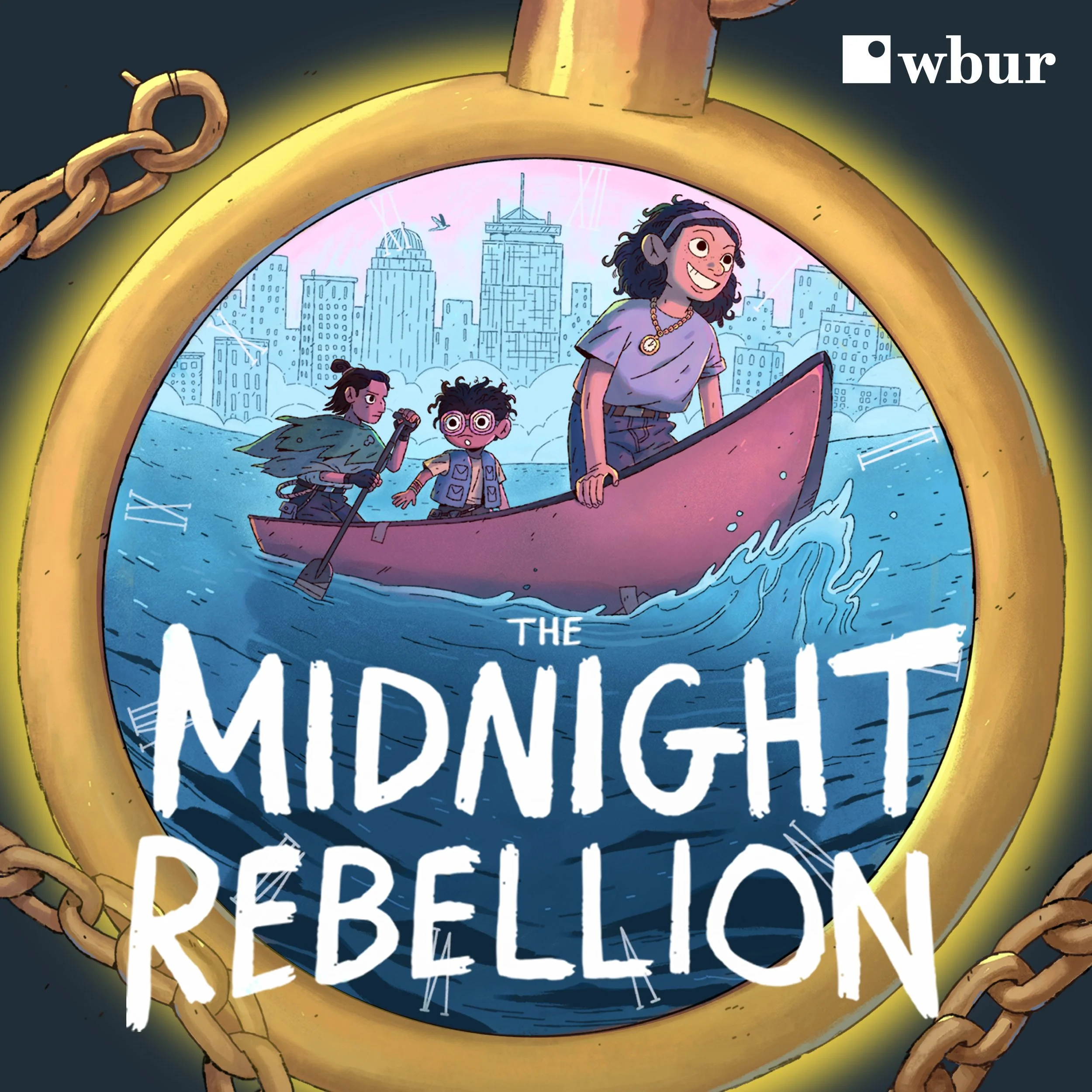
At first Dean wasn’t sold, but a few years later he’s become a full believer, and is the co-creator of WBUR’s The Midnight Rebellion, a choose-your-own-adventure podcast set in a futuristic climate-ravaged Boston.
This week we’re sharing the first episode of the series. But we also hear from Dean directly about what it was like to tackle such a different kind of storytelling and why he thinks embracing a format borrowed from a hit book-genre of the nineties is so apt for exploring climate action.
Featuring Dean Russell, and the cast of The Midnight Rebellion.o hear the rest of the series, subscribe to The Midnight Rebellion wherever you get your podcasts.


ADDITIONAL MATERIALS
As listed, our staff recommendations for cli-fi books are The Ministry of Time by Kaliane Bradley, A Children’s Bible by Lydia Millet, and It Lasts Forever and Then It’s Over by Anne de Marcken.
SUPPORT
To share your questions and feedback with Outside/In, call the show’s hotline and leave us a voicemail. The number is 1-844-GO-OTTER. No question is too serious or too silly.
Outside/In is made possible with listener support. Click here to join our Patreon and get ad-free episodes of the podcast.
Follow Outside/In on Instagram, TikTok, or join our private discussion group on Facebook.
CREDITS
Outside/In Host: Nate Hegyi
The interview portion of this episode was produced and edited by Taylor Quimby.
Mixed by Marina Henke.
Our staff also includes Felix Poon, Justine Paradis, and Jessica Hunt
Executive producer: Taylor Quimby
Rebecca Lavoie is NHPR’s Director of On-Demand Audio
Music by Blue Dot Sessions.
Outside/In is a production of New Hampshire Public Radio
Submit a question to the “Outside/Inbox.” We answer queries about the natural world, climate change, sustainability, and human evolution. You can send a voice memo to outsidein@nhpr.org or leave a message on our hotline, 1-844-GO-OTTER (844-466-8837).
The Midnight Rebellion is a production of WBUR, Boston’s NPR.
Created by Ben Brock Johnson and Dean Russell
Written and produced by Dean Russell
Directed by Emily Jankowski and Dean Russell
Managing Producer | Samata Joshi
Production Manager | Paul Vaitkus
Director of Digital Audio | Ben Brock Johnson
Story by Dean Russell with Joanna Lewis, Taylor Orci, Craig Rowin, and Kristine Songco
Editors | Mary Kole and Dave Shaw
Mix and sound design | Emily Jankowski and Paul Vaitkus
Additional post-production | Fred Greenhalgh, and Mumble Media’s Jayme Catsouphes, Cara Ehlenfeldt, Liz Mak, Lee Mengistu, David Tatasciore, Renée Vargas, Jake Young, and Sharif Youssef
Art | Sophie Morse
Animation | Rory Panagotopulos
Casting | Rebecca Schankula
For a full list of the cast visit the show’s homepage.
Audio Transcript
Note: Episodes of Outside/In are made as pieces of audio, and some context and nuance may be lost on the page. Transcripts are generated using a combination of speech recognition software and human transcribers, and may contain errors.
Nate Hegyi: What do you like better? Are you a sci-fi guy or a fantasy guy?
Dean Russell: Oh man, that's a tough question. That is a… that is a tough question. I am… I'm like a sci fi lite, fantasy heavy person, you know?
[MUX IN, Helvetica]
Nate Hegyi: From NHPR, this is Outside/In, a show where curiosity and the natural world collide. I’m Nate Hegyi and speaking with me, is Dean Russell.
Dean Russell: I love, a well-done sci fi that is more about emotions and characters and less about the super techy stuff.
Nate Hegyi: So you'd be more like a Dune guy than, like, an Interstellar guy.
Dean Russell: Oh, you know what? Actually, like it's the other way around. I'm so much more into Interstellar than I am Dune.
Nate Hegyi: The reason we’re talking to Dean about sci-fi and fantasy, is because he recently undertook a pretty wild job transition. One that, for me – as a reporter – I found pretty surprising.
Dean Russell: What I normally do is journalism. And, uh, what I have been doing for the past couple years is making a fiction podcast show.
[mux swells]
Nate Hegyi: Today on the show, we’re doing something a little different. We’re going to chat with Dean Russell about getting kids to care about climate change… and on connecting action heroes… with climate action.
Dean Russell: I don't know if you remember Captain Planet, but at the end of Captain Planet, they would always do these sort of like, “Turn off your lights!” And, uh, I remember that as a kid!
Nate Hegyi: And we’ll take a listen to the first part of his choose-your-own-climate adventure: The Midnight Rebellion.
Dean Russell: Yeah it’s not, uh, it's not a usual Outside/In episode.
Nate Hegyi: Stick around.
CLIP: The power is yours!
AD BREAK
Nate Hegyi: From NHPR, this is Outside/In. I’m Nate Hegyi.
[sound of old school internet booting up]
Nate Hegyi: If you can propel yourself backwards a few decades… before YouTube, before AOL….
[AOL sound]
Nate Hegyi: Before most kids even had a video game console….
[SEGA sound effect]
Nate Hegyi: There was the choose-your-own-adventure book.
[MUX IN, Merg Station]
Nate Hegyi: I loved these books when I was a kid. It was a genre of storytelling that blew up in the 1980s and ‘90s. The stories were told in the 2nd person. You, as the reader, were the protagonist. Every few pages you’d be asked to make a pivotal choice. Should you attempt to slay the ogre, or convince it to let you pass? Read an intriguing spellbook? Or follow the mysterious figure? Then, after agonizing over the decision, you’d flip to the appropriate page, and the narrative would continue with your choice baked into the story. And hey, if you didn’t like where it went? You could just flip back and start again. These books sold hundreds of millions of copies before falling out of style in the late ‘90s. And let me tell you – they could get pretty wild.
Nate Hegyi: Were you into choose-your-own-adventure books when you were a kid?
Dean Russell: I was…
Nate Hegyi: This is WBUR reporter and producer, Dean Russell.
Dean Russell: In doing this project, I reread them and I read one. I wish I could remember the title, but basically the problem is that aliens have stolen all of the fossil fuels on earth and we need to get them back. It was like written in the 80s, but, uh…
Nate Hegyi: I was about to ask you that feels very like feels very much like lined up with the, uh, the oil crisis of like the late 70s where we're already struggling without oil. And they're like, what if it was aliens…
Dean Russell: Absolutely.
Nate Hegyi: …instead of the Iranian regime?
Dean Russell: Exactly, exactly…
[mux swell and fade]
Nate Hegyi: The reason Dean was rereading those choose-your-own-adventure classics, is because Dean has spent the past few years developing one of his own. One that also involves fossil fuels… although the similarity probably stops there. It’s called “The Midnight Rebellion.”
Dean Russell: The idea for this show came from how they kind of gave us when we were kids this sort of sense of agency that other stories don't allow. And, you know, I love like a really well constructed story, but the ability to craft it yourself or like have an impact on it… It's such an unusual way of experiencing something. And… as we talked about it, it just felt right for a show that is essentially about climate change.
Nate Hegyi: The Midnight Rebellion follows a 12-year old kid who – I guess slight spoiler here – accidentally travels 100-years into the future, to a climate ravaged version of Boston. Dean told me it was actually his boss who came up with the basic concept several years ago. He approached Dean and said “hey… I’ve got a weird idea.”
Dean Russell: I had just wrapped up a long sort of investigative project for climate change and health. And, you know, I'd been doing so much on Covid-19 and my world was, was so, so serious, uh, that it was hard for me to get behind, uh, what felt really kind of silly when he, when he first talked about it, it's like “a choose your own climate podcast.” It felt very much like, “That's great! I hope someone does that, but I don't… I'm not that person.”
[MUX IN, Corner at Cicero]
Dean Russell: Um, but you know, the more time I have spent with it, the more it's made so much sense to me. The way that we are, you know, motivated to take action, the way I was motivated as a kid was through fiction. It was through these stories of people doing impossible things and eventually it clicked and, and came together.
[small swell]
Nate Hegyi: Yeah. Like on Outside/In, we often wrestle with the agency we do and don't have when it comes to climate. Do you see climate action as a kind of choose your own adventure story?
Dean Russell: I mean, everything we do is a choose your own adventure story But yeah, no, it is. We actually have the ability to shape the narrative, to change what happens. And it's not easy and, uh, you definitely can't do it all on your own, but you have to do things and you have to make choices and the choices are often hard. It very much feels like a choose-your-own-adventure, just with some higher stakes.
Nate Hegyi: Oh yeah, yeah… Much… much much higher –
Dean Russell: Slightly higher stakes!
[mux swell and fade]
Nate Hegyi: I imagine it was also really tough to, when you're doing a story like this, to make it not sound like a PSA. Was it hard for you balancing story and actual climate education?
Dean Russell: I think actually this… this was the hardest part for me. You know, it's like when you were a kid, you want to read something that's fun or you want to watch something that is fun and you don't often… I mean, I loved Bill Nye and, you know, magic School Bus and stuff... but you don't often want to just be told information. And it was difficult to strike the balance between allowing the story to carry itself and to be fun and for there to be, you know, robots that shoot lightning and, you know, silly jokes and also, you know, working in facts about climate change. Working it into the scenery, working it into a pivotal plot moment and working it into the decisions. You know, at the end of each episode, we do have like this 30-second PSA because we really do want… we want you to feel something, but we also don't want you to walk away feeling like, uh, the story is so separate from your life. I don't know if you remember Captain Planet, but at the end of Captain Planet, they would always do these sort of like “Turn off your lights!” And, uh, I remember that as a kid.
[MUX IN, Camphor Kingdom]
Dean Russell: Striking the balance was… was difficult. Eventually I just had to kind of give in and let the story be the story. And have faith that all of the research that we did for this, um, would, would come through. And so far, I mean, that's, that's been the indication that we've gotten from, from kids listening, like you know the things that they have taken away from it, it makes it feel worth it.
[mux swell]
Nate Hegyi: That was Dean Russell, co-creator of WBUR’s choose-your-own-adventure podcast, The Midnight Rebellion. When we come back we’ll listen to the first episode. Plus, are you looking for some summer reading? Our own staff recommends THEIR favorite climate fiction… so stick around.
AD BREAK
Nate Hegyi: From NHPR, this is Outside/In, a show where curiosity and the natural world collide. I’m Nate Hegyi. Before the break, we talked with Dean Russell, co-creator of The Midnight Rebellion, a new WBUR kid’s podcast with a special twist. We’re going to listen to the first episode, but we’re curious what you think… Is this something you’d play on a family road trip? What role do you think fiction can play in climate action and climate education? Take a listen, and then send us an email with your thoughts. Our address is outsidein@nhpr.org. Ok. Here it is.
WBUR’S : THE MIDNIGHT REBELLION
PART I: CITY OF TIDES
CHAPTER 1 - ALMOST MIDNIGHT
NARRATOR: If you are listening to this, congratulations. You have made it to the first chapter of The Midnight Rebellion.
This is an interactive podcast. That means you will hear two choices at the end of each chapter. I will say something like, “Should our heroes play it safe or risk it all?” Then you must choose. How? I will explain that when the time comes.
For now just know that your decisions determine the outcome of our story. Good or bad, life or death. It’s on you.
Choose wisely.
[MUX]
NARRATOR: This is The Midnight Rebellion.
Part I. City of Tides ... Chapter 1, “Almost Midnight.” [MUX]
INT. JOULE’S HOUSE, BOSTON RESIDENTIAL - NIGHT (PRESENT DAY) [SFX: RAIN. THUNDER rolls, soft at first. ]
NARRATOR: The hour is nearing midnight, but Joule [JOOL] Watts-Green cannot sleep. She lies in bed, watching bomblettes of rain explode against her window skylight, counting the seconds ...
JOULE: (to self, soft) ... two, three, four ...
NARRATOR: ... between the blindingly bright flashes of lighting ...
[SFX: CRACKLING, medium distance away.]
JOULE: (to self, soft) ... six, seven ...
NARRATOR: ... and the rolling booms of thunder.
JOULE: (to self, soft) ... ten, eleven, twelve—
[SFX: Thunder BOOM, closer.]
NARRATOR: Joule’s mom, Dr. Elizabeth Green, taught her this counting trick: The shorter the time between flashes and booms, the closer the heart of the storm .
JOULE: (to self, soft) ... two, three ...
NARRATOR: But it is not the nearing storm that keeps Joule up. It is the fact that when the clock ticks twelve a.m., it will be one year to the day when her mom, Dr. Green, entered her laboratory during a storm just like this ... and never came home.
[SFX: Thunder BOOM — closer still]
NARRATOR: As the thunder goes outside, a creak inside catches Joule’s ears. She sits up. A pale shadow shifts in her doorway.
VOICE [HART]: (whispering) Joule ... Joule ...
NARRATOR: The shadow enters her room. A flashlight flick on ... [SFX: A soft CLICK — flashlight turns on]
NARRATOR: And there is a grinning face. Joule’s shoulders relax. JOULE: (quietly) Hart! You scared me.
NARRATOR: It is her brother, Hartree, or Hart.
HART: I scared you? Would you say I gave you a Hart attack? Eh!
JOULE: Please, never become a comedian.
HART: No promises, sis. (beat) Now, wakey wakey. It’s time.
NARRATOR: She stares at Hart. His irises shine bright like a blue flame. He has the same broad build as Joule, the same freckled nose, the same coarse hair. Their ears are different. His are slim and regal. Hers are so big some say they make her look like a sailboat, earning her the much-loathed nickname ...
HART: C’mon, Sailor! (piratey) Argh, the winds be blowin’. Hang on to yer sails.
JOULE: I really wish you wouldn’t call me that. It doesn’t even make sense. I hate the ocean. I hate being wet ... and speaking of, it’s pouring. I’m not going outside.
HART: But now’s our chance, sis. Dad’s asleep. We’re not. It’s basically destiny.
NARRATOR: Joule shakes her head. How could two people born on the same day into the same family be so different? Twins, age twelve: Joule, the law-abiding citizen. And Hart, the roguish leader with the ability to drag Joule along no matter how much she resists.
She followed him out of the womb. Will she follow him now?
JOULE: No. Dad said the lab is off limits. Nobody’s been in there since ... since…
HART: Since Mom died. You can say it.
JOULE: The lab is dangerous, Hart.
HART: It will be good for us. C’mon. I know you miss her. What better way to honor her than raiding her stuff?
NARRATOR: Hart has been trying for months to get Joule into the lab — always, he says, “to honor” their mom. While this may be true, it is also the case that Hart is, like their mother was, an inventor. And Dr. Green’s lab is full of gizmos for inventing.
No one knows what she was creating the day of the accident. The police found nothing outrageous in the lab, except of course, Dr. Green’s ashes. It was enough to condemn the place.
(FLASHBACK) DAD: Are you sure, Detective? She was a physicist, she studied climate change. She wasn’t a bomb maker.
(FLASHBACK) DETECTIVE: Mr. Watts, if I was you, I’d lock up that lab of hers and never step foot inside again.
NARRATOR: This led to much speculation at East Boston Middle. The dominant theory was that Dr. Elizabeth Green had faked her death because she was tired of being a mom. It is well known that before she was “Mom,” people called her “Lightning Lizzie.”
(FLASHBACK) KID 1: My dad called her a “radical.”
(FLASHBACK) KID 2: ... an “Earth nut.”
(FLASHBACK) KID 3: ... a “Green freak.”
(FLASHBACK) KID 1: ... a “rebel.”
NARRATOR: Many moms are tired of being moms, and some even have exciting pasts involving protests and jail time. Yet faking a death to escape one’s children is very, very rare. Unfortunately, that leaves us with the hard truth that Joule’s mom is dead, and something in the scientist’s lab did it.
[SFX: Thunder BOOM — sharp and jarring]
HART: You’re just like Dad. Afraid of breaking the rules. JOULE: I break rules.
HART: Name one.
JOULE: I ... I don’t double-knot my shoelaces sometimes.
HART: That’s not a rule. That’s never been a rule anywhere ever. Besides, I see your shoes every day. They’re double-knotted.
JOULE: That’s not true. I triple-knot for baseball.
HART: Ugh! Fine. Stay here. I’m following in Mom’s footsteps, and that means, I’m going. With or without you.
[SFX: Door closes, Hart walks away]
JOULE: Hart, wait! You’ll get yourself hurt ... Grrr. Fine!
NARRATOR: I wish I could tell you why exactly Joule decides to go after her brother. I do not think she herself knows. It may be that she is worried for him. Or that she is jealous of how similar he is to their mom. Regardless, Joule throws on a sweater and jeans and tiptoes downstairs.
[SFX: Quick movements — clothes rustling, soft footsteps, etc.]
NARRATOR: She laces her sneakers — single-knotted because, at this moment, she is feeling quite rebellious — and follows Hart out the sliding back door into the rain.
EXT. BACKYARD — CONT’D
NARRATOR: The laboratory was once the family’s detached garage. A two-story Victorian with purple shutters, it sits far back from their street, and on the top floor offers a lovely view of Boston Harbor, when it is not storming.
[SFX: Running through rain, muddy yard, arrives at door]
NARRATOR: Immediately, Joule regrets her wardrobe. Her sneakers squelch through mud. The sweater drinks in the chilly June rain as she waits, seemingly forever, for Hart to pick the lock.
JOULE: C’mon, Hart. I’m freezing.
NARRATOR: Idly, Joule kicks the pools forming in the handprints on the walkway. Years ago, when her parents were converting the garage, she and Hart had pressed their palms into the concrete walkway as it dried. It was another thing Hart made her do. She thought her parents would get upset. But they loved it.
[SFX: WINDOW SMASH.]
INT. GARAGE LAB, JOULE’S HOME - CONT
NARRATOR: Joule looks up. Hart drops a rock and slips his hand into the broken glass window to unlock the door.
JOULE: Seriously?
HART: Eh, it was cracked already. Dad’ll think the storm did it. [SFX: DOOR opens.]
HART: Ah ha! Here we are. (jokey evil) The LABORATORY! (beat) Now, keep your eyes peeled. I need a few actuators and a light sensor and a new battery for my latest creation... the K-9000. Get it, like ‘canine’? Because it’s a dog robot.
NARRATOR: Joule rolls her eyes. Wringing out her mane of hair, she enters the cluttered space. Pinewood crates stacked to the ceiling, whiteboards with strange symbols, glass jars of brown liquids lining the shelves; all of it, gathering dust.
JOULE: (concerned) Hey, be careful with that stuff. [SFX: Crate thudding, paper crinkling, tools clinking]
NARRATOR: Hart is head down in a crate, tossing out gizmos. His feet kick in the air. Then he reemerges flushed and pleased.
HART: Ha! Look! Mom’s most advanced piece of technology.
NARRATOR: He holds aloft a radio. A little red radio. The sight of it hits Joule with a wave of emotions. Her mother loved that radio, listened to it every day while she worked ...
[SFX: Switch CLICKS. STATIC BLARES from a RADIO speaker.]
NEWS ANCHOR (STATICKY): This is 90.9 WBUR, Boston’s NPR. It’s eleven fifty-nine, here’s the news. Brutus Bright held a rally today on Boston Common...
HART: I can just feel Mom in here. Can’t you?
NEWSCASTER/REPORTER (STATICKY): ... The tech billionaire received roars of approval when downplaying the severity of climate change:
CANDIDATE (PA, STATICKY): First they take your fuel! Then they’ll take your freedom! We won’t let that happen! ... (APPLAUSE)
NARRATOR: ... and the sound throws her back in time ... [SFX: Static clears and newscaster voices crossfade.]
FLASHBACK: INT. GARAGE LAB, JOULE’S HOME - DAY (1 YEAR AGO) [SFX: Low background static, rain pelting against windows, soft MECHANICAL WHIR in the background]
NARRATOR: It is a gray morning in June. It is the day her mom died. Joule watches as her mom hunches over her workbench, twisting away at tiny gears and springs.
MOM: Grr. This is ridiculous.
JOULE: Can you fix it? I’m sorry. I don’t know what I did wrong.
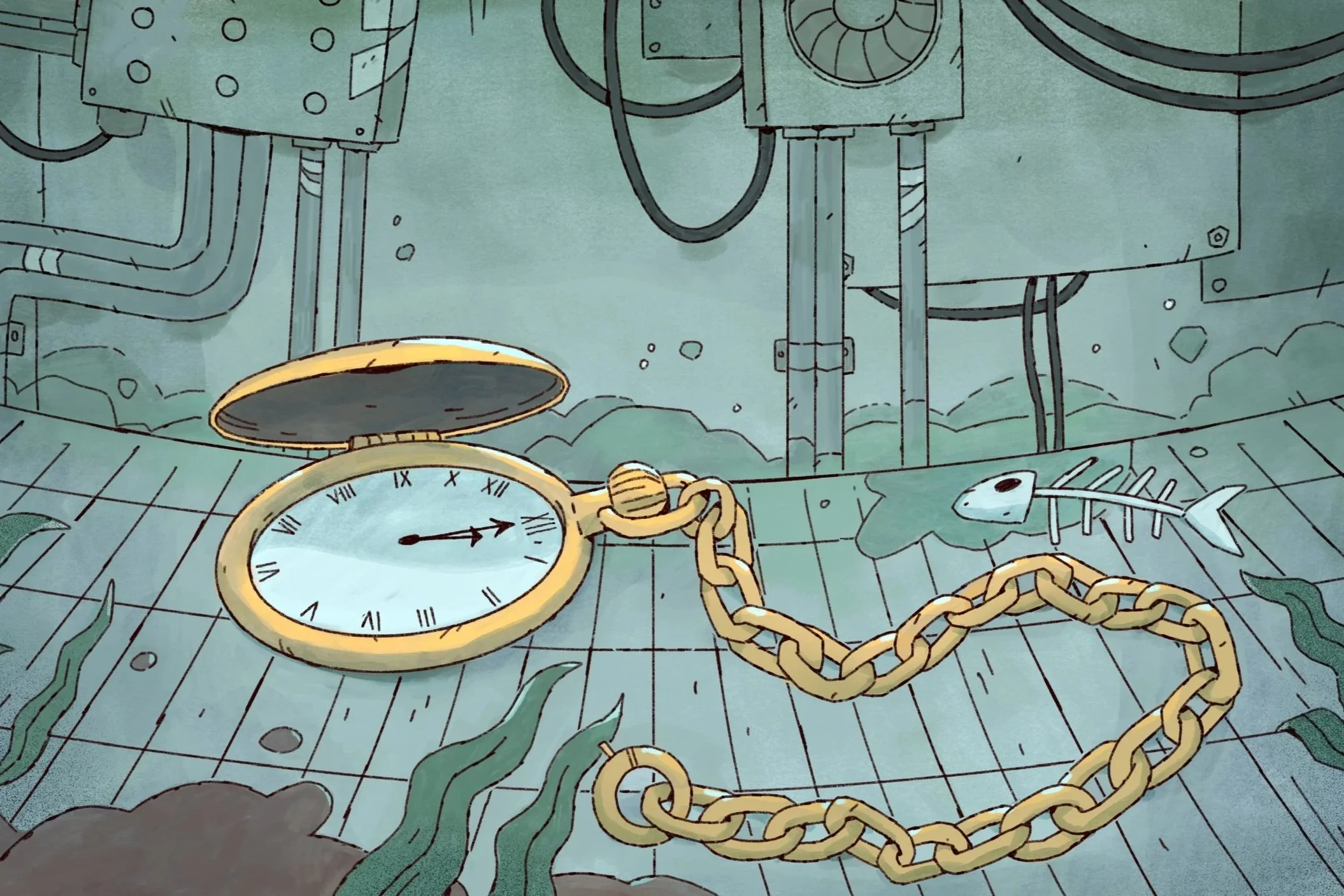
NARRATOR: Her mom is mending a gold pocket watch. A family heirloom that Dr. Green carries it with her everywhere. That was except for the day before, when Joule borrowed it for a class presentation, and the timepiece broke.
MOM: What, hun?
JOULE: Your watch. You seem mad.
MOM: (gentle) Oh, no. It’s not the watch, Joule. It’s that. TMR Ch1 - 7.
NEWSCASTER (STATICKY): ...said he would burn more fossil fuels like coal, oil, and gas, despite the fact that they are the single biggest cause of climate change—
[SFX: Radio LOWERS.]
MOM: I just worry about the world we grown-ups are leaving you. By the time you’re my age, it’ll be too hot to think and half the city will be underwater.
JOULE: Oh. Yeah.
MOM: Did you know a bad climate brought down a civilization before? The Maya. Old Egypt. I swear, if we keep making poor choices, it’ll happen again to us.
JOULE: I know. You told me before.
MOM: (realizing) Ah. Right. Your dad tells me that I scare you kids with all the doom talk. Sorry. It’s just that I care.
JOULE: I know.
MOM: You’re strong, Joule, you and Hart are my little spark and fire. You’ll be okay.
JOULE: I know.
MOM: And the watch will be okay too. Just one more twist. Listen. [SFX: Soft ticking — a clock resumes its rhythm]
[SFX: Radio static surges — MORPH into music. Thunder rumbles.]
INT. GARAGE LAB, JOULE’S HOME - NIGHT
NARRATOR: Joule shakes herself from the memory. It is night, her mother is dead, and Hart has found the worst station imaginable.
[SFX: LOUD, BAD MUSIC]
HART: (over din) Do you think K-9000 should have a scary bark? Or should it speak English? Is that weird?
JOULE: (over din) I’m going upstairs. I can’t think straight.
HART: What do you want to think about?
NARRATOR: She doesn’t answer because saying it aloud is too hard.
HART: Whatever, Sailor. Oh! But don’t forget K-9000 needs an actuator. Let me know if you see one!
[SFX: Wood creaking as Joule climbs the loft ladder. Trap door shuts. Rain becomes louder, now pounding on the roof above.]
INT. SECOND FLOOR, GARAGE LAB - CONT
NARRATOR: Joule climbs the creaking ladder to the hatch door in the ceiling and emerges in a dark den. She flips the switch.
[SFX: Light switch — CLICKS multiple times.]
JOULE: (to self) Nothing. Hm. There’s got to be a lamp around.
NARRATOR: She peers into the dimness. Then she spots a circular silhouette, like a black hole. A flash ...
[SFX: SUPER LOUD THUNDER!]
NARRATOR: ... And that is when she sees it.
JOULE: Whoa. What is that?
NARRATOR: Tall. Round. A metallic sheen of not one color but many: copper, nickel, silver, bronze. She steps closer.
[SFX: Step. Machine lights up. Begins humming.]
NARRATOR: And the thing comes to life. Red lights flicker on. The object is twice her height, a globe on four steel legs, like a lunar lander or a diving bell. There is a heavy vault-like door and a single porthole window, from which more light shines.
[SFX: Objects whirling.]
NARRATOR: Rods sticking out from the body begin to twirl. Copper coils spark.
[SFX: Sparks.]
JOULE: Ahh!
NARRATOR: Ribbons of steam curl into the air.
JOULE: (cautious) What are you?
NARRATOR: It is ugly, as if it climbed out of a junkyard. The legs are uneven. The coils lurch and stutter. The spherical shell is a patchwork of metals.
Its purpose is far from obvious. But it is a device of some sort. An instrument. A vessel. A mechanism. A ... what’s the word?
JOULE: A machine.
[SFX: Pssshhhhhh! Pneumatic door.]
NARRATOR: The door opens, folding down like a gangway, and the machine ... vomits.
[SFX: WET SPLAT — something slimy lands on metal] JOULE: (disgusted) Ugh. Eww. Smells like fish guts.
NARRATOR: Reeking fluid floods out of the opening: water and slimy green ropes of seaweed and, yes...
JOULE: It is fish guts. Gross.
NARRATOR: The machine quakes. She opens her mouth to call ... JOULE: (almost calling out) Har—
NARRATOR: ... but her brother’s name dies on her lips. Because something else catches her eye. Inside the machine, on the cabin floor ...
[SFX: Thundercrack.]
JOULE: (shocked) Mom’s pocket watch.
NARRATOR: ... the one Dr. Green kept with her always. The gold watch chain is caught in the grating at the back of the cabin.
[SFX: Machine hum intensifies — Storm goes crazy.] NARRATOR: Joule steps to the threshold, driven by curiosity. JOULE: No. This is crazy. I should call Hart. I should ...
NARRATOR: Her mind narrows. The sound of the storm slips away. The machine, too, shakes in silence. All she hears is the blood pumping through her body, her heart ticking like a clock.
[SFX: SILENCE except HEARTBEAT mixed with imagined CLOCK TICK.] [MUX]
NARRATOR: This is where you come in. Joule faces a choice, and you must help her decide Should she run to get her brother, or should she step into the machine right now? Alone.
To find her brother, select Chapter 2, “Get Hart.” To step inside, select Chapter 3, “Into the Machine.
That’s right, you will not listen to this story in numerical order. To make your choice, go to Chapter 2, “Get Hart,” or Chapter 3, “Into the Machine.”
Choose wisely. This is The Midnight Rebellion.
[CODA — TMR TIPS]
NARRATOR: One more thing. This is a show about making choices, in the story — and out. So we will end each chapter with a real-life challenge. Today’s chapter features a bad thunderstorm. Because of climate change, storms are increasing in places like Boston, the Southeast, and the tropics. A warmer planet evaporates more water into the air, making storms more common and stronger.
But just like Joule makes choices, we can too. Try one simple thing this week. For instance, to reduce pollution, ride a bike or take the bus instead of the car. Big changes start small.
Keep listening for more tips and more adventure. Up next: Chapter 2, “Get Hart” OR Chapter 3, “Into the Machine.”
Nate Hegyi: That was The Midnight Rebellion, from WBUR – you can find, and continue the story, wherever you get your podcasts.
[mux posts and ends]
Nate Heygi: The choose-your-own-adventure novel may have peaked in the 1990s… but one genre that’s been getting bigger in recent years, is cli-fi… or climate fiction. These are books that feature characters and places that are in flux - they can be futuristic dystopias, or just people today, navigating climate disasters, migration, and more. So we asked our team to present some staff picks on favorite cli-fi novels from the past few years. Here’s what we’ve got.
[MUX IN over producers, Gelano]
Taylor Quimby: Hello hello Taylor here. My recommendation is called The Ministry of Time by Kaliane Bradley who in an interview was asked to sum up this novel and she called it “a time-travel romance about bureaucracy, empire and cigarettes.” This is one of those books that’s not about climate change per se but when all is said and done the climate is what drives the action.
Justine Paradis: Hi it’s Justine here. So my recommendation is definitely a stretch for cli-fi, it’s more zombie-fi, but I’m recommending it anyway. It’s one of the funniest and most haunting and most original books I’ve read in a really long time. It’s called It Lasts Forever and Then It’s Over by Anne de Marcken. The narrator is a zombie and it’s the internal experience of hunger and loss during and after the end of the world. It’s such a beautiful book, it's again so funny, I really recommend it.
Marina Henke: Helllooo it is Marina here. My cli-fi recommendation is a book called A Children's Bible by Lydia Millet. It is about a group of kids that are trying to survive through this very apocalyptic hurricane. But while they’re trying to do that their parents are busy having an extravagant vacation.
That’s it for today – I’m your host, Nate Hegyi.
The interview portion of this episode was produced by Taylor Quimby, and mixed by Marina Henke.
Our staff includes Felix Poon, Justine Paradis, and Jessica Hunt.
Music by Blue Dot Sessions.
For a full list of credits for The Midnight Rebellion, check out our show notes.
Outside/In is a production of New Hampshire Public Radio.