How far would you go for a crow?
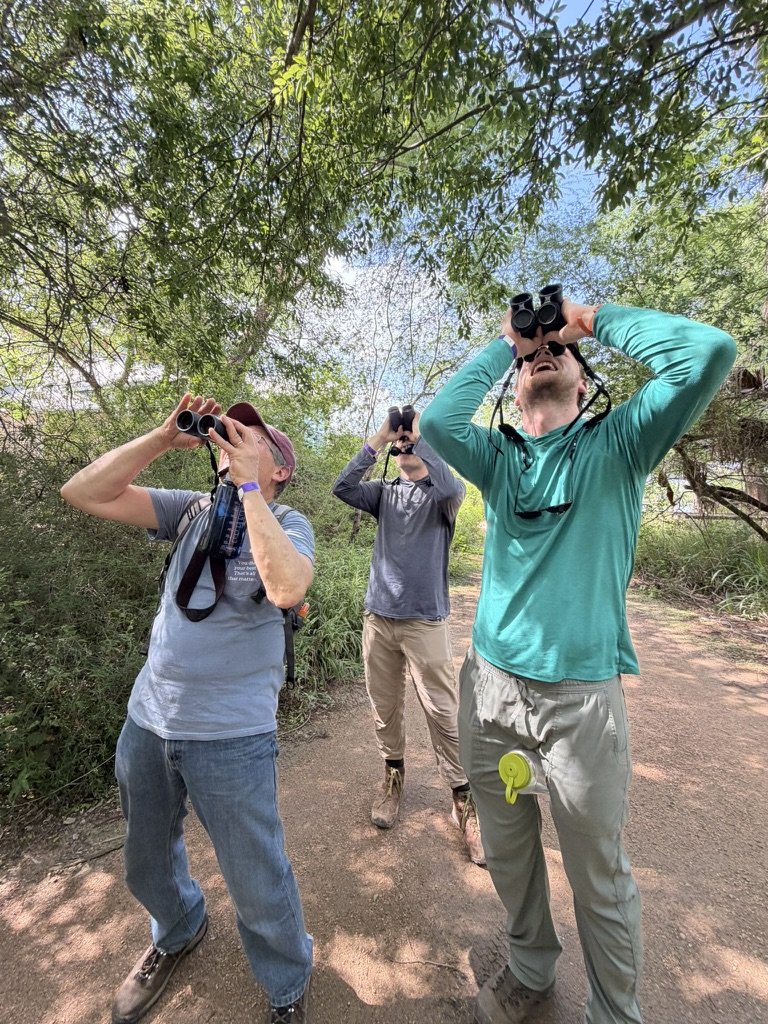
Trying to spot an inconspicuous grosbeak at the Edinburg Scenic Wetlands and World Birding Center. (Credit: Michaela Elias)
To the American birder, spotting the Tamaulipas Crow is potentially a once-in-a-lifetime event. The crow's range is mostly in Mexico and extends ever so slightly into Texas, specifically in and around a dump called the Brownsville Landfill. Spotting the Tamaulipas — north of the border — means being able to check it off your American Bird Association Checklist.
So just how far will die-hard birders go to see this bird?
In this episode producer (and first-time birder) Michaela Elias sets out to the southern border with a group of experienced birder friends to find out. Together with her "wingmen" Michaela braves the Texas heat, crawls through brush and over slippery rocks, and risks getting attacked by dogs — to find out whether collecting bird sightings as if they're Pokémon is a meaningful way to engage with the natural world.
Featuring Jake Glassman, Joe Hack, and Joel Glassman.


ADDITIONAL MATERIALS
Check out the eBird app, a crowdsourced database of bird observations that lets you log all the birds you’ve seen and where you’ve seen them.
SUPPORT
To share your questions and feedback with Outside/In, call the show’s hotline and leave us a voicemail. The number is 1-844-GO-OTTER. No question is too serious or too silly.
Outside/In is made possible with listener support. Click here to join our Patreon and get ad-free episodes of the podcast.
Follow Outside/In on Instagram, TikTok, or join our private discussion group on Facebook.
CREDITS
April bird sightings at the Edinburg Scenic Wetlands and World Birding Center. (Credit: Michaela Elias)
Host: Nate Hegyi
Reported and produced by Michaela Elias
Mixed and edited by Taylor Quimby, with help from Rebecca Lavoie and Felix Poon.
Our staff includes Marina Henke, Justine Paradis, and Jessica Hunt.
Executive producer: Taylor Quimby
Rebecca Lavoie is NHPR’s Director of On-Demand Audio
Special thanks to Loden Henning, Jose Maldonado and the rest of the team at the Brownsville Landfill, Nathan Burkhart and all the organizers and guides with the Brownsville Birding Festival
Music by Blue Dot Sessions, and Ryan James Carr.
Outside/In is a production of New Hampshire Public Radio.
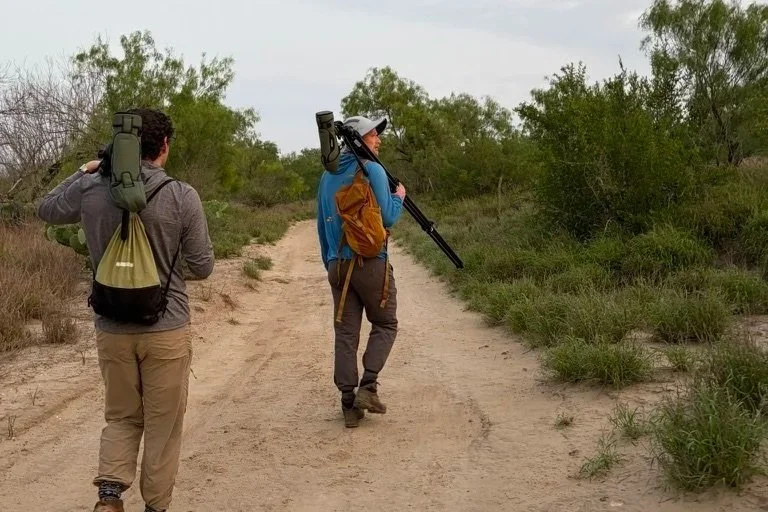
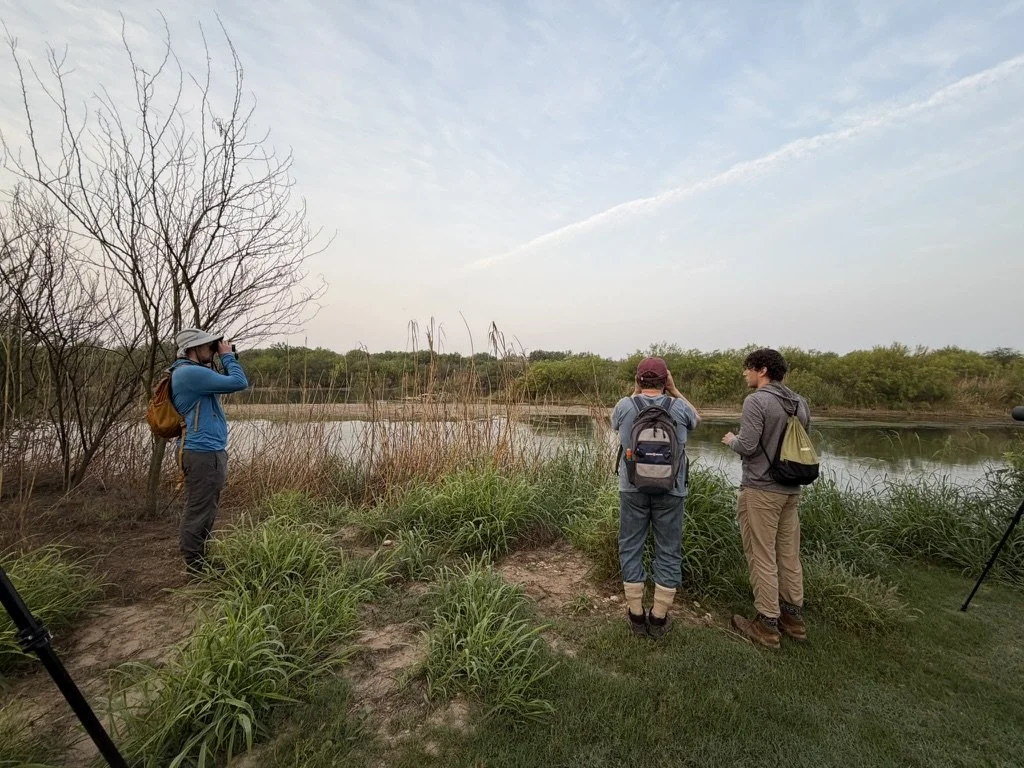
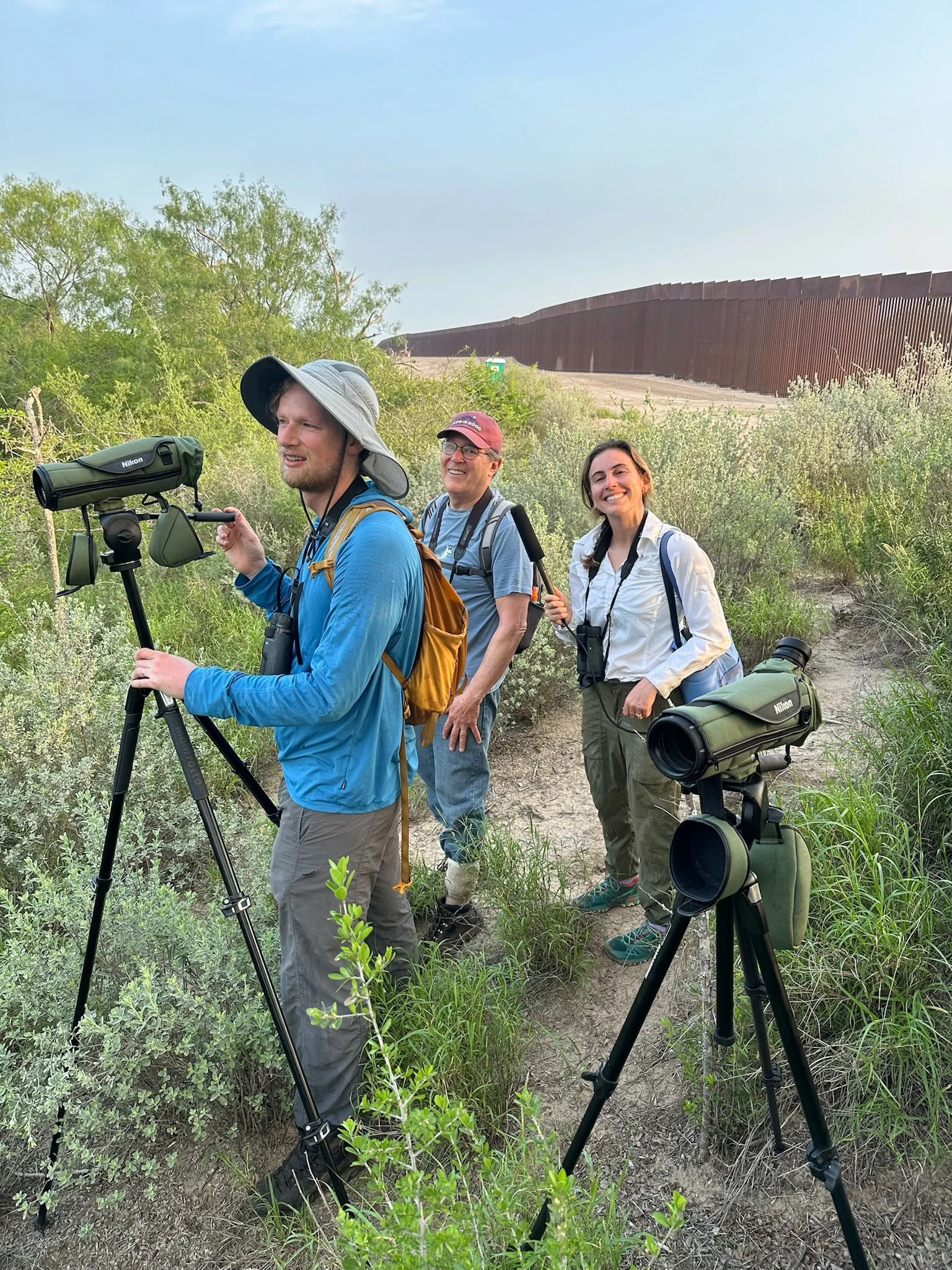
Jake and Joe carry their scopes through Bentsen-Rio Grande Valley State Park. (Credit: Michaela Elias)
Audio Transcript
Note: Episodes of Outside/In are made as pieces of audio, and some context and nuance may be lost on the page. Transcripts are generated using a combination of speech recognition software and human transcribers, and may contain errors.
Nate Hegyi: From NHPR, this is Outside/In – a show where curiosity and the natural world collide. I’m Nate Hegyi.
[Landfill ambi, seagulls]
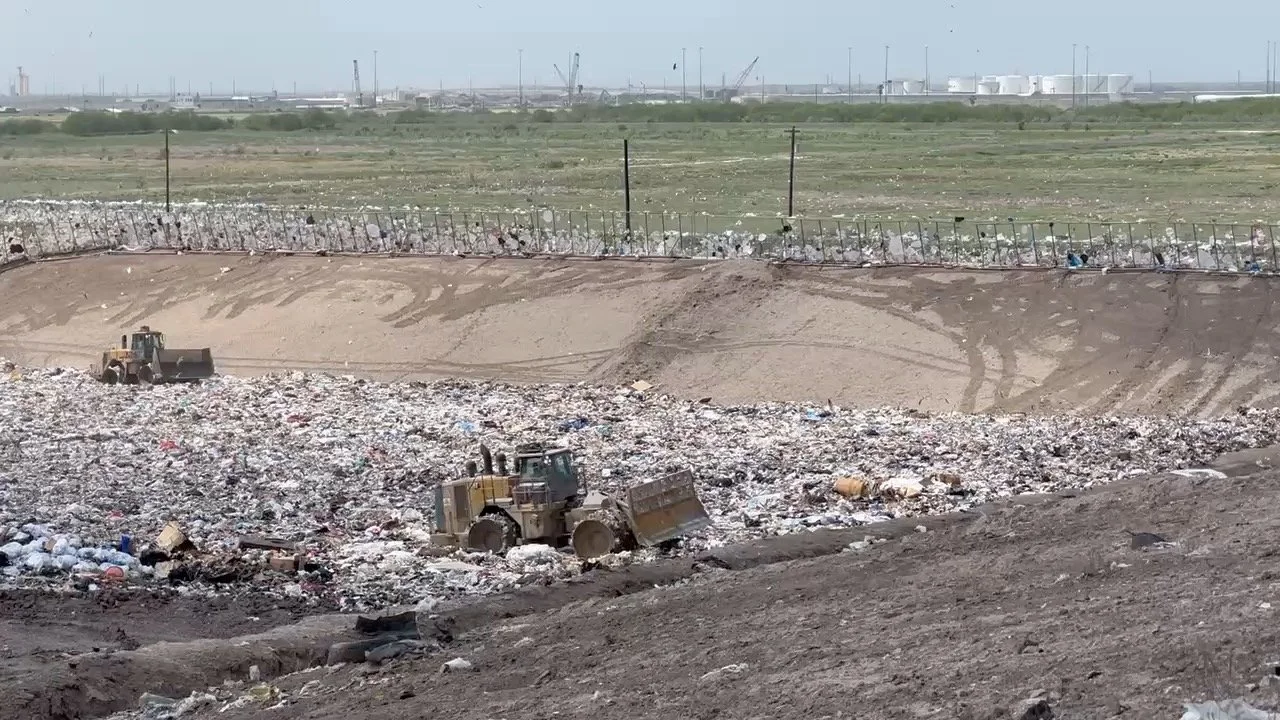
I want you to picture a sky filled with birds. And on the ground? A colorful field of garbage.
Michaela Elias: Do you wanna describe some of the trash that you see?
Loden Henning: Actually, it's funny you ask because I have my eyes set on this beautiful hot tub.
Narration: This is the Brownsville Landfill, which sits at the Southernmost tip of Texas. It’s right on the border with Mexico.
Loden Henning: Can you imagine the view sitting in a hot tub surrounded by beautiful birds?
Mux - Postbox Facto, Blue Dot Sessions
Brownsville is semi-famous for being the town next to Starbase, where SpaceX launches its big Starship rocket.
Clip: Hello, welcome once again star people and welcome back to Starbase, Texas.
Voice 2: Ignition.
But another thing Brownsville is famous for is the birdwatching that happens at this dump.
Guide: Anybody know what these gulls are called? Most of these ones with the Black hoods--laughing gulls. Laughing gulls, right? If you hang out here long enough, you'll go crazy just like [00:01:30] them.
Mux fades
Narration:
To understand why this dump is so popular for birders, you need to understand: Die-hard birders are collectors.
Many maintain something called a “life list” – a personal record of ALL the birds they’ve ever seen.
Seeing a bird from one of these lists for the first time – that’s called a “lifer.” And if you’ve been collecting your life list for… well, your whole life… it can be a big deal.
Some life lists are informal, but others come from official registries, almost like a sport.
And like any sport, there are rules.
For example, the American Birding Association’s Checklist includes over 1,100 species found across the U.S., Canada, and Hawaii.
And a bird sighting from this list only counts if you see it in the US, Canada, or the Hawaiian islands.
And that means, any bird on the list whose range just barely crosses the Mexican border is a very hard bird to cross off your ABA lifelist.
A bird like the Tamaulipas Crow.
Guide: This was for a long time, the only place in the country where you could see that species.
Yeah.
So it has a fame for that in the birding world
The Tamaulipas Crow and the rest of these border crossing birds, is why this dump – and all of South Texas, really – is a huge birding hotspot.
Problem is, it’s been a minute since the workers here have seen it.
Michaela Elias: Okay.
Jose Maldonado: Yeah. Jerry, have you seen it lately?
Jerry: I've seen it, yeah.
Michaela Elias: You have seen it lately?
Jerry: Last year I saw a couple of them were on the polls over there.
Looked similar. Yeah. Felt similar. Yeah. I said it was.
Michaela Elias: Yeah.
Jerry: So it hasn't, it's been seen maybe or maybe not.
[mux swell - Short Circuit, Ryan James Carr]
So today on Outside/In, we’re taking a trip to the US Mexico border with first time birder, Michaela Elias.
Michaela Elias: I’ve been here about an hour so far, looking for this bird.
Can her college buds and birding guides find the lifers they’re looking for?
[new clip]
Jake Glassman: It's like. You know, belching clouds of steam, it smells like old shellfish, but the birding was fantastic
And can Michaela be convinced that checking birds off a list is a meaningful way to engage with the natural world?
Michaela Elias: Is it cool? Cooler than you thought? Different than you thought?
Joel Glassman: I, well, thank the lord It doesn't stink.
Stay tuned.
_____________________
From NHPR, this is Outside/In. I’m Michaela Elias.
Michaela Elias: I see two men in the middle of the road just looking [00:06:00] like they don't know where they are. And I think we found our guys.
I flew to south Texas a few days before Jake and Joe – my birdwatching guides for the next few days.
Michaela Elias: Oh, hey. Nice hair!
I hadn’t seen them in a year or so. And before I could ask them how their flight was – Jake asked me, “do you wanna see a cool bird?”
Michaela Elias: I do wanna see a cool bird. That's what I'm here for. How close should I get to this tree?
MUX - Vessel One, Blue Dot Sessions
Now I'm no birder. I recently acquired my first pair of binocs and could not tell my finches from my sparrows.
But these two? They’re die-hards.
Jake Glassman: I’ve been interested in birding since I was a little kid.
This is Jake Glassman, by the way. College bud number one.
Jake Glassman: My parents gave me a life list, like the list of birds that are in the US that you can kind of check off when I was in first grade.
TODAY, JAKE WORKS IN ENVIRONMENTAL POLICY. HE’S THE KIND OF GUY WHO Gives his friends a tarot card reading based on the BIRDS present AT THEIR WEDDING ceremony.
Jake Glassman: Birds are amazing 'cause you can go and you can find a hundred species of them in a day. But they're also not like insects where there's thousands and thousands of species and it's really overwhelming. So there’s something about the accessibility of them and the beauty of them.
[mux fades]
Jake met my other guide – Joe Hack, during a college orientation backpacking trip.
Joe Hack: You know I grew up in Omaha, Nebraska, and there aren’t a lot of Jews in Omaha. Um, but I saw Jake and thought that looks like a nice Jewish boy, I’m going to go talk to him.
When I first met Joe in college, his freshmen dorm room didn’t have pictures of family members - it was plastered with intimate close-ups of birds.
Joe Hack: I actually showed Jake a new, a new bird for him.
Michaela Elias: Wow.
Joe Hack: A black back woodpecker. I set the dynamic from the start, yeah. I'm kind of the alpha.
Michaela Elias: Yeah.
Joe Hack: And, uh, he's just lucky to be there.
Mux - Via Verre, Blue Dot Sessions
That was in 2013... and these two have been wingmen ever since. Their birding escapades have taken them all over the world from the Peruvian Rainforest to the mountains of Nepal... And later this week, I get to join them at a literal dump in South Texas.
Exotic, right?
Jake Glassman: A lot of the situations you find yourself in as a birder are funny.
Michaela Elias: Yeah.
Jake Glassman: And we are, I'd like to think, generally aware of it. [laughs]
[mux swell and then underneath tracking]
[mux fades]
Jake Glassman: …Good raptors, swallows…
Michaela Elias: Did you log all of it?
Jake Glassman: We’re working on it.
ME: It was morning, and we had stopped for breakfast tacos to make plans and compare notes from the day before.
Joel Glassman: What was [00:07:00] most exciting were the species that I discovered that they've never seen before. Whoa. Such as, um, the pie-billed scalp.
Narration: This is Joel, Jake's dad. He is also, as you can tell, a lifelong birder – and a pretty good trash-talker too.
Joel Glassman: Neither of these bird brains were able to find them, but I was able to find them densely hidden in some of the underbrush and I made their day for them because they [00:08:00] were totally surprised. Okay.
Narration: The BIG DREAM FOR THIS WEEK–for me at least– IS TO SEE THE TAUMALIPAS CROW AT THE FAMOUS BROWNSVILLE LANDFILL.
But Jake and Joe had a number of birds from their life lists they were hoping to encounter over the course of the week.
The plan was to follow the border westward, stopping at mostly unplanned destinations described in guidebooks or on an app.
I would get initiated into this world… and hopefully, they would get some lifers.
Joe Hack: We have a lot of options. We could go to Edenberg and try to find the Crimson collared grosbeak
Michaela Elias: sounds interesting to me.
Joe Hack: So this is the only one that's known to be north of Mexican border.
Michaela Elias: So it's kind of like a Tamaulipas Crow adjacent experience. Exactly. Though it might not be in a landfill. Where are [00:08:30] we gonna look for it though?
Joe Hack: An urban park.
Michaela Elias: Okay.
Mux - Paving Stones, Blue Dot Sessions
Michaela Elias: This part of South Texas is flat and dry, with short stubby trees. The humidity makes everything a bit hazy and time moves slowly. The roads are dotted with Taquerias and strip malls.
But about an hour from Brownsville is the Edinburg Scenic Wetlands and World Birding Center, a serene urban pocket of manicured nature.
As we go to pay the admission fee, I ask the woman at the entrance if she's seen the bird we’re looking for – the crimson-collared grossbeak.
Woman at Edinburg: Yes. I saw her the first week that she came through.
Narration: Native to Northeastern Mexico, this is the only known crimson collared grosbeak in the US at this moment – a singular bird.
The employee told us some 3,000 birders have come to see it over the past six months… Sometimes coming hundreds of miles for a brief glimpse…
Woman at Edinburg: new Jersey, New York, Washington, California…. We had people drive overnight from Florida.
Michaela Elias: Whoa.
Woman at Edinburg: Yeah. That they wanted to see this one bird and then go back to Florida 'cause they only had two days.
Mux - Bossa Cova, Blue Dot Sessions
Narration: Traveling 2,000 miles in hopes of seeing a bird may sound extreme. But for people in this world, it's fairly standard.
And if you, like me, ever travel from Seattle to Texas, birding with no prior experience, here are a few steps to improve your chances of success.
[mux swell]
Step one. You're going to want to know what your target looks and sounds like. Thankfully there are lots of books and online guides.
Joe Hack: This is the female. The male is a very dark crimson and black .
That’s Joe.
Jake Glassman: I'm listening to what this grosbeak sounds [00:10:00] like. Mm.
That’s Jake.
Jake Glassman: This is the song, apparently [plays sound]
Michaela Elias: Pleasant.
Jake Glassman: Very grossbeaky.
Step two. Gird yourself for a long effort.
Jake Glassman: Some of these things, you could honestly be here for hours and not find it. It's the heat of the day also. Tough for the birdies.
Michaela Elias: Yep.
Jake Glassman: And we're, but we're resilient too.
Narration: Step three. Use your phone.
EBIRD, FOR THE NOT YET INITIATED, IS AN APP WHERE YOU CAN LOG ALL THE BIRDS YOU'VE SEEN AND WHERE YOU'VE SEEN THEM.
IT’S ACTUALLY BECOME A PRETTY IMPORTANT TOOL FOR SCIENTISTS. BUT BIRDERS ALSO USE IT LIKE A CROWD-SOURCED TREASURE MAP, triangulating coordinates of reported sightings – ASSUMING THE TREASURE HASN’T FLOWN AWAY.
AND ACCORDING TO EBIRD, OUR GROSSBEAK WAS RIGHT HERE JUST HOURS BEFORE.
Jake Glassman: It was like up around here by this structure.
Joe Hack: Yeah. I mean, it was literally seen this morning right there, and I think I was hearing it.
Jake Glassman: Oh, you think so? I think so, yeah.
Joe Hack: But yeah. Let's we small. Let's just walk over.
By this point, the sweat was starting to seep into my eyes and I was getting dehydrated.
WE WERE wandering AROUND these intertwined gravel paths flanked by tall shrubbery, making it feel mazelike, DRIFTING APART AND THEN FINDING EACH OTHER AGAIN.
Mux - Small World Reveals, Blue Dot Sessions
Michaela Elias: I've been here about an hour so far looking for this bird. And I don't fully know what to look for, so I could have crossed paths with it and [00:11:30] had no idea. But it would be good if I saw it before they did.
Narration: Because birdwatching can at times be… disappointing… Jake told me birders have some frowned-upon tricks up their sleeve. He calls them the “dark arts.”
Jake Glassman: the dark arts is what we call, using, uh, playback. So play,
Michaela Elias: if you were to play the sound
Jake Glassman: Yeah.They talk about this in Listers. But for me, it like taints the, , the discovery of it a little bit where it's like I called the thing in.
Michaela Elias: Yeah.
Jake Glassman: But everybody has their different, different preferences for how to use it.
Narration:
We had spent nearly all day at the Edinburg Scenic Wetlands. And we had seen lots of birds – but no Crimson collared grosbeak.
But then – when I wasn't sure I could muster another sweltering lap through the hedgerows – a birding angel shared some intel.
Michaela Elias: Oh really? Yeah. What? We got a sighting. Let's go. A friendly, friendly fellow birder offering up a tip.
Narration: Which brings me to another pointer for beginning birders. If you don’t know what you’re looking for, confidently point to anything that could pass for feathers.
Michaela Elias: What's that one?
Michaela Elias: What's this one?
other birder: [00:13:00] Lemme see what you're looking at.
Michaela Elias: There's a bird right in there over here do you see it's hopping?
other birder: Yeah, that's it.
Michaela Elias: Oh, I got it. I spotted it.
Michaela Elias: It was the grosbeak.
Over there, yeah yeah, right there, you see? On that branch, it just hopped.
other birder: Yeah, that's it.
Mux - A Little Powder, Blue Dot Sessions
Narrator: I was pretty pleased with myself. For one, I can be kind of competitive, even when it’s not warranted. But also this thing that had seemed kind of rarefied, like it might take years of study and fruitless effort for any sort of real payback, suddenly seemed accessible. I may not be rattling off bird calls as I hear them, but with a little extra patience, I could hang, even contribute.
Joe Hack: Michaela found it.
Michaela Elias: Say that again.
Joe Hack: Michaela found it.
I can't believe it. I I, the novice
Michaela Elias: So it goes, you've taught me well. You've taught me well. What can I say?
[MUX, INTO BREAK]
Nate Hegyi: The search for the Tamaulipas crow continues… after a break.
This is Outside/In. I’m Michaela Elias.
For my inaugural birdwatching experience, Jake and Joe had taken me to a wildlife sanctuary. But now that I had spotted a grossbeak…I was practically a pro.
It was time to level up.
Jake Glassman: Part of it for me that is really important is finding wonder in the like, really mundane stuff.
Jake says the mundane or even objectively unpleasant places birding has taken him have made for some of the most memorable experiences. He went birding with his dad, for example, outside a shellfish processing facility.
In December.
Jake Glassman: And that place is like not somewhere really anyone else wants to be. It's like. You know, belching clouds of steam, it smells like old shellfish, you know, it's, um, it was cold, it was raining on us, but the birding was fantastic and we had an amazing day and we didn't care about any of that and noone else was around really.
A trip with these guys was not gonna be spent solely at landscaped parks. It was time for some less trodden territory. And I felt ready.
Mux - Paving Stones, Blue Dot Sessions
Jake Glassman: You’re going off the beaten path, and like that’s not an inconvenience that’s the actual point.
[mux]
On day two, I got a little taste of off-the-beaten-path birding when Jake was thumbing through his guidebook and came across a promising tip. It was about a private birding spot by the Rio Grande.
After a short drive, we turned off the main road. We saw a very homemade sign that said camping, swimming, picnics, birding...free to look! And my expert birding friends seemed to take this as a good omen.
But then the road got rockier and bumpier. until we reached a very abandoned house.
Joel, the elder – and presumably wiser of the group – spoke up.
Joel Glassman: I don't know where the hell we are, but I'm staying in the car.
Jake Glassman: We're in the former settlement of Chapino along the Rio Grande, and there's a look at that big dog.
Michaela Elias: Oh. Oh,
Joel Glassman: and there's a big dog.
Jake Glassman: We're at this spot where there's a bunch of dogs. There's a burned out building, and there's like a lot of trash, like there's a stroller over here..
Narration: Normally, I, too, would be protesting at this point. But I was learning about birding. And something about Jake and Joe’s exploratory energy and conviction that sometimes the most suspect spots are where the best stuff is found had me going along for the ride.
There are many signs that say, welcome for this [00:16:30] birding area. And we reached a sign finally that says, stop, you must pay.
Again, it was supposed to be “free to look.”
Joe Hack: It says no guns of any kind. So Joel, you gotta leave that Magnum back in the entrance. Sorry, bud.
Joel Glassman: I wonder why the sign at the entrance said free
Michaela Elias: it did stay free for watching.
Joe Hack: That's how they get you. That's how they get you, right?
Jake Glassman: Yeah. I'm not ready to be got
Michaela Elias: no.
Joe Hack: All right.
Michaela Elias: Not today.
Joe Hack: Let's turn around.
Not every promising tip leads somewhere. It turns out knowing when to take the path less traveled, and when to bail before you get attacked by dogs, are both critical birding skills.
Mux - Sudden Courier, Blue Dot Sessions
Joel Glassman: You know, Michaela sometimes you get a little too off the beaten path
Jake Glassman: Sometimes you risk it for the biscuit, sometimes you don't.
Joel Glassman: Yeah. Oh, I like it. Risk it for the biscuit. Yes.
Michaela Elias: You haven't heard that one? Oh, oh,
Joe Hack: Briskets for biscuits.
Michaela Elias: You're a man of so many, good phrases.
Joel Glassman: Yeah, I know. Well, [00:17:30] I know I have a new one.
The next day, I got another shot at the beaten path. And to make things a little more fun, someone decided we would have to step up our game further with a 5:30 AM wakeup call.
Michaela Elias: So what are we gonna see in the dark?
Joel Glassman: Don't ask goofy questions will you?
Joe Hack: Michaela, you're here already.
The Salineno Wildlife Preserve is a small tract of riparian forest right on the border.
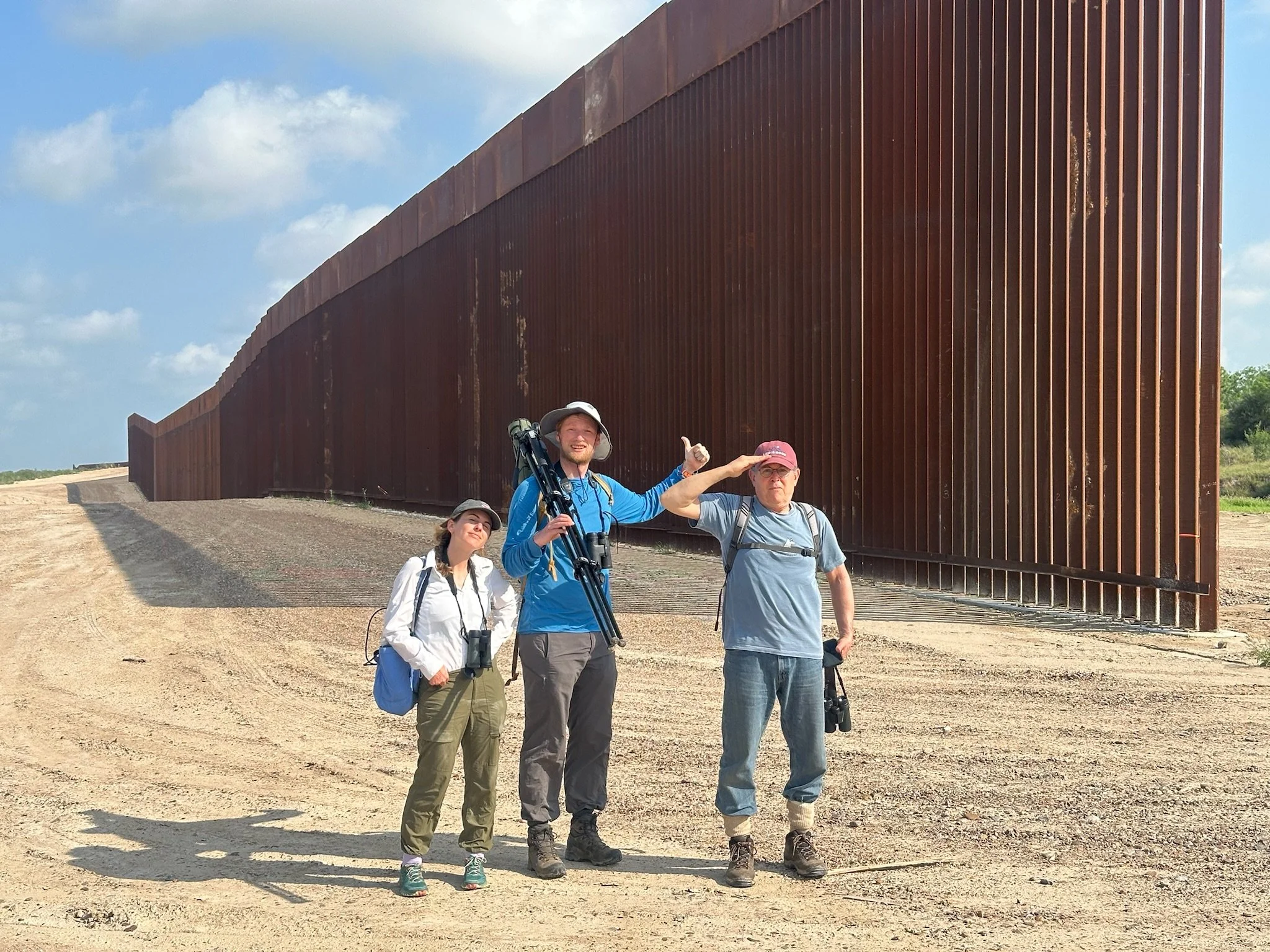
we pulled into a gravel parking lot and hung our binoculars around our necks. As we got out of the car, the morning light spilled over a dense thicket hugging the Rio Grande. We were looking North over the river –The border wall loomed behind us.
It was a lot more rugged than the sanctuary the day before.
And, incredibly, we were not the first ones there.
Jake Glassman: There's already birders.[00:20:30] .
Narration: One thing I’ve learned by this point is that serious birdwatchers have targets.
Sure, they’re on the lookout for anything of interest – but Joe also prepared a shortlist for the day of birds that might be in the area: the red-billed pigeon, Audubon's oriole, the Ringed Kingfisher, the morelet’s seedeater – and if we’re lucky, a Muscovy duck.
First, we have to get in place.
Narration: I couldn’t help but notice the other birders were camped out comfortably in an opening along the shore. Meanwhile…
Michaela Elias: Ugh.
… I was gathering 20 minutes of mic handling noise as we crawled on hands and knees through brush and over slippery rocks to get A slightly more favorable view point.
Michaela Elias: A mosquito breeding fabulous pond.
Jake Glassman: There's more. There's more of a path that goes the river, if we walk up a little bit.
Narration: We forged on until we spotted our first mark.
It looked like any other pigeon you might see – except for its muted coat of reds and blues, and a pinkish beak.
Jake Glassman: Oh wait, hold on.
Michaela Elias: Wanna stop here?
Jake Glassman: Pigeon. It's just sitting. Oh, just sitting there? He's just sitting on top of a dead snag. I think that's the same pigeon.
Joe Hack: Oh, that's great.
Jake Glassman: You see Michaela?
Michaela Elias: Mm-hmm.
Jake Glassman: Dad, do you see him just at the top of the, the dead snag here?
Joel Glassman: Across the way?
Jake Glassman: Across the way. I'm gonna try to lock the scope position.
Narration: Competitive as the boys may be – there’s a generosity about the way a sighting gets passed around, almost like a dish at a big family table.
Jake Glassman: Who wants to [00:23:30] look in the scope?
Joel Glassman: I do. I do.
Jake Glassman: Okay. Dad, why don't you, it's kind of hard for me to hold, so can you see
Joel Glassman: Oh yeah. Yeah. Look at him.
Oh, that's very cool.
Mux - Vessel One, Blue Dot Sessions
Yes I did find it funny to be fawning over a pigeon. But I was beginning to realize that birding is all in the details. A pigeon could be just another pigeon, or I could note the reddish hue, more intricate song, and the fact that it’s in this place, and turn something all too familiar into something of significance.
Jake Glassman: Yeah. Alright, kiddos.
Michaela Elias: We did it.
Jake Glassman: We got one.
Michaela Elias: One down.
Jake Glassman: One down.
Narration: We walked another hundred feet and parked ourselves in a small [00:24:00] clearing about 30 feet above the river.
It was a surreal scene. The ambling river in front of us with the border wall looming at our backs.
It was a reminder that birds pay no mind to the arbitrary lines we draw that determine what lists we add them to or who belongs where.
Save for the chatter of the birds, we stood in silence, and for once, I wasn’t trying to fill it.
It turns out, really looking, something I'm realizing now I don't do much of, requires your full attention.
So the quiet holds until, of course, a bird is spotted.
Joe Hack: Oh, Kingfisher. Kingfisher. Ringed. Oh, ringed.
Mux - Short Circuit, Ryan James Carr
Michaela Elias: So quick.
Jake Glassman: So speedy Oh. Oh, cool.
Narration: And then we're rolling. Target bird after target bird.
Joe Hack: Oh, I see the oriele. I see the oriele. Oh, the Orieles on the, it's on the top of the, lemme put it in the scope.
Yep. You got it.
Jake Glassman: Nice Joe.
Joe Hack: Oh, that's a gorgeous one. [00:25:30] Oh,
Jake Glassman: Joe, you're on your A game today.
Joe Hack: I think it's 'cause I was extra sassy this morning. Yeah.
Narration: Whether it's the sass or the extra cup of coffee or just good birding karma, everyone agrees this morning had a little dose of magic to it.
Joel Glassman: Oh, look at this guy. Wow.
Michaela Elias: I honestly, I was not happy to wake up this morning, but now I'm feeling better about it.
Joe Hack: It's kind of like karma. It's like the karma of birding, you know? It's just like, get up early, you like do something kind of sketchy. Just go where you're probably not supposed to, and then magic happens. Yeah.
Narration: You wake up early, do something kind of sketchy and then the magic happens. That morning we saw the morelet’s seedeater, red-billed pigeon, ringed kingfisher, Audubon's oriole, lifers for all of us.
Mux fades
Five hours later, we made our way back down the goat path, sun-baked and giddy.
Michaela Elias: Does anyone have a favorite river song?
Joe Hack: Old Man River.
Michaela Elias: Shut up.
Joel Glassman: Oh, that's my, yeah. See, I can reach those of them.
Jake Glassman: Sing it dad
Joel Glassman: Oh, don't make me do this. Forget.
Old man river.
Joe Hack: That old man river, [00:27:30] he just keeps rolling. He keeps on rolling.
Joel Glassman: Hey, that was pretty good, huh?
Michaela Elias: That's amazing Joel.
Joel Glassman: Well, I have, I have my range.
Mux - A Little Powder (The Most Minimal Piano) Blue Dot Sessions
This would seem like the perfect outing to wrap up a pretty successful first birding trip. But I had one more stop to make.
The Brownsville landfill.
Joe Hack: We hit this at uh, kind of
Michaela Elias: prime time.
Joe Hack: Prime time.
Michaela Elias: Friday afternoon. People are getting rid of their trash.
Joe Hack: Their trash.
Michaela Elias: You know what more trash means, Joe?
Joe Hack: More birds.
Michaela Elias: Oh yeah. Prime time for us too. Uhhuh
So do you think we are going to see the [00:28:30] Tamaulipas crow?
Joe Hack: I, no, I don't think we will, but I think we will probably see a Chihuahuan raven, which is also a good bird that I have not seen well before. So,
Michaela Elias: so things are looking [00:29:00] good.
Narration: Joe wanted to level-set our expectations. But the same human delusion that makes some people buy lottery tickets every week was making me think this might just be the day.
We hopped out of the car to check in at a booth. The wind was picking up over the landfill, and the attendee there was clearly used to people like us coming by.
Joe Hack: Hi, we're just bird watchers. We're here to, uh, just go in the dump.
Landfill worker: You don't have, uh, reflect vests. Uh,
Joe Hack: no.
Landfill worker: No. Hang on.
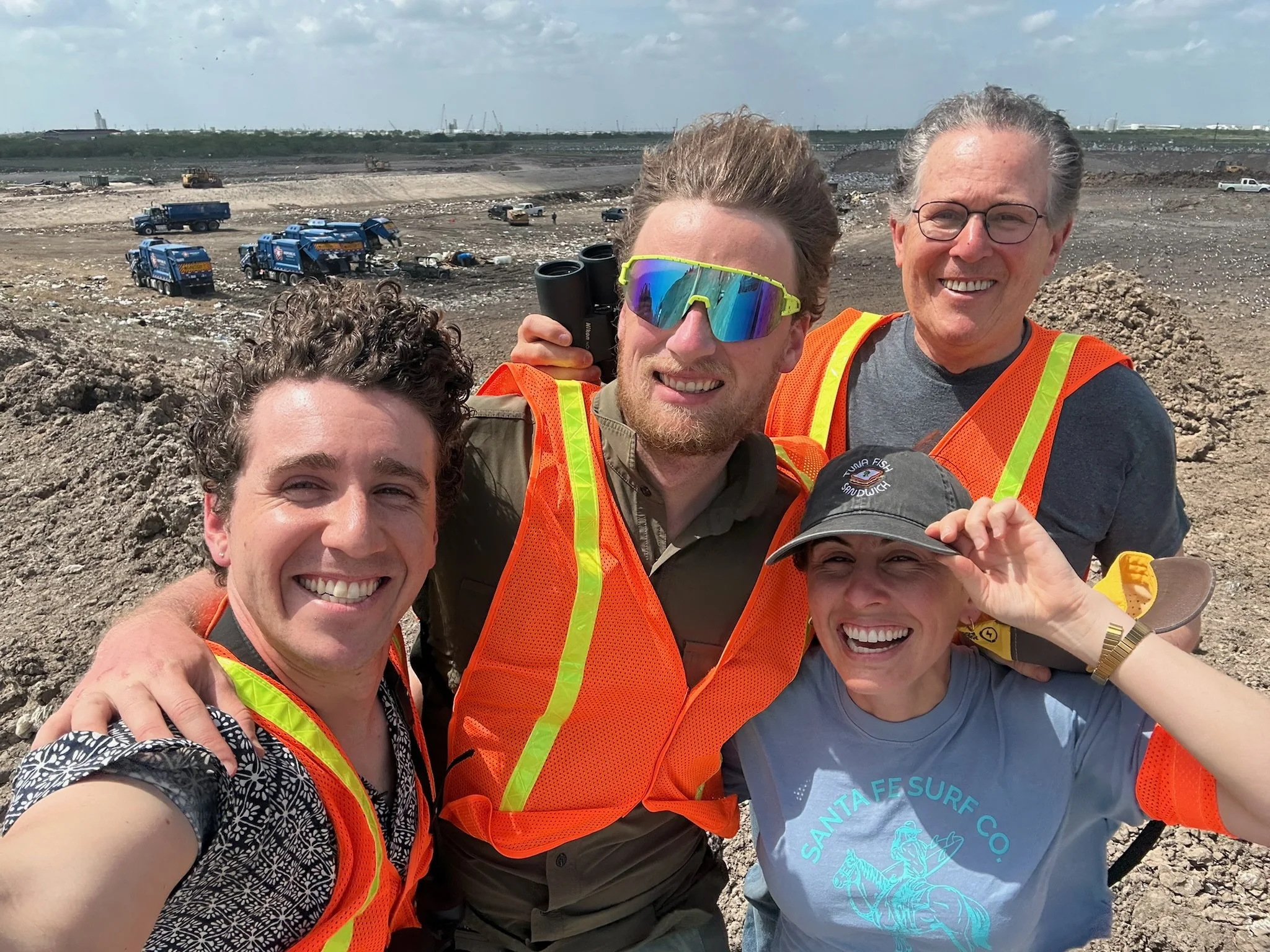
Narration: Clad in [00:29:30] orange vests, we pulled up to where Jake and Joel parked for an initial inspection of the site.
Mux - Paving Stones, Blue Dot Sessions
Michaela Elias: We made it to the landfill. Let's go. .
Narration: Joel had been skeptical about the landfill portion of this journey – but he’s been converted.
Joel Glassman: Um, I, it, this is just too cool.
Michaela Elias: Is it cool? Cooler than you thought? Different than you thought?
Joel Glassman: I, well, thank the lord. It doesn't stink. But, But visually to, to think about birding here is, um. How do I'm speechless?
Michaela Elias: Not something you had on your bingo card for the trip.
Joel Glassman: No, no, but I'm glad that I'm doing it.
Narration: The landfill is huge - about 100 times the size of the sanctuary we visited the day before.
We drive further, windows down, taking it all in.
Joel Glassman: Zillions of birds, tons of trash. And it's actually artistic, [00:31:00] you know? Yeah. If you kind of just look at the trash and the movement of the birds, there's all these colors and there's all this movement, and if you didn't know it was trash, okay.
It could be a picture.
Narration: Birding in a landfill is not so different than birding in a nature preserve. You’re using the same equipment, the same techniques. But you might just use different reference points when describing what you see to your fellow birders.
Joel Glassman: So the Franklins, where do you see?
Where are you seeing the pink.
Joe Hack: Yeah. Um, you see the, you see the [00:31:30] bag of Miracle Grow, Joel?
Joel Glassman: oh, wait a second.
Joe Hack: So find the bag of Miracle Grow.
Joel Glassman: Yes. Yes.
Joe Hack: And then look back and slightly to the left, about like 30 feet maybe.
Narration: After [00:32:00] scanning the landfill for a while we saw no signs of the crow. But we did see the Chihuahuan raven, Jake’s backup bird… and we listened to the manic laughing of the gulls as they waited for their next meal delivery.
And even though we all agreed the visit had still been worthwhile, I couldn’t help but think, without its prized bird, this might just become another landfill we'd rather look away from.
Michaela Elias: I wonder if [00:32:30] their visitation has gone down since the Crow's Not here. Crow's not here.
Joe Hack: Oh, I, I, I'm sure. Yeah. Yeah. I'm sure it has
Jake Glassman: not everyone is as boundlessly optimistic and determined as we are.
Michaela Elias: It's true. It's true.
Jake Glassman: That's okay. Not everyone has to be,
Michaela Elias: I think birding is about being optimistic. I think You can't be, [00:33:00] what do you guys think about this? You can't really be a birder if you're not an optimist.
Joel Glassman: doesn't really serve you to be pessimistic, right?
Michaela Elias: No.
Joel Glassman: You'll never get up at a quarter of five in the morning.
Yeah, if you're pessimistic.
Michaela Elias: For days in a row, and then stay up to midnight.
Narration: The next day, I left Brownsville sans crow but with a number of lifers on my list, a new aptitude for eBird, and a few mental snapshots I keep coming [00:35:00] back to.
Mux - A Little Powder, Blue Dot Sessions
The four of us, necks craned, attention fixed on a palm-sized bird perched in a branch.
Sitting in stillness with old friends as we gazed across a river. Gulls hovering like puppets over the landfill.
Did a weeklong birding trip make me a birder? If anything, this week made me think that's the wrong question altogether. Yes, birding can be the checklists, foot-long cameras, and big floppy hats.
But it’s mostly just a little bit of patience, a fondness for detours, and the belief that any place is worth a second look. Your backyard. A nearby park. Or a local landfill.
I left Jake, Joe, and Joel in Brownsville, but their adventure was not [00:36:00] over yet.
Jake Glassman: so later today we're gonna look for a bird called a cattle tyrant, which is a type of fly catcher that is typically found in South America,
and this bird showed up at some point in Corpus Christi, Texas, right in the middle of downtown… [fades underneath]
Narration: Just when you think you've seen it all.
[mux, into credits]
Nate Hegyi: That’s it for today. This episode was reported and produced by Michaela Elias.
It was edited and mixed by our executive producer, Taylor Quimby, with help from Felix Poon, and NHPR’s Director of On-Demand, Rebecca Lavoie.
Our staff also includes Marina Henke, Justine Paradis, and Jessica Hunt.
Special thanks TO THE OTHER FOLKS YOU HEARD THROUGHOUT THE EPISODE: Joe Hack, Jake Glassman, Joel Glassman, Loden Henning, Jose Maldonado and the rest of the team at the Brownsville Landfill, Nathan Burkhart and all the organizers and guides with the Brownsville Birding Festival
Music by Blue Dot Sessions.
Outside/In is a production of New Hampshire Public Radio.