Did #savethebees get it wrong?
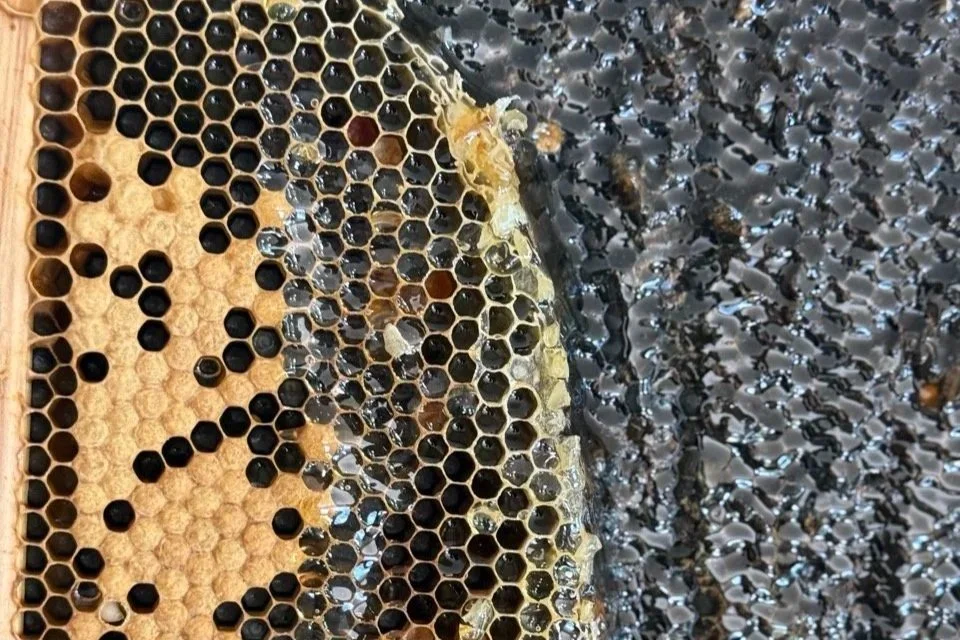
Credit: Corner Shop Communications for The Biodiversity Lab
Noah Wilson-Rich has made it his mission to save the bees — from colony collapse disorder, loss of habitat, and disease. He’s doing this not just as a scientist, but also as an entrepreneur.
But is that a good thing?
And what happens when you think you know the answer to a solution, only to realize that you got it wrong? “The ‘save the bees’ movement is canceled,” he says. But what should we do in its place?
Featuring Noah Wilson-Rich, and Lauren Ponisio.


ADDITIONAL MATERIALS
Credit: Felix Poon
Check out Noah Wilson-Rich’s Ted X Talks:
SUPPORT
To share your questions and feedback with Outside/In, call the show’s hotline and leave us a voicemail. The number is 1-844-GO-OTTER. No question is too serious or too silly.
Outside/In is made possible with listener support. Click here to join our Patreon and get ad-free episodes of the podcast.
Follow Outside/In on Instagram, TikTok, or join our private discussion group on Facebook.
Credit: Felix Poon
CREDITS
Host: Nate Hegyi
Reported, produced, and mixed by Felix Poon
Editing by Katie Colaneri and Taylor Quimby
Our staff also includes Marina Henke, Justine Paradis, and Jessica Hunt
Taylor Quimby is NHPR’s Director of Podcasts
Music by Bluedot Sessions, Walt Adams, Jules Gaia, and Vicki Vox
Outside/In is a production of New Hampshire Public Radio
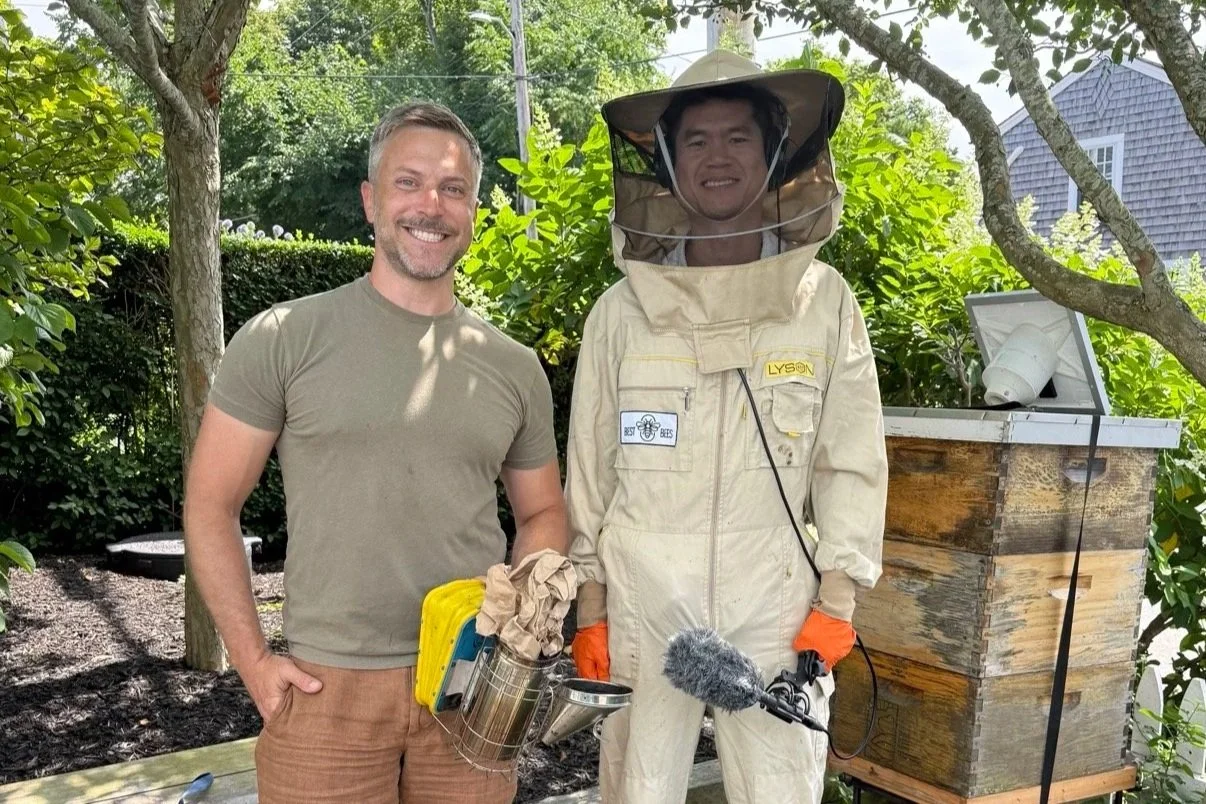
Producer Felix Poon poses in a bee suit with scientist, entrepreneur, beekeeper Noah Wilson-Rich. (Credit: Corner Shop Communications for The Biodiversity Lab)
Audio Transcript
Note: Episodes of Outside/In are made as pieces of audio, and some context and nuance may be lost on the page. Transcripts are generated using a combination of speech recognition software and human transcribers, and may contain errors.
Noah Wilson-Rich: My name is Noah Wilson-rich, and I am a scientist. I can start that again.
Felix Poon: That's great. You can do it again.
Noah Wilson-Rich: Well, I don't wait, Rekha. How should I describe what I do?
[MUX IN: Calisson by Blue Dot Sessions]
Nate Hegyi: From NHPR this is Outside/In, a show where curiosity and the natural world collide. I’m your host Nate Hegyi. And this is Noah Wilson-Rich, asking his PR person how he should introduce himself.
Noah Wilson-Rich: What do I do? Scientist? Serial entrepreneur? Beekeeper?
Actually, why don’t we go back to the beginning of Noah’s story – and you’ll see why it’s so hard to put a label on him.
It’s 2009, Noah’s finishing his PhD in biology at Tufts University near Boston, where he studies honey bees and their immune systems.
And it’s the perfect time to be studying that. Because honey bees are mysteriously disappearing……a phenomenon called Colony Collapse Disorder.
News Clip: (news jingle) Federal government is on a mission to save honeybees…
News Clip: … they’re dying off in large numbers, their colonies collapsing.
But something else… is also collapsing at this time. The economy.
News Clip: The Dow tumbled more than 500 points, after two pillars of the street tumbled over the weekend. Lehman Brothers, a 158-year-old firm, filed for bankruptcy.
It's one year into the great recession… and bee research jobs are few and far between.
Noah Wilson-Rich: It was a tough time to find a job, and yet I needed to move on with my career. I couldn't stay in school forever, and so I started to get creative and think about, well, what other ways can I make money?
Nate Hegyi: What he really wants is a research job - but instead, he’s stuck bartending at a restaurant in the lobby of a business school.
Noah Wilson-Rich: and I was overhearing their conversations. And I heard about a competition down the street at MIT called the $100,000 Entrepreneurship Competition.
Nate Hegyi: Noah isn’t in the running for the $100,000 grand prize. But he does participate in the “pitch contest” portion of the event, where the winner only gets $5 thousand dollars. And all you have to do is make a 60 second elevator pitch.
So Noah gives it a shot.
MIT $100K: Ready? Set? Pitch!
Noah Wilson-Rich: Hi my name is Noah Wilson-Rich I’m finishing up my PhD and….
Noah’s pitch is pretty simple:
Noah Wilson-Rich: Vaccines for honeybees. Now in 2006, I started… [fade out]
He figures, so many businesses rely on bees to pollinate crops. A vaccine to help stop colony collapse disorder could save the bees, and make some money.
And when it’s time to give out the awards?
He wins second place, and $2,000.
[MUX IN: Pembroke Pines by Walt Adams]
<<NUTGRAPH>>
Nate Hegyi: That was 16 years ago. Today, Noah Wilson-Rich is still good at making his pitch to save the bees.
Noah Wilson-Rich: My goal was, if I can get 20 beehives at $1,000 a year, then I could start a good research operation.
He’s started bee businesses, done bee vaccine research and development, and has given bee TED X talks – Not just as a scientist, but also as a serial entrepreneur.
But actually saving the bees? Turns out, it’s a lot more complicated.
Tedx Clip: The number of beehives in the United States reached an all time high. So mission accomplished, right?
Tedx Clip: Wrong.
Stay with us.
<<FIRST HALF>>
Felix Poon: From NHPR this is Outside/In, a show where curiosity and the natural world collide. I’m Felix Poon.
In 2010 Noah Wilson-Rich needed a way to fund his bee research, so that’s why he started his new business, The Best Bees Company.
Noah Wilson-Rich: I was selling beehives on Facebook, and I said, I put up a page, I said, I am selling beehives. I’ll manage them at your home garden, your business rooftop. Does any body want some bees?
When Noah sold his hives he didn’t just drop them off and never come back. For a fee Noah was also their beekeeper. He’d harvest the honey for them, and in return he got research data.
Noah Wilson-Rich: You keep the honey. I keep the data.
Noah was living in a small apartment in Boston at the time. And like a lot of small businesses getting their start online, things…were pretty scrappy.
Noah Wilson-Rich: I didn't have a yard, a deck.
and I thought, how am I going to keep a research lab going when I don't have anywhere to put beehives?
I would temporarily house boxes of bees in our apartment, in our bathtub
[MUX IN: Dusting by Blue Dot Sessions]
And I had a roommate at the time and God bless Ian. Shout out to Ian because he would cry sometimes. Not to blow up his spot, but he'd be like, you can't do this. You're driving me insane. You can't have thousands and thousands of stinging insects in our apartment. It's not cool.
The other thing Noah didn’t have…was a car to deliver beehives to customers.
Noah Wilson-Rich: I was taking the city bus around… and I was bringing boxes of live bees on public transit under a cloth.
Felix Poon: Like Mbta buses and the T?
Noah Wilson-Rich: Yeah, literally like under a sheet, just a box of 10,000 stinging insects, which were fine. It was totally safe, like we experienced at beekeeping.
Felix Poon: Most of Noah’s customers were backyard hobbyists in the beginning.
[MUX OUT]
And then he started working with commercial buildings and luxury hotels. He appealed to their corporate sustainability goals, and installed hives on their rooftops.
Business was booming
And it was this hockey stick growth of, oh my gosh, what am I doing? This is a lot.
Eventually Noah started renting cars to sell beehives outside the city. And that’s when he started to notice a surprising thing with all these beehives he was managing. Something that might just help save the bees from a growing trend of diseases and low winter survival rates.
He talked about it at a 2012 Ted X Talk.
TedX Clip [04:20]: There’s a counterintuitive trend we noticed in these numbers.
TedX Clip [04:39]: Overwintering success is hard and that is when most of the colonies are lost. And we found that in the cities, bees are surviving better than they are in the country.
A bit counterintuitive right? We think bees, countryside, agriculture. But that's not what the bees are showing. The bees like it in the city.
[MUX IN: Urban Conspiracy by Jules Gaia]
honey bees had been in trouble - with high rates of hive losses - for a couple decades already. Scientists blamed three main suspects as to why: pesticides, disease, and habitat loss….
So Noah looked at each one of these to see if he could explain why his urban beehives were doing better than his beehives in the country.
Could it be.. there were lower levels of pesticides?
He partnered with Harvard to sample pesticide levels throughout Massachusetts.
And he found that there were not lower levels of pesticides in cities compared to rural areas. Statistically they had similar levels. So there goes that hypothesis.
What about diseases? Noah looked at The Best Bees Company’s data.
Noah Wilson-Rich: we found that beehives all around Massachusetts had equal levels of disease, specifically this varroa mite.
(The varroa mite, by the way, carries a lot of nasty bee diseases…they’re like the ticks of the bee world.) Point being: The disease hypothesis wasn’t likely either.
So then Noah looked at habitat loss. Now, habitat isn’t just a place for hives to exist. It’s also the flowers that feed bees, and give them the nectar they use to make honey.
Noah wasn’t sure how to test this at first. But then an idea struck as he was talking to a colleague.
[MUX OUT]
Tedx Clip: And we thought about genomics. Kind of like AncestryDNA or 23and Me, have you done these?
Felix Poon: This is from another Ted X Talk Noah gave in 2018.
You know, you spit in a tube and you find out, “I’m German!”
Well we developed this for honey. Right? So we have a sample of honey and we look at all the plant DNA and we find out, “I’m sumac!”
…turns out, when it comes to the habitat hypothesis, it isn’t so much what’s in the honey – but how diverse is it.
Noah measured the number of plant species found in suburban, rural, and urban honey from The Best Bees Company’s hives across the country (since they had gone national by then.)
And he says he found his suburban honey samples only averaged about 100 plants per sample, the rural ones had more, about a hundred fifty. But the urban honey had about 200 plants per sample.
The contrast in Boston was even greater. A sample of Bostonian honey had 8 times the number of plants than a sample honey from one of its suburbs.
Noah thinks the reason for the disparity boils down to landscaping.
Thinking about cities that might have a lot of weeds, community gardens, um, other just plants that are misplaced or things we wouldn't expect for them to be there versus lawns in suburbs or monoculture crops and farmland.
And Noah’s not the only researcher to have found this link between plant diversity and bee health.
More types of flowers means more vitamins and minerals – the bee version of a balanced healthy diet. And that healthier diet seems to help more bees survive the winter.
There are a few take-aways from this data. For one, we could stand to plant more flowers instead of grass in the suburbs to support bee populations there.
Noah’s main take away though, was different.
He wanted to focus on boosting the number of urban hives.
Basically, to make cities into honeybee breeding centers.
Noah Wilson-Rich: let's start to source bees in the city, and then we'll replace them in sink populations in the countryside where they're doing really poorly. So we'll start moving urban bees, where we're breeding them now into the countryside to replace those dead beehives.
Noah’s efforts were part of a larger movement. It included agricultural scientists, commercial beekeepers, and a growing number of hobbyist beekeepers…all rallying around the hashtag “save the bees.”
[MUX IN]
They were all responding to something called "colony collapse disorder."
In the 2000s… scientists and beekeepers started noticing worker bees just leaving their hives en masse and never coming back.
We still don’t know exactly why this was happening, but researchers and commercial beekeepers reacted by developing new ways to manage specific diseases, and the EPA began restricting harmful pesticides they thought might be contributing to the problem.
Over the years, honey bees stopped mysteriously disappearing. Eventually, they bounced back with the number of beehives in the US reportedly reaching an all-time high in 2022.
By these measures, the “save the bees” movement was a resounding success.
Tedx Clip: So, mission accomplished…right?
Tedx Clip: Wrong. We caused an ecological disaster. And we lit the fuse on a $577 billion dollar ecological time bomb.
The problem with too many honey bees…. That’s after a break.
<<MIDROLL>>
Felix Poon: From NHPR this is Outside/In, a show where curiosity and the natural world collide. I’m Felix Poon.
We’re gonna come back to Noah Wilson-Rich and what the Save the Bees movement got wrong.
But first, let’s talk about bees.
[MUX IN: Trusty by Blue Dot Sessions]
Now a lot of times people will say “bees” and really mean “honey bees”, as if there are no other types of bees out there.
But there are over 20 thousand species of bees, globally. The Western Honey bee - the one at the center of the #savethebees movement – is just one.
Western honey bees became the de facto “bee” because most other bees don’t produce harvestable honey. And with few exceptions, the honey bee has come to dominate honey production the world over.
Plus, honeybees are hugely important to our agricultural system.
Take almonds for example. In February, thousands of semi-trucks from across the US descend on California with 2 MILLION beehives to pollinate almond trees. (That’s nearly 80% of all managed honey bee hives in the entire United States, by the way. The event is called The Superbowl of Beekeeping).
Come spring the bee trucks might go north for the fruit and berry blossoms. And in summer: the midwest and the south to pollinate canola, melons, cucumbers.
Without those honey bees, our food system as we know it would collapse.
So what about all of those OTHER species of bees? We call those “Native bees,” and they can’t be used in the same way for industrial agriculture. That’s because most native bees don’t live in colonies. They live by themselves in underground burrows or hollow twigs, not in hives that you can just pick up and put on a truck.
They’re basically wild bees, as opposed to honeybees, which are technically managed livestock that were originally brought over from Europe by colonial settlers.
[MUX SWELL AND OUT]
This doesn’t mean native bees aren’t good pollinators though.
Lauren Ponisio: You know Native bees do do really effective pollination
This is Lauren Ponisio, a native bee researcher at the University of Oregon, who I interviewed for another story last year.
and also often pollinate crops better than honeybees, particularly native North American species like blueberries, cranberries.
and even on industrial farms studies have found that native bees can help the honeybees.
Lauren Ponisio: so honeybees are actually more efficient pollinators often when, when native bees are around.
And animals benefit from them too – birds, bears, deer – they all depend on wild plants pollinated by native bees.
All this to say: native bees are just as essential as honeybees are.
And they’re in trouble too - in many cases more so than honeybees are.
Several native species are in danger of going extinct, and some we might not even know about may have already been lost.
But most researchers, beekeepers, much of the #savethebees movement – they were focused on one species of bee: The Western honeybee. … And that includes Noah.
He says he prioritized honey bees because he saw them as an indicator species.
In theory, if an indicator species is doing well in an area, then other species in that area should be doing well too.
Noah Wilson-Rich: And so if we focus on the indicator species, then everything else will fall in place. Around 2018, we started to see data coming out that said, uh oh, there's perhaps too many honeybees in areas. And that's causing negative impacts on other species.
Noah Wilson-Rich: And that started to shed some warning lights around 2018, 2019, 2020 of maybe the Save the Bees movement got it wrong.
[MUX IN: Urban Conspiracy by Jules Gaia]
Honey bees consume a ton of nectar and pollen, and some studies were showing that when there’s a lot of them, they don’t leave much for native bees.
Plus the other problem with having too many honey bees around is basically a lack of social distancing and the spread of diseases.
Bees can get diarrhea when they’re sick, and…not to gross you out, but they can end up leaving bee poop on flowers. As Lauren Ponisio put it, flowers are like the “bathroom doorknobs” of the bee world. And these doorknobs aren’t just infecting other honey bees, they’re infecting native bees too.
[MUX SWELL AND OUT]
Felix Poon: So, Noah realized he was acting from a flawed premise. This idea of cultivating honeybee hives in the city and exporting them to rural towns and suburbs to boost their numbers there – that might have done more harm than good to native bees.
Something had to change.
Noah Wilson-Rich: like, okay, we need to potentially shift away from honey bees and beekeeping. What is a beekeeping company look like without beekeeping? Right? This audacious big question that I loved, you know, I think that this is so cool. How do we shift our perspective?
Felix Poon: But what about all the beehives that were already out there that the company manages? Like you, you, you, you're not suggesting that you take them back, did you?
Noah Wilson-Rich: Everything was on the table for sure.
Felix Poon: But did that happen?
Noah Wilson-Rich: That did not happen. No,
Felix Poon: That didn’t happen because they couldn’t take them back. The hives belonged to the clients, not the Best Bees Company.
So…then what?
Well it may not surprise you that Noah, ever the optimist, saw this less as a failure… and more as an opportunity.
And he promoted it – of course – in another TED X talk.
[Clapping]
Tedx Clip: I’m gonna tell you something that is gonna sting. I have killed bees. Not intentionally. But I did.
This is from a Ted X Talk Noah gave in 2025. He starts with a mea (MAY-uh) culpa (KUL-puh). But then he pivots into a new idea.
The #savethebees movement is cancelled.
[MUX IN: Some Kind of Friend by Vicki Vox]
We’re replacing it, we’re advancing it, with what I call the biodiversity blueprint. Here’s the thesis. We need measurable data and tech-driven biodiversity action at scale.
Not just for the environment. But for your bottom line if you are a business, and for your community health and wellness as an individual person.
Felix Poon: In 2025, Noah left the Best Bees Company, the business that he started all those years ago from his cramped city apartment… Though they are still selling beehives in major cities across the US.
These days, most of Noah’s focus is on a new consulting company he started, The Biodiversity Lab. Because for Noah, it’s not just about saving a single species anymore. It’s about the biodiversity of a place
Because to Noah-the-scientist, biodiversity is valuable in and of itself, but to Noah-the-serial entrepreneur, it’s also valuable to businesses with corporate sustainability goals.
But only if you can measure it.
Noah Wilson-Rich: Biodiversity Net Gain. It's something that the UK government put forth for real estate developers a few years ago,
In the UK, for example, a recent bill requires developers to leave the natural habitat of any site they develop in a better state than before construction.
Noah Wilson-Rich: they have to increase biodiversity on their site by 10% over 30 years. So many business folks were like, what do I do? How do we do that?
Noah wants to bring this biodiversity net gain idea to the US – to help developers here improve the land they develop.
The idea is he’d come in and be like, okay, I can help you measure biodiversity – test the DNA of honey and soil to tell you what plants are in the area, and use acoustic sensors to tell you what animals are there.
And then that data would tell you, like, you need to put these plants and flowers on your roofs and walls, and you need to create more nesting habitat for birds and bats and bees. And then we’ll measure it again and hopefully demonstrate that you’re actually leaving the natural habitat better than before construction.
This is something he thinks EVERYBODY should be doing… He even mentions a group that’s proposing pollinator programs around data centers.
Noah Wilson-Rich: there's a program called DCS for bees. To flip the script and make this industry go from something that's seen as an environmental disaster to an environmental leader
[MUX SWELL AND OUT]
But is it “flipping the script?” Or is it green-washing?
Honestly? Maybe a little hard to tell.
On the one hand, the group that came up with that program - “DCs for bees?” it’s an industry lobbying group that’s advocating for data center construction in Ireland.
That does seem like it is greenwashing.
But, on the other hand, when research first came out that too many honey bees in an area might hurt biodiversity, Noah says companies asked him to give a talk debunking the new data.
Noah Wilson-Rich: say don't believe, don't look over here. Keep doing the urban beekeeping, keep doing this stuff.
Felix Poon: Because they get to promote themselves as like, we're green. We have sustainability initiatives.
Noah Wilson-Rich: Yeah, let's keep using the save the bees hashtag, for today’s benefit, perhaps in a marketing gain for a business or getting more investors or, you know, helping our top and bottom lines.
Felix Poon: But Noah wouldn’t do it.
Noah Wilson-Rich: my training, first and foremost, has always been as a scientist to reveal the underlying truth in a situation.
Noah is a scientist.
But he doesn’t talk like most scientists do… remember this line from his 2025 Ted X Talk?
We caused an ecological disaster. And we lit the fuse on a $577 billion dollar ecological time bomb.
Felix Poon: If you didn’t know any better you’d think our global food systems were on the verge of collapsing, all because of urban beekeeping. But that’s just not the case.
When I talked to bee biologist Lauren Ponisio last year, she said “honeybees are not in any danger of extinction, and never have been.” That’s because, like I said, honeybees are managed livestock. Lost hives just get replaced with new ones.
And, the jury’s still out on one of Noah’s other main points: that an abundance of honey bees are bad for native bees.
Sure, there are troubling signs… but some researchers say we simply don’t have enough real-world data yet.
“More research is needed,” as the old scientific adage goes.
Noah’s less careful with his words though. Quite the opposite in fact. It feels like every time I watch a Ted Talk he gives, I can’t help but feel like he’s trying to sell me a problem… and sell me the solution.
So…I ask him about that.
Felix Poon: you come across as very entrepreneurial. Like here's the answer. Urban bees, that's the answer to this problem. And I'm promoting this. And then, uh, lately with the biodiversity blueprint, it's like this. This is the answer. And it almost feels a little bit like deja vu. It’s like, oh, you have the answer again, great let’s follow you. But wait. what if you're wrong? What if this isn’t the way forward. Is entrepreneurship compromising the ability to be a scientist and understand, and learn about just bees and biodiversity?
Noah Wilson-Rich: So there is a really inspiring speaker. Um, author. Her name is Ayana Elizabeth Johnson. and her brand of what if we get it right? Right.
Back in my graduate school and undergrad days, I was so frustrated that this was really hard work. Years of trying to vaccinate bees, you know day and night, I've published over 20 academic papers, written a book. What if nobody reads this? What is it all for?
[MUX IN: Honey and Mud by Blue Dot Sessions]
Felix Poon: Noah’s flipping the question on its head. Instead of whether or not being an entrepreneur compromises the academic rigor of his science, to him the question is whether choosing to be an academic would have compromised his ability to change the world.
That gave me a fire. It lit my pilot light to shift from academia to entrepreneurship, to guide collective environmental action, to say, yeah, what if we get it wrong? But what if we get it right?
[MUX SWELL AND OUT]
Noah Wilson-Rich: This is our beehive. And uh, it is positioned under this beautiful tree.
Noah doesn’t live in the city of Boston anymore. I met up with him at his home in Provincetown, or PTown as it's affectionately called…at the very tip of Cape Cod.
His beehive here is a pretty standard size: 3 milk crate-sized wooden boxes stacked one on top of the other.
On top of the stack is a solar-powered bioacoustic device that sits on top of it.
Noah Wilson-Rich: and we're identifying how many different species of birds, bats, bees and beyond are in our habitat.
And then hanging from a tree branch above the hive is a “bee hotel”. It’s basically a small plastic box with a bunch of hollow bamboo stalks for native bees to nest inside.
Noah Wilson-Rich: Sometimes it could be a blue orchard bee, which is a native species, or a leafcutter bee, which is not native, but a good pollinator.
Noah’s come a long way from his scrappy bathtub beehive days. He’s got a more complex setup now – with his native bees hotel, and bioacoustic sensors.
Noah Wilson-Rich: As I'm lifting this, it's already really heavy and it's covered in honey.
And Noah is optimistic as ever…it’s like he’s still doing the elevator pitch contest on how to save the bees, and how to save the planet.
This is amazing. Whoa! It's gonna be so much heavier than you think. I have a bee up my nose. No, it's all good. I got it. Yep.
For him, every setback is another opportunity. Even when it stings.
Felix Poon: Does that hurt?
Noah Wilson-Rich: It was a sensitive spot. Yeah. Yeah I did. My my eyes were tearing up. Yeah, but I'm good. I don't even feel it anymore. Yeah.
Felix Poon: I think the, um. I think the stinger is actually still on your nose.
Noah Wilson-Rich: Really?
Felix Poon: Yeah.
Noah Wilson-Rich: Well, maybe. Okay, when we go inside, you can.
[MUX IN: Things to Sort Out by Walt Adams]
Nate Hegyi: If you want to see pictures of Felix’s visit to Noah’s beehive, be sure to go to outsideinradio.org.
There you’ll see Felix in a bee suit. A video of Noah talking lovingly about his bees. And him scraping honey off a beehive frame. Very satisfying
Nate Hegyi: And if you're interested in supporting the show and getting ad-free episodes of Outside/In, head on over to Patreon.com/outsideinradio. That link is also in the show notes.
[FOR BROADCAST]
And remember, we are a podcast! If you wanna hear more check us out wherever you get yours. Just search Outside SLASH In.
<<CREDITS>>
Nate Hegyi: This episode was reported, produced, and mixed by beekeeper extraordinaire Felix Poon.
It was edited by queen bees Katie Colaneri and Taylor Quimby.
I’m your honeybee host Nate Hegyi. Taylor Quimby is Director of Podcasts.
Our team also includes Justine bumble bee Paradis, Marina mason bee Henke, and Jessica leaf cutter bee Hunt.
[FOR BROADCAST]
Nate Hegyi: This episode was reported, produced, and mixed by Felix Poon.
It was edited by Katie Colaneri and Taylor Quimby.
I’m your host Nate Hegyi. Taylor Quimby is Director of Podcasts.
Our team also includes Justine Paradis, Marina Henke, and Jessica Hunt.
Felix Poon: Special thanks to Deputy Sheriff Rowdy Freeman for talking to me about beehive thefts, and Thyra (TEE-ruh) McKelvie from the company Rent Mason Bees for talking to me about mason bees.
Nate Hegyi: Music in this episode was by Blue Dot Sessions, Walt Adams, Jules Gaia, and Vicki Vox.
Outside/In is a production of New Hampshire Public Radio.