Silicon Planet
Like a typecast actor who can’t escape the blockbuster franchise they’re known for, the element of silicon is inescapably associated with Silicon Valley. But that association undersells just how important, how foundational silicon is for human civilization.
It’s another edition of “The Element of Surprise,” our occasional series about the hidden stories behind the periodic table’s most unassuming atoms, isotopes, and molecules. And this time, it’s all about silicon.
From humankind’s early tools, to the quartz crystal hidden in your digital watch, we’ll cover how this underrated element has a lot more to offer than one California valley might suggest.
Featuring Vince Beiser, Megan Brewster, and Rachel Maines. “Ripped” logo photo credit:


ADDITIONAL MATERIALS
Still confused about the difference between silicon, silica, and silicone? We think this explanation is helpful.
See the inside of a silicon wafer fab. It’s wild.
Or watch this old video on how silicon wafers are made. Also wild.
If you are very into watches, you might enjoy this detailed history of how the “Quartz Crisis” upended the Swiss watch industry.
Want to learn more about the environmental impacts of sand mining? Check out this 2019 UNEP report.
SUPPORT
To share your questions and feedback with Outside/In, call the show’s hotline and leave us a voicemail. The number is 1-844-GO-OTTER. No question is too serious or too silly.
Outside/In is made possible with listener support. Click here to become a sustaining member of Outside/In.
Follow Outside/In on Instagram or join our private discussion group on Facebook.
CREDITS
Host: Nate Hegyi
Reported and produced by Taylor Quimby
Mixed by Taylor Quimby
Editing by Marina Henke and Rebecca Lavoie
Our staff includes Marina Henke, Felix Poon, Jessica Hunt, and Justine Paradis
Executive producer: Taylor Quimby
Rebecca Lavoie is NHPR’s Director of On-Demand Audio
Music by Blue Dot Sessions and Ryan James Carr
Our theme music is by Breakmaster Cylinder.
Outside/In is a production of New Hampshire Public Radio
Audio Transcript
Note: Episodes of Outside/In are made as pieces of audio, and some context and nuance may be lost on the page. Transcripts are generated using a combination of speech recognition software and human transcribers, and may contain errors.
Nate Hegyi: From NHPR. This is Outside/In, a show where curiosity and the natural world collide. I'm your host, Nate Hegyi, here with producer extraordinaire Taylor Quimby.
Taylor Quimby: All right, Nate, I want to play a little word association game. Okay?
Nate Hegyi: Okay.
Taylor Quimby: I'm going to name an element from the periodic table. And I want you to blurt out like, the first word that comes to mind. Ready?
Nate Hegyi: Yes.
MUX IN: Craz - Blue Dot Sessions
Taylor Quimby: Oxygen.
Nate Hegyi: Uh, air. Life.
Taylor Quimby: Carbon.
Nate Hegyi: Life again.
Taylor Quimby: Silicon.
Nate Hegyi: Bill Gates.
Taylor Quimby: Bill Gates. So you hear silicon, and you’re thinking Silicon Valley – am I right, Nate?
Nate Hegyi: Yeah, exactly. Computers.
News montage clip 1: I'm here in Silicon Valley this week. The talk is…[cross fades]
News montage clip 2: …Silicon Valley index comes out of… [cross-fades]
News montage clip 3: …The Silicon Valley guys do not, you know, a lot of times…. [cross-fades]
MUX OUT
Taylor Quimby: Well, well well. Nate Hegyi, you fell right into my trap.
Nate Hegyi: I did.
Taylor Quimby: So yes, silicon is rightly associated with the tech industry because all the chips that power our phones and computers are indeed made of silicon.
Nate Hegyi: Yes.
Taylor Quimby: But here is my beef; these other elements, they get major league science cred. You know, you heard oxygen and carbon and you were thinking about big thoughts… chemistry, you know, the earth, the universe.
Clip from The Hitchhiker's Guide to the Galaxy: “Life, the universe and everything…”
Nate Hegyi: Yeah.
Taylor Quimby: Silicon gets so tied to Silicon Valley... It's like a talented actor that got cast in one big budget franchise and cannot escape the association.
Nate Hegyi: It's the Tom Holland of elements.
Taylor Quimby: Yeah. It would be like if your first thought when I mentioned oxygen was Oprah and the Oxygen Network.
Nate Hegyi: Exactly. [laughs]
MUX IN - Patina, Ryan James Carr
Taylor Quimby: And I am here to correct the record because silicon is just as cool and just as essential as those other things.
[sound of Oprah saying “You get a car! You get a car!]
MUX SWELLS
Nate Hegyi: This is Outside/In, a show where curiosity and the natural world collide. I'm Nate Hegyi here with producer Taylor Quimby.
Taylor Quimby: And if you could not already tell, we have got another edition of The Element of Surprise.
Nate Hegyi: This is our occasional series about the hidden stories behind the periodic tables, most unassuming atoms, isotopes and molecules.
Taylor Quimby: And today we are telling you all about the sovereign of semiconductors, the headliner of the hard Rock cafe. Technically a metalloid, but I think it's pretty metal… Silicon.
Vince Beiser: It’s absolutely crucial to modern civilization.
Nate Hegyi: Plus, Taylor gets a little bit into the yin and yang of chemistry.
Rachel Maines: Why do we use it? Because it's a fuel. Why is it dangerous? Because it's a fuel.
Nate Hegyi: Stick around.
MUX OUT
[break]
From NHPR. This is Outside/In, I am Nate Hegyi here with producer slash middle school science teacher impersonator, Taylor Quimby.
Taylor Quimby: I'm not wearing my elbow patch coat.
Nate Hegyi: Ooh, I like that. I know, I would love to have one of those.
Taylor Quimby: Okay. Um, so one reason I think silicon is so underrated, Nate, is that it is often sharing the molecular stage, so to speak.
Nate Heygi: Yeah.
Taylor Quimby: And what I mean is that in the natural world, silicon is not a solo act in nature. You usually find it very tightly bonded to atoms of oxygen. But together, these two are pretty much the world's greatest rock supergroup.
Nate Hegyi: Okay.
Taylor Quimby: They have been topping the geologic charts for billions of years, and you've definitely heard of them. They are called quartz.
MUX IN - Trusty, Blue Dot Sessions
Nate Hegyi: Quartz is silicon?
Taylor Quimby: Silicon and oxygen. Get it? “Rock duo?” “Topping the geologic charts?”
Nate Hegyi: That's cute. Taylor. That's very cute.
MUX SWELL
Taylor Quimby: Yeah. So the chemical formula for quartz is just SiO2, one atom of silicon and two of oxygen. And more than 10% of the entire Earth's crust is actually made out of quartz. Were you into, like, semi polished stones?
Nate Hegyi: Oh, yeah. I think every kid goes into like a little bit of a semi polished stone, uh, phase.
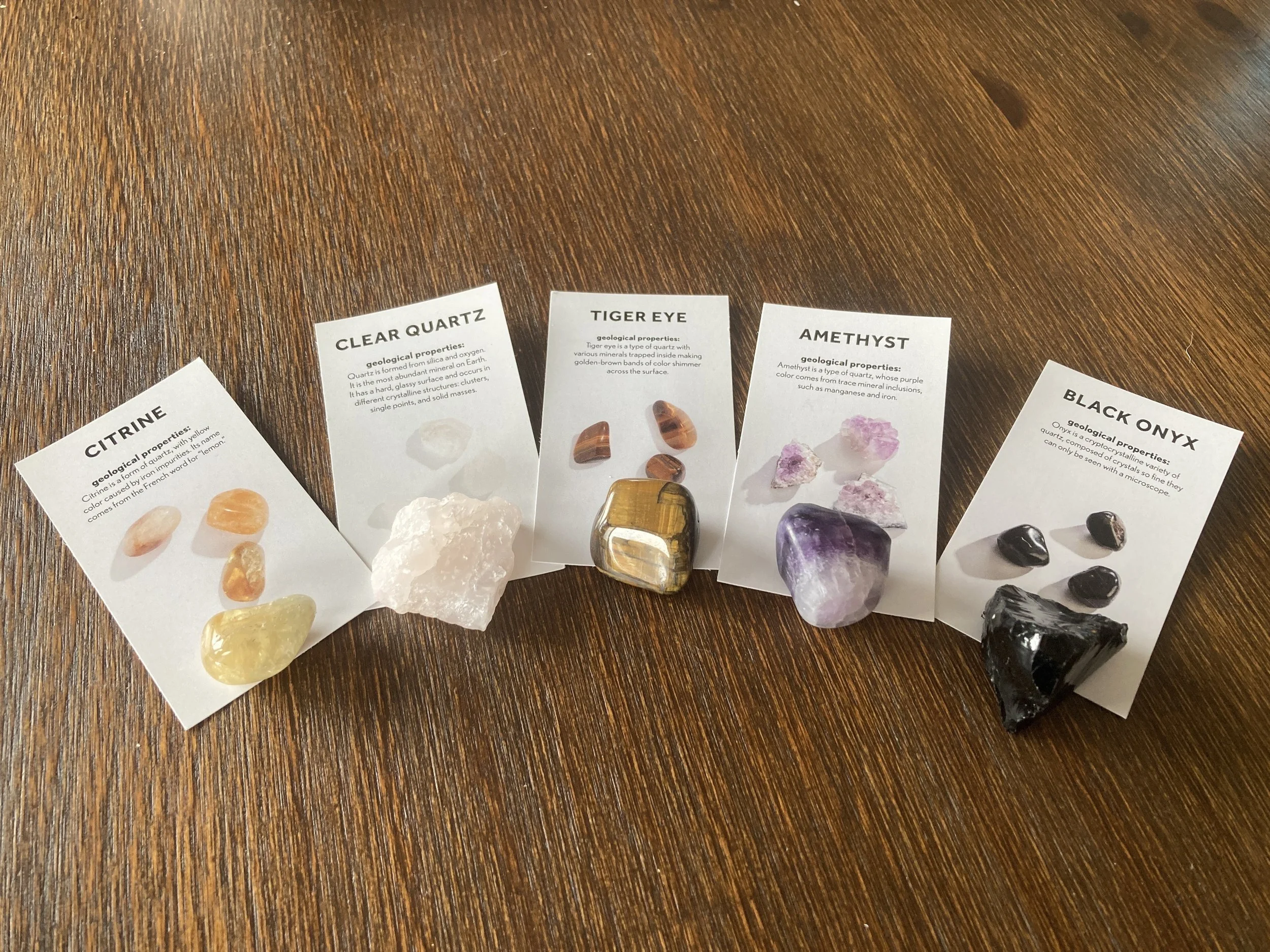
Taylor Quimby: Jasper, tiger's eye (which I thought was super cool)...
Nate Hegyi: Oh yeah.
Taylor Quimby: Amethyst.
Nate Hegyi: Yeah.
Taylor Quimby: These are all just different forms of quartz, also just silicon and oxygen – with, in some cases, some other trace elements thrown in for flair.
Nate Hegyi: So silicon and oxygen, it's kind of like the Hall & Oates of the rock world.
Taylor Quimby: Yes. [laughs]
Nate Hegyi: Some of your favorite songs, you don't really realize, oh, Hall and Oates wrote that one.
MUX SWELL AND OUT
Taylor Quimby: But there is one type of rock that has been so important in human history, and I had no idea it was just another form of quartz. I'll give you a hint.
[The theme to The Flintstones plays for a few seconds]
Fred Flintstone: Yabba-dabba-dooo!
Nate Hegyi: Flint?
Taylor Quimby: Flint.
MUX IN - Kyklos, Blue Dot Sessions
So, Flint, the veritable Swiss army knife of the Stone age is indeed also just silicon and oxygen. We have been using flint to shape civilization as far back as three plus million years ago. We're talking Neolithic people crafting axes, cutting tools, bashing it against pyrite to make sparks and set fires. Right?
Nate Hegyi: Absolutely. It allowed us to cook meat, thus make our brains bigger.
Taylor Quimby: Think silicon. And speaking of the Flintstones, do you remember what Fred Flintstone did for work?
Nate Hegyi: Uh…
MUX STOPS ABRUPTLY
No, I don't remember.
MUX RESUMES
Did he… Is he, like, in construction?
Taylor Quimby: Yes! Yeah. So he worked at – you're gonna love these puns, by the way – Slate rock and gravel company. His boss was Mr. Slate.
Clip from The Flintstones: “Mr. Slate, a Mr. Flintstone to see you.”
Taylor Quimby: All of which is appropriate, because what does quartz in the crust break down into? Well it breaks down into gravel… and then… sand.
MUX OUT
Vince Beiser: Even though it seems like the humblest, the most boring thing, the most irrelevant thing in the whole world, sand is actually absolutely crucial to modern civilization. It is the thing that our cities are made of and I mean literally constructed out of.
Taylor Quimby: So this is Vince Beiser. He is author of The World in a Grain: The Story of Sand and How It Transformed Civilization.
Vince Beiser: The most important thing that we use sand for is concrete, of course. Right. This. I have to admit, I had never even thought about concrete before I started researching sand. But concrete is made out of something, and that something turns out to be sand and gravel. So every apartment block, every office tower, every airport runway that you see is basically just a huge mass of sand and gravel that's been stuck together.
MUX IN - Coffetop, Blue Dot Sessions
Taylor Quimby: And it’s not just concrete… Bricks, mortar, ceramics, all of these things are made in part out of quartz based sand.
Vince Beiser: Asphalt, that black stuff that we drive on. Also sand and gravel that's just been stuck together.
Taylor Quimby: Every window you have ever looked out of? Also, sand.
Vince Beiser: Glass is literally just sand that's been melted down.
Nate Hegyi: That is so cool.
Taylor Quimby: Basically, you can sit in a house built on a silicon based foundation, sipping from a silicon based mug and looking out a transparent silicon glass window at a silicon based road.
Vince Beiser: We use more sand than any other commodity in the world except water. More than wheat, more than oil, more than rice, more than wood, you name it. We use about 50 billion tons of sand every single year. That's enough to cover the entire state of California.
Nate Hegyi: Like the world is silicon, essentially.
Taylor Quimby: Exactly. You know, we talk about Silicon Valley. It's like Silicon planet.
MUX OUT
I want to pivot from sand and talk about quartz crystals.
Nate Hegyi: Okay.
Taylor Quimby: Are you a watch guy? Nate. I don't think I've seen you wear watches.
Nate Hegyi: I'm wearing like, a GPS watch.
Taylor Quimby: A GPS watch? What's that?
Nate Hegyi: You don't know what a GPS watch is?
Taylor Quimby: Well, is it like a watch… that has GPS?
Nate Hegyi: Yeah. You know, it's like a step tracker.
Taylor Quimby: Oh, a step tracker.
Nate Hegyi: Kind of. And it does other things. And it, like your heartbeat and things like that…. What are you from like 1995? With these, like, Flintstone references and “what a GPS watch?”
Taylor Quimby: Okay. Okay, so maybe you've heard that like plain digital watches, you know, like, so the Casios that we kind of grew up with, those are sometimes called quartz watches.
Nate Hegyi: Yeah. They are. Right.
Taylor Quimby: Yeah. It's not a brand, which I thought when I was younger. It is a category of watch, and that is because inside every digital watch is a tiny quartz crystal. That is what gives it its internal clock.
MUX IN - Jespen, Blue Dot Sessions
Nate Hegyi: Oh, that's so cool.
Taylor Quimby: So if you run an alternating current through a quartz crystal, it vibrates. And more importantly, engineers can shape that crystal so it vibrates at a very precise and measurable frequency. It vibrates exactly 32,768 times per second. And so watchmakers add a little component. It measures those vibrations. That is how it knows what a second is. That's how it measures time.
Nate Hegyi: Man, inventions are so cool. Just like what we humans have accomplished. It's pretty wild.
Taylor Quimby: So there's one of these quartz oscillators, as they're called inside your smartphone, in your Wi-Fi router, in your GPS watch digital watches. By the way, when they were invented, tanked the famous Swiss watch industry, which had doubled-down on the old school mechanical watches that relied on gears and whatnot. Do you know what they call that period in Switzerland?
Nate Hegyi: The Dark age, the darkness.
Taylor Quimby: They call it the quartz crisis.
Nate Hegyi: The quartz crisis. Not not big fans of quartz over there.
MUX SWELL AND FADE
Taylor Quimby: So we've got quartz. We've got quartz sand. We've got quartz crystals. And to introduce you to the next thing, I want you to meet Megan Brewster.
Megan Brewster: Silicon is such an amazing element and there's so much to talk about.
Taylor Quimby: She's a materials scientist. She's vice president for advanced technology at Impinj, a company that makes those little RFID tags that are in lots of electronics. But I talked to her mainly because she, like me, is a silicon nerd.
Megan Brewster: Silicon is the foundation of our modern world, but in a way that it's like the air we breathe, the ground we're walking on. You don't think about it, you take it for granted.
Nate Hegyi: Wait, I gotta actually interrupt you. Did she say sili-KIN?
Taylor Quimby: Well, some people say sili-CON. Some people say sili-KIN.
Nate Hegyi: Tomato. Tomah-toe.
Taylor Quimby: Got it. Yeah. Tomato. Tomah-toe. Sili-KIN. Sili-CON.
So a tiny bit of chemistry here, Nate. When we're looking at this silicon and oxygen relationship or really any simple molecule that is a core building block for bigger ones, we call that a monomer.
Megan Brewster: A monomer is a single molecule. And then when you put a bunch of monomers together, you get a polymer, many monomers.
Taylor Quimby: And these polymers, these repeating chains of monomers, that could be something organic, like DNA. Or in the case of silicon and oxygen.
Megan Brewster: Sio is your monomer. And you put a bunch of those together SIOSIOSIO.
Taylor Quimby: And you can make something that is not found in the natural world at all. Silicone, which we often think about as a kind of synthetic rubber… but is really, depending on how you define it, a form of plastic. And a very useful one at that.
Hot Hands As-Seen-On-TV commercial: Uh oh. Did grandma's griddle melt those mitts? You need hot hands. The amazing new silicone gloves. Tough enough to handle all the hot stuff. Remove the lid and watch hot hands handle scalding hot steam like a dream.
MUX - Craz (variation: Bass Up) Blue Dot Sessions
Taylor Quimby: Yeah. So silicone, which I don't know why they did this, but they just threw an E on the end of silicone. And now it's the name for the plastic silicone. Yeah. Um, it has a lot of great qualities. It is super heat resistant. Uh, which is why it's a good material for stuff like.
Megan Brewster: Kitchen utensils, like spatulas and molds and oven mitts.
Taylor Quimby: Plus, it is inert, chemically speaking. It doesn't contain BPA, right?
Nate Hegyi: Yeah.
Taylor Quimby: That's why silicone ends up in things like baby products.
Megan Brewster: So think about toys, pacifiers, pet products.
Taylor Quimby: And of course.
Megan Brewster: Silicone has surface properties that are well suited for implants.
TQ: Implants.
[MUX OUT]
And silicone isn’t just used for breast reconstruction, but also testicular implants, facial implants, heart valves, all sorts of things.
It’s proved it’s worth as a very good “biomaterial” – which is the name for pretty much anything we put in our body.
Truly the list continues. Contact lenses. They're made of silicone implants. As we mentioned, catheters. The soft, sort of flexible surface of silicone can trick the body into thinking this is not a foreign substance.
Nate Hegyi: That's wild.
Taylor Quimby: And it's it's less toxic. It has fewer of those things that can leach out and mess up your endocrine system and what have you. So it is kind of like weirdly, the safe plastic to put inside you.
Nate Hegyi: So the contact lenses I'm wearing right now are silicone.
Taylor Quimby: Without jumping into detail, I would say 90% chance. Yes.
Nate Hegyi: Crazy. I am looking through the world, through silicone.
MUX IN - Kyklos, Blue Dot Sessions
Taylor Quimby: You know, I should clarify like silicone. It's not that it can't ever cause health problems. Yeah, but I think what's interesting is that in medicine, you always have to consider the alternatives. So before silicone catheters, for example, we used things like rubber or latex. And when you consider that latex allergies are pretty common and we use about 100 million urinary catheters every year worldwide.
Nate Hegyi: Er that'd be a bad allergy to have. Yeah, yeah.
Taylor Quimby: Silicone starts looking pretty good.
MUX SWELL, AND FADE
Nate Hegyi: Hey, from NHPR, this is Outside/In, a show where curiosity in the natural world collide. I'm Nate Hegyi, and I'm here with Taylor Quimby, who's been trying to convince me – successfully, I would say –
Taylor Quimby: Yeah!
Nate Hegyi: – That I have not been sufficiently grateful for the role Silicon plays in my life. And I can already say that, absolutely. I have not been sufficiently grateful.
Taylor Quimby: All right, Nate, so it is time to talk about one of my favorite words. And that word is… metalloid.
Nate Hegyi: Sounds like a game that you would play at an arcade.
Taylor Quimby: Yeah. I thought it sounds like a villain in of the Teenage Mutant Ninja Turtles.
Nate Hegyi: Yeah, totally.
MUX - Coffetop, Blue Dot Sessions
Taylor Quimby: So silicon, when it's by itself and not attached to oxygen, is one of just a few elements that are classified as metalloids. Metalloids look kind of like metals. They've got that reflective silvery luster, but they are different in some key ways. For example, metalloids are brittle. Unlike most metals, you cannot hammer them into different shapes. There are no metalloid blacksmiths. Here's another one. Metals are conductors, right?
Megan Brewster: Metals such as aluminum or copper, they just naturally conduct electricity. You don't have to add any energy.
Taylor Quimby: Again, this is Megan Brewster, a materials scientist who currently works for the RFID company, Impinj.
Megan Brewster: On the other side of the scale, you've got insulators like ceramics. So like your coffee mug, that's not going to conduct electricity even once you add massive amounts of energy.
Taylor Quimby: Metalloids are somewhere in the middle.
Nate Hegyi: Oh. Are they semi conductors?
Taylor Quimby: Exactly. You got it.
Megan Brewster: Semiconductors are the Goldilocks of materials. They conduct electricity with not too little, not too much energy, just the right amount of energy and our ability to control that electrical conduction. That's the basis of computer chips.
Nate Hegyi: Oh cool.
Taylor Quimby: But Nate, can I be honest with you? I don't think I have ever, in my career, written and rewritten a section as much as I have this next one. Okay. And that's because, you know, I think you can say like, oh, they're a semiconductor, but it is really hard to grok how you get from that idea to your smartphone.
Nate Hegyi: Yeah, exactly. But this is like the building block for the computer, for the smartphone, for the etc., etc..
Taylor Quimby: Listen, I'm going to try my best. You're half right. Okay. Okay. You've heard of binary, right? Binary code.
Nate Hegyi: Yeah. 010101. That is the building block of our computing world.
Taylor Quimby: Correct. And we use the semiconducting property of silicon to make what is called a transistor. These are essentially on and off switches. And when we talk about ones and zeros on electricity that's a one off. No electricity. That's a zero.
Nate Hegyi: A zero. Okay.
MUX - Front Runner, Blue Dot Sessions
Taylor Quimby: We have built more and more complicated codes, that can do more complicated things – all of it from ones and zeros… and All of it comes down to a material that you can control the electricity to shut it on and off, on and off, on and off, over and over again, billions of times. That's computing.
Nate Hegyi: It's amazing. I'm like looking at you through a Zoom screen and just thinking of all the ones and zeros that are going on and off in my computer, just to show your face to me.
TQ: I should say – there ARE other elements that are used to make microchips.
Yeah. Because I was going to say, aren't there like, uh, critical minerals and all this other kind of stuff too?
TQ: Yeah, and they tend to get a lot of attention. But silicon is really the foundation of how these things work.
Megan Brewster: Because silicon is so abundant in Earth's crust, we usually focus on the other elements because those are harder to find or they're harder to purify, they're harder to substitute.
Taylor Quimby: It's almost like, um, the opposite of rare earth minerals. When we think about it, it's like the super abundant earth mineral.
Megan Brewster: That's exactly. Yeah. The rare earth elements are the ones that get a lot of attention and rightfully so. But, you know, they are like the spice to a dish. You might get excited about the spice, but the fact of the matter is the dish is carrying the weight of, you know, your caloric intake and your meal.
Taylor Quimby: It's the starch.
Megan Brewster: It's the starch. Yeah.
MUX SWELL AND FADE
Taylor Quimby: So needless to say, you know, I think silicon deserves a lot more credit for the role it plays in our lives. But I mentioned this earlier, the way we use silicon, or the amount we use is not without problems. Take sand. I mentioned earlier that more than 10% of the entire Earth's crust is made out of quartz. But if you go googling around, you will frequently hear reports about how we are in the midst of a global sand shortage.
Vince Beiser: It's not that we're actually that the planet is going to run out of sand anytime soon.
Taylor Quimby: Here's Vince Beiser again, the author of The World in a grain with an explanation.
Vince Beiser: There's lots of sand in the world. The problem is the damage that we're having to do to get that sand. Sand mining happens all over the world and in many different ways, right? It runs the gamut from literally, you know, in developing countries, you've got you might be like half a dozen guys with shovels, you know, loading up a bag, a bunch of bags being carried on the back of a donkey or a pickup truck all the way to gigantic multinational corporations that have ships that are the size of 80 storey apartment buildings, just vacuuming up sand from the bottom of the ocean. Some does more harm than others. And depending on where it's happening and how well regulated it is, and so on and so on, it can be worse. It can be better. But probably the one of the most common ways and the most damaging ways that we get sand is by dredging it up from riverbeds.
MUX IN - Langustina (variation: Less Guitar) Blue Dot Sessions
It's really easy. Basically, you just take a big old ship like a barge, put it out in the middle of a big, any big river, the Mississippi, the Yangtze, the Mekong, whatever. Drop a pipe from the from that barge down to the bottom of that river and just. It's like a big straw.
Clip from There Will Be Blood: I drink your milkshake!!!
Vince Beiser: Just sucks that sand right up.
Clip from There Will Be Blood: [Slurping through a straw sound] I drink it up!!
Vince Beiser: The problem is, anything that was living down on that riverbed. Any fish or shellfish, right? They're gone. You've just annihilated their habitat. Second is, by doing that, you've stirred up all the silt and muck and mud and whatever else was down at the river bottom, which can literally suffocate fish that live further up in the water. You know, they're swimming around in there can literally choke them to death.
[MUX SWELL AND FADE]
Nate Hegyi: Wow.
Taylor Quimby: And not surprisingly, you know, there's a very direct human cost to this kind of resource extraction too, right? Vince actually started this book because he had heard this story about a guy in India who was literally murdered because he was trying to stop illegal sand mining in his community.
Vince Beiser: You have organized crime. You've got gangs that are involved in illegally digging up sand in places where they're not supposed to, and places where they have no right to. And if you get in their way, they do what organized crime does everywhere. You know, they pay bribes to officials to leave them alone. Uh, and if you try to stop them, they will beat you up. They will kidnap you. And if they have to, they'll kill you.
AMBI MUX CREEPS IN AND SWELLS - Alum Drum Solo (Atmo only) Blue Dot Sessions
Nate Hegyi: You know, it's funny. You think of all these, um, you know, materials in our world that we think are rare or, or disappearing water, gold, oil, those kind of things. But you never really talk about sand.
Taylor Quimby: Just an FYI – if you’re thinking, can’t we just take all the sand from the sahara? Desert sand like that is typically too smoothed from erosion to make for good concrete and some other things. The grans act more like ball bearings than they do this chunky cohesive material.
And I think what’s hard to grapple with here, is that , when you look at the amount of sand that's needed, particularly to develop the world at the speeds and scope that we do, you know, Vince will tell you like there is no alternative material. There is no there is nothing that you could be like, oh, well, we'll use this instead. Yeah, that doesn't have consequences.
Nate Hegyi: It really makes me want to make sure I recycle my glass.
Taylor Quimby: Yeah. Right. Yeah.
Vince Beiser: You know, awareness has definitely grown. Right. Even though most people still have never heard of it. You know, there's been a lot more reporting. There's a lot more academic research going on around it now. So the issue is getting more attention. Um, I can't really say that there's been much improvement.
Taylor Quimby: To me, this tension between the benefits and costs of a particular material or element or how we use it. Yeah. I think it's interesting because it keeps coming up in these elements of surprise segments that we do. We are constantly weighing the benefit of allllll the things a particular material allows us to do with the cost of what it takes to get that thing. Um, so my last story for this episode, and my favorite example of this comes from another silicon-based mineral. And it’s a sorta famous one you’ve probably heard of.
Taylor Quimby: What is asbestos?
Rachel Maines: Okay. It's a naturally occurring mineral.
Taylor Quimby: Asbestos.
Nate Hegyi: Oh, yes.
Rachel Maines: It's a it looks in its pure state, a very good vein of asbestos. You can see the the the fibers. Mhm. And it's white or off white.
Taylor Quimby: This, by the way, is Rachel Maines, a historian and author of Asbestos and Fire Technological Trade Offs and the Body at Risk. It is very weird to look at. It's kind of like it almost looks like husky hair. It's kind of pearlescent. Yeah. It's ironically sort of beautiful. Um, and it admittedly has a few really useful properties.
Rachel Maines: It is resistive to chemicals. It's resistive to heat. Uh, and it's um resistive to basically almost all forms of corrosion. It's electrically resistive.
Taylor Quimby: And maybe you’ve heard that asbestos is bad for you – it is – but back in the early and mid 20th century, a good fire and electrically resistant material was in high demand.
Rachel Maines: Early on, they didn't understand how electricity worked. And there were no such people as electricians. So they would just come in and string wire and the next thing you know, the house is on fire. You know, it was it was a mess.
MUX IN - Jespen, Blue Dot Sessions
I have a book and if you need horrific anecdotes, there's plenty of them in there. If you want to know about how many children died, uh, in the 1950s and school fires, for example, we had when I went to school, there were, uh, 7 to 10 school fires per day in the United States.
Taylor Quimby: So we started using asbestos in SOOO many places.
In many cases, local building codes would require fire safe materials – and asbestos was the best we had.
It was sometimes referred to as the “miracle mineral.”
It was in insulation. It was in wiring. It was in car brakes, and household products like pot holders and tablecloths. We used it for Christmas decorations – we even used it in Santa beard.
Nate Hegyi: Ooh.
Rachel Maines: Santa Beards and whiskers used to be made of asbestos because Santos used to smoke.
Taylor Quimby: I mean, putting it right on your face. Um. Wow.
Rachel Maines: Yeah, but you can see if you're smoking something, you know, that could ignite your fake beard. A and you've got a child sitting in your lap and you're smoking and your beard catches fire. I mean, that's, that's a bad scenario.
Nate Hegyi: I mean, like, this is very dark, but, you know, like there's just the double lung danger there of smoking - and then also breathing in little pieces of asbestos just cannot be good for you.
Taylor Quimby: Yeah, now we know that asbestos causes a lung disease called asbestosis, and a particular type of cancer called mesothelioma. But Rachel points out this really interesting thing, right. Um, which is the reason they're dangerous.
Rachel Maines: And the reason they're dangerous is this very same reason that they are fire resistive, chemical resistive and electrically resistive, which is that basically nothing causes them to deteriorate.
Taylor Quimby: And when something that doesn’t deteriorate gets into your lungs – that’s really bad.
MUX IN - Coffetop, Blue Dot Sessions
Rachel put it this way. She compared it to gasoline.
Rachel Maines: The same properties that make it dangerous also make it desirable to use. Why do we use it? Because it's a fuel. Why is it dangerous? Because it's a fuel.
Taylor Quimby: Um, I'm not trying to redeem asbestos or tell you that you shouldn't worry about it if you move into an older house. But this point that Rachel just made — the dangers and the benefits of an element being so often two sides of the same coin — THIS is what I’d like to think of as the true yin and yang of chemistry. .
Rachel Maines: We have since found substitutes for almost everything. Um, that asbestos did. But some of them were extremely difficult. Automobile brakes. That was a very difficult substitution. Took more than 20 years to develop something that would stop a car in effect as effectively as asbestos did.
So Nate – I’m glad I have gotten you to appreciate silicon more than you did before this episode.
Nate Hegyi: I mean you kind of had me at hello. With this episode. You just threw in “the whole world is silicon.”
Taylor Quimby: I know. Right? But if I’m really going to embody a true middle school science teacher what I would say is — hopefully, without dampening ANY of your new found silicon joy — The moral of the story is there is no good or bad element, any more than there is such a thing as a miracle mineral.
NH: Yeah. Those silicone hot hands though… are pretty miraculous.
TQ: Yeah that’s why they’re “As seen on TV” – you know they’re good.
MUX IN - Patina, Ryan James Carr
Silicone “Hot Hands” ad: With its five finger non-slip grip, you can even reach into the pot and grab the red hot lobster! It’s the silicone glove you’re gonna love! I can even shred pulled pork without using a fork! Lift a 20 pound turkey, with HOT HANDS!
That’s it for today, if you’ve got a suggestion for our next Element of Surprise, send an email via silicon microchip to outsidein at nhpr dot org, or call us at our handy hotline - 1 844 GO OTTER.
TQ: And don’t forget, Outside/In is a podcast – so if you want to hear about any of the elements we’ve already covered – helium, aluminum, and lead – you can listen to those episodes now, and subscribe, wherever you get your pods.
This episode was reported, produced, and mixed by Taylor Quimby.
Editing by Marina Henke and Rebecca Lavoie.
Our staff includes Felix Poon, Justine Paradis, and Jessica Hunt.
Taylor Quimby is our executive quartz oscillator.
Rebecca Lavoie is NHPR’s Director of podcast-safe silicone.
I’m your carbon-based host, Nate Hegyi.
TQ: Music in this episode from Blue Dot Sessions and Ryan James Carr.
Outside/In is a production of New Hampshire Public Radio.