A dry river runs through it
Albuquerque and the Rio Grande go hand in hand. The river cuts right through town, which means if you leave your office at closing time, you could have your feet in the water before 6.
But, not this past summer. This August, along the river’s middle section, more than a hundred miles ran dry. What scientists have warned about for decades – the gradual aridification of the desert Southwest – finally arrived in Albuquerque.
So, what was it like for the people who flocked to the river daily? Our producer Marina Henke went to Albuquerque to hear from them directly.
Featuring Laura Paskus, David Gutzler, Matt Springer, Kim Eichorst and Alida Davila.


ADDITIONAL MATERIALS
Laura Paskus wrote a whole book about climate change in New Mexico. It’s called At the Precipice. You can also find her work on Substack.
You can find out more about the Bosque Ecosystem Monitoring Program (BEMP) here.
CONNECT WITH US
Outside/In is made possible with listener support. Click here to join our Patreon and get ad-free episodes of the podcast.
To share your questions and feedback with Outside/In, leave a voicemail on our listener hotline, 1-844-GO-OTTER, or email outsidein@nhpr.org. We answer questions about nature, climate change, sustainability, humans and evolution, and more. No question is too serious or too silly.
Follow Outside/In on Instagram, TikTok, or join our private discussion group on Facebook.
CREDITS
Host: Nate Hegyi
Reported and mixed by Marina Henke
Editing by Taylor Quimby
Our staff also includes Justine Paradis, Felix Poon and Jessica Hunt
Taylor Quimby is NHPR’s Director of Podcasts
Music by Blue Dot Sessions, and Silver Maple
Special thanks to Mark Kelly and Shane Baron-Deutsch
Outside/In is a production of New Hampshire Public Radio
Audio Transcript
Note: Episodes of Outside/In are made as pieces of audio, and some context and nuance may be lost on the page. Transcripts are generated using a combination of speech recognition software and human transcribers, and may contain errors.
[AMBI OF RIO GRANDE RIVERSIDE FADES IN]
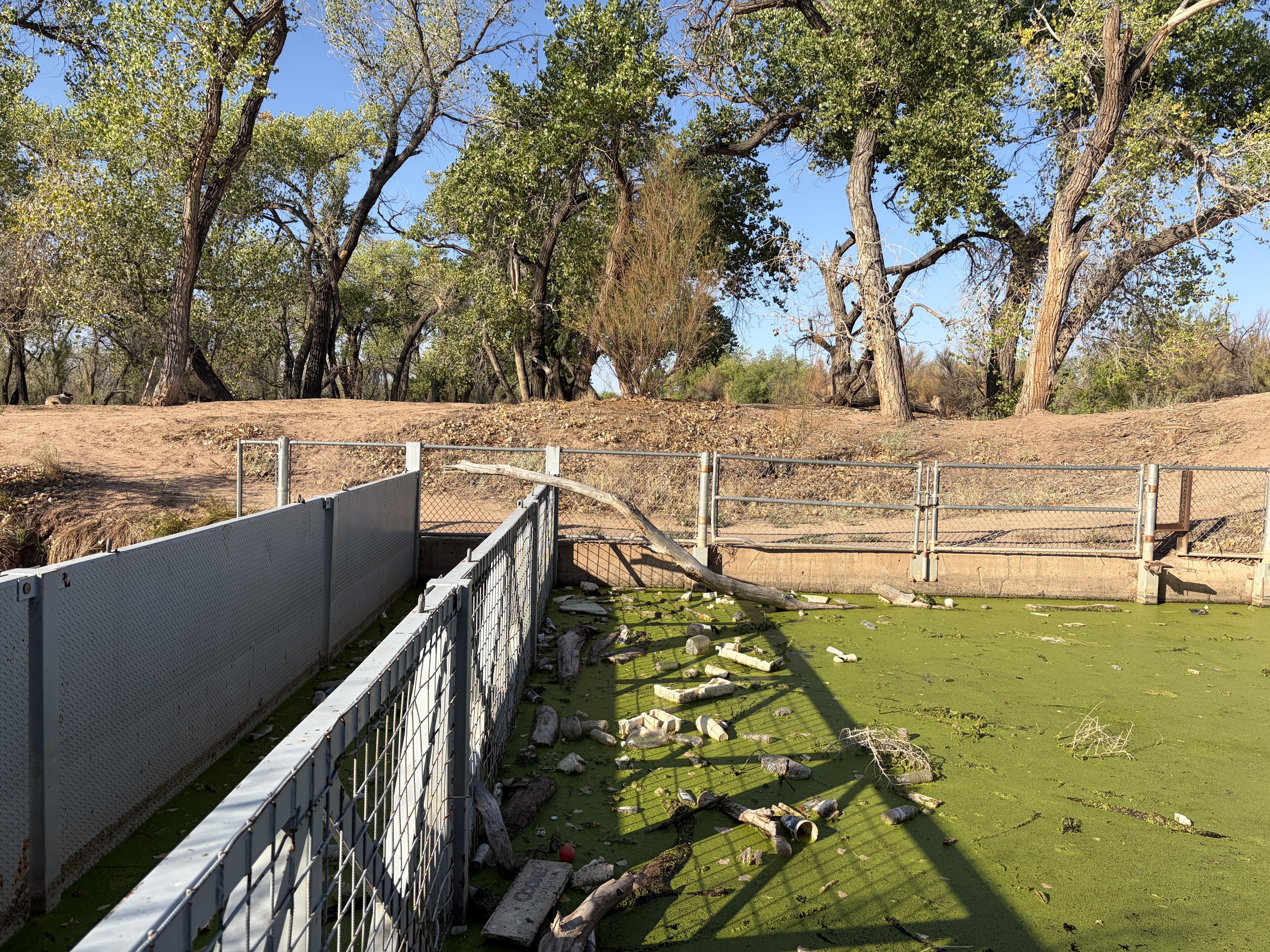
Nate Hegyi: In Albuquerque, New Mexico, right behind a megachurch and a huge parking lot, there’s a pool of dirty water. It’s something called a “flood control baffle,” basically a big strainer that keeps trash from reaching the nearby Rio Grande.
Marina Henke: Oh, there's an animal that's covered in green gunk.
Laura Paskus : It's… I think that's a bullfrog… he’s huge!
Nate Hegyi: Our producer Marina Henke was there at sunrise with the environmental journalist Laura Paskus.
Marina Henke (whispering): I'm gonna go walk over to the frog…. What do we have there?
Laura Paskus (whispering): I think that's the snapping turtle!
Nate Hegyi: This is not exactly a typical place to go hunting for wildlife. The water in the pool is covered with a thick mat of duckweed. There’s chunks of styrofoam floating on the surface, a few dozen soda bottles. If you were a bullfrog, or a snapping turtle… why stop here when the Rio Grande is just a few minutes away? But Laura’s taken Marina here for a reason. The Rio Grande in Albuquerque is dry.
Laura Paskus: This water in front of us is the only water for wildlife probably within about 5 to 7 miles.
[MUX IN, Brer Krille]
Nate Hegyi: I’m Nate Hegyi and this is Outside/In a show where curiosity and the natural world collide. What happens when the river that runs right through town stops running? That’s what’s played out in Albuquerque this past summer. Marina talked with locals there about how it feels to watch a landscape you know change…
Carmelita: I think Mother Nature is sending us a message, take care of me or I won’t take care of you.
Nate Hegyi: … and the many contradictions of life in the desert.
Matt Springer: Just let people live… and let ‘em fish if they can find water.
Nate Hegyi: That’s coming up, right after a break.
AD BREAK
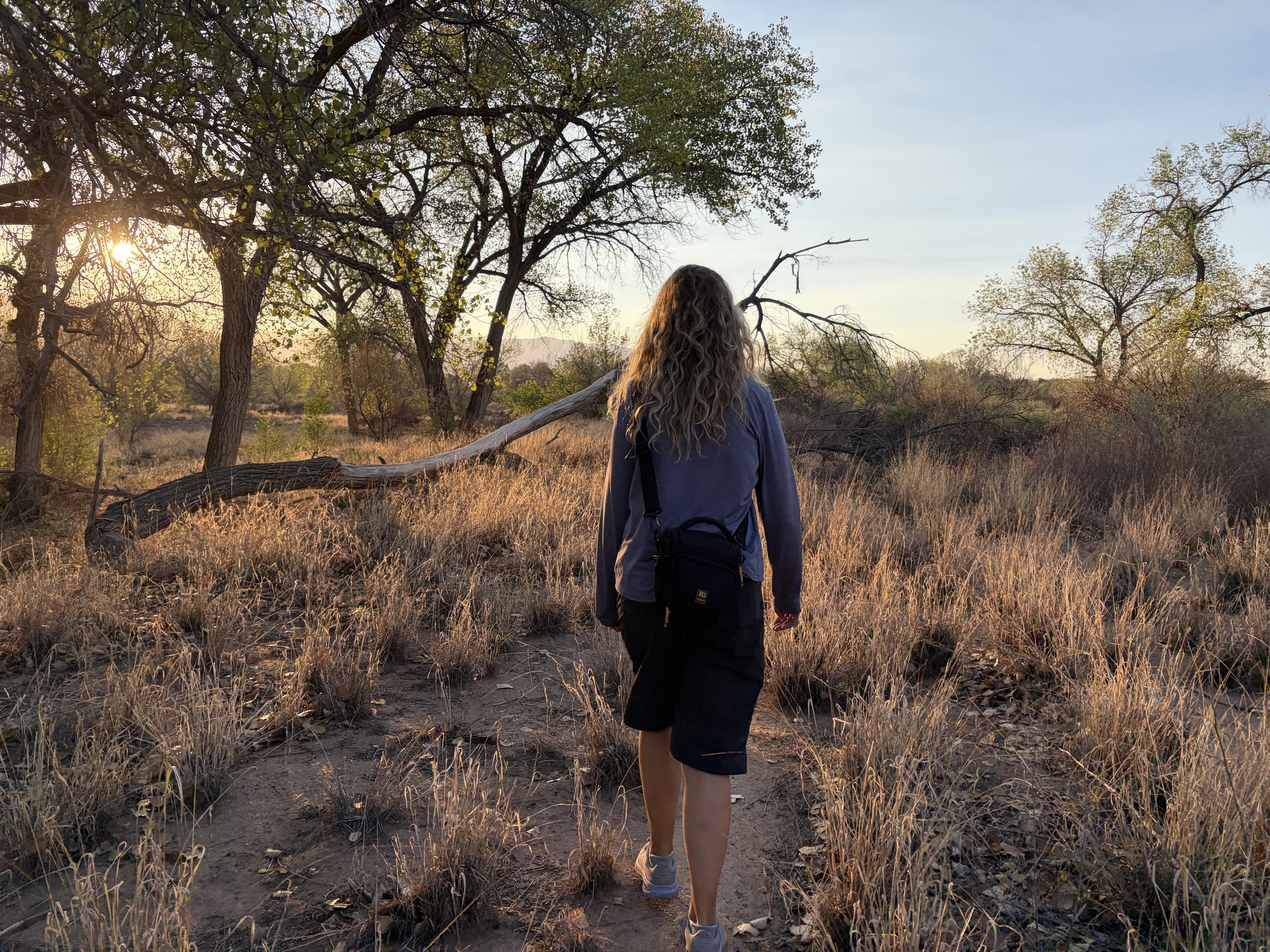
Marina Henke: This is Outside/In a show where curiosity and the natural world collide. I’m Marina Henke. Laura Paskus has been coming to walk along Albuquerque’s Rio Grande for almost twenty years. She’s been an environmental journalist even longer. She’s also somebody that just very genuinely loves to be outside – the type of naturalist who can’t help but interrupt herself when she sees something cool.
Laura Paskus: No… sorry! I thought it was a porcupine print. Sorry, sorry, sorry… (fades under)
Marina Henke: On this morning in August, Laura has offered to walk me to the Rio Grande. But before we get going, we linger a bit at this dirty oasis that is the flood baffle. Five or six hummingbirds dart along the water’s surface. I notice they’re one of the few birds around.
Laura Paskus: Normally this Bosque would be full of warblers and tanagers, bluebirds, Yellow-breasted chats… like this really noisy bunch of summer birds… Anyway, I'll stand here all day looking for the snapping turtle. (Laughs). So sorry, we'll get going.
Laura affectionately calls this route one of her “nerd walks.” She’s gotten to know the wildlife here intimately. Not just as a habitat, but almost like a little neighborhood. There’s the blonde porcupine that hangs out in one grove of cottonwoods. Or the family of coyotes she sees year after year. One time…
Laura Paskus: It was late spring, early summer, a few years ago. There was water in the river and there were three coyotes, like young little ones who had swam across the river and were pulling themselves up onto the bank of that island in front of us. And they were all like, kind of like scrawny and awkward and like shaking off and like falling over as they were shaking off.
[MUX FADES IN, Left at Hemlock]
Laura Paskus: it was like one of those things that you're… you… you just can't believe that you live in this giant desert city and at lunchtime you get to come down to this beautiful river and see like crazy little coyotes living their best life.
Marina Henke: This is the allure of what people call “The Bosque” – the Spanish word for forest, but in Albuquerque what refers to the cottonwood groves that line the Rio Grande. The Bosque feels a bit like a secret garden that everybody in the city has a key to. Since it runs on both sides of the river’s banks, it’s long and skinny. There’s no official entrance – over the years I’ve spent visiting Albuquerque I’ve made plans with so many people to “meet at the Bosque” only to get texted a random GPS point for a parking lot or a dead end street. Once you’re there, it feels wild and untamed… at any turn of the trail you’re just as likely to run into a person on horseback as a group of sandhill cranes taking off across the river. Not today though.
Laura Paskus: So this is an area that there would be beaver activity in this drain that's dry. We would probably see porcupines, there's that Cooper's hawks nes…
Marina Henke: Oh, wow. Yeah.
Laura Paskus: … that I think has been abandoned. It’s pretty lonely out here these days. But maybe you will see something today.
As we approach the Rio Grande, I notice the cottonwood leaves are brittle and yellow. So dried out that, even though it will get to almost 100 degrees today, it looks like early winter. And then Laura points me towards the path that will take us to the riverbank.
Laura Paskus: And I'll let you go first.
Marina Henke: Okay, great. This cut right here?
Laura Paskus: Yeah.
Marina Henke: Okay… Oh, man. Wow.
Laura Paskus: It sucks.
Marina Henke: Yeah.
Laura Paskus: So this week in the Middle Rio Grande, there are more than a hundred miles dry in a few different stretches.
Marina Henke: This may be a dumb analogy, but seeing a dry river reminded me of stumbling onto an empty pool in the wintertime. The proportions seem off, it feels a little eerie, it always seems like something I shouldn’t be seeing.
Marina Henke: It’s so sandy…. I mean, it's, um… it feels like walking on a beach.
Laura Paskus: Yeah. Yeah. It’s like, you know, it's kind of like packed mud for a little while and still retains some kind of structure to walk on. But yeah, now we're just sort of like trudging through the Sahara.
[MUX SWELLS AND FADES]
Marina Henke: So… how does a river dry? In the American Southwest, it’s a process that starts high up in the mountains.
David Gutzler: Snowpack is a glorious water storage mechanism for those of us downstream because it falls all winter long, but at very high elevations…
Marina Henke: David Gutzler, Professor Emeritus at University of New Mexico, where he spent his career studying climate change.
David Gutzler: … we don't need to build dams to keep it in place because it just sits there. And so our water storage is accomplished for us by nature.
Marina Henke: It’s a storage system that works well until… there’s no snow. Which was the exact fate of this past winter in New Mexico. Across the state, average snowpack never accumulated past just 11% of its median depth. David has explained a lot of complicated climate science over the years. This is not one of those occasions.
David Gutzler: This year it's unfortunately easy to explain because the snowpack just failed, followed by a record warm spring.
Marina Henke: One thing that can be confusing here is that portions of the Southern Rio Grande have already been drying up for the last century. But what hasn’t been normal is that for the past few years that dryness has reached Albuquerque. And what’s not normal this summer is how early it dried up, and how long it’s stayed that way.
[MUX IN, Li Fonte]
Marina Henke: It’s not a problem of too little precipitation though. David’s research takes a much wider lens, and what he’s found is even more concerning. Climate change is attacking this snow pack system from all sides.
David Gutzler: Even for the same amount of water falling out of the sky in the mountains, the delivery system that nature has kindly set up for us is less abundant, it's more spread out because the snow season is shorter, more of it evaporates and therefore doesn't get all the way down the river, and one final challenge for us… the predictability gets less.
Marina Henke: These changes, felt year after year, collectively describe a process you may have heard of before: Aridification.
David Gutzler: The whole region just gets drier and drier. And that's what we're seeing.
Marina Henke: Aridification is a phrase that can sound a bit sci-fi-ey, like something that happens on a far off windswept planet. In Albuquerque though, it’s happening in the middle of town.
[MUX fades, as ambi of walking through dry riverbed comes up]
Marina Henke: Laura and I walk towards a slight bend in the river, where the channel opens up to the width of half a football field. Here the ground is hard and cracked.
Laura Paskus: It's kind of like a, I don't know, like a fluvial geologist's dream to get to look at all these different things happening in the channel. It just stinks that we are seeing it because the river is totally dry.
Marina Henke: All across the channel, scrubby plants have started to fill the bed. This will be a problem when any water does return since their roots will suck up moisture before it’s had a chance to saturate the soil. Tire ruts criss-cross the sand, where some people have decided to use the dry river to ride ATVS. Officials have warned residents against this – disturbing the soil can actually prompt more plant growth – but with more than a hundred miles dry, it’s a tough rule to enforce. Meanwhile, Laura remains most focused on the non motorized prints. Right after we’d entered the bed, we’d seen the distinctive swish of a beaver trail.
Laura Paskus: Here's our beaver friend again. And then there's a snake track over there too….
Marina Henke: I mean, I know you can't exist in the mind of a beaver, but are these animals just spending most of their day trying to find water?
Laura Paskus: I would think that any beavers that are still alive… like beavers obviously need water to survive like any animal does, but beavers are really easy prey when they're not in the water for mountain lion, coyote... I mean if I were a beaver walking around in a sandy water bed, I would be scared and hot and thirsty and… I don't, I don't know if beavers feel hopeless, but I feel a little hopeless for this beaver that we’re seeing because I don’t know where it would be coming from or going to.
[MUX IN, Particle Emission]
Marina Henke: I imagine it can be hard for a sports writer to casually turn on a Sunday game, for a food writer to just go to a restaurant without it feeling a little like work. In that way environmental journalists like Laura, especially ones who have covered the same slow-moving disasters for a long time, have to accept that they can’t necessarily leave work at the office. When she steps out on one of her nerd walks after a day of writing about climate change… well… there it is. So Laura’s had to work hard to keep some of this landscape for herself. To take joy in the fresh print of a coyote or the sight of sandhill cranes taking off in the fall. This year though, more than any other in her career, she’s noticed a new feeling crop up: disbelief.
Laura Paskus: I am trying not to…. I'm trying not to think like one person, one journalist could like, save a river because that's like crazy-person narcissist talk. But like, I really thought back in 2002 when I heard that the river was drying from these, you know, biologists who were working on fish. I thought, ‘Oh my God, the state's largest river is drying! If people only knew that this was happening, we would do things differently!’ And, you know, here I am 24 years later, standing in the middle of a hundred dry miles and wondering not so much what was the point of bearing witness, but I guess it wasn't enough. So what else are you supposed to do?
[MUX BEAT]
Marina Henke: So what else are you supposed to do? Ignore it? Adapt? Fight back? As scientists and journalists in the city grapple with the future of an increasingly dry Rio Grande, there’s also about 600,000 other people who are too. The people of Albuquerque. So what do they make of it? That’s after a break.
AD BREAK
Marina Henke: This is Outside/In a show where curiosity and the natural world collide. I’m Marina Henke. A five minute walk from the dry riverbed of the Rio Grande, is a place called Tingley Beach. Counterintuitive to its name, Tingley is in fact… not a beach at all. Instead, there’s a couple of stocked fishing ponds, another one just for model boats. And at 9 in the morning the parking lot is already starting to fill up. There’s joggers, bikers, and a handful of guys casting lines into the ponds.
Marina Henke: Morning! (to dog) Oh, hi you!
Marina Henke: Right away, I meet an older woman named Carmelita, walking her big, impossibly fluffy dog. She’s been coming to Tingley for about seven years.
I ask Carmelita what she thinks about Rio Grande going dry.
Marina Henke: Have you ever seen it like how it is this summer?
Carmelita: Oh absolutely not. I see trees that are dying just… this summer has been so cruel to the Bosque. I mean, you look at the plant life and you can see they're suffering. You know, they're bent over. It's… it's just a tragedy like I've never seen. And I've been here most of my life.
[MUX IN, Kirkus]
Carmelita: I remember when we used to watch people canoe down the river… you know it was just… it was a sight to see so many people, but not anymore.
Marina Henke: The drought this summer raises real questions for how Albuquerque identifies itself as a city. Walking off my plane it took me – and I’m not exaggerating – less than thirty seconds to pass an advertisement of the flowing river, filled with paddleboarders. Having the Rio Grande dry in Albuquerque is a little like having the lights of Times Square turned off, or seeing San Francisco without the Golden Gate Bridge. For people that come to it daily, it's starting to take a toll.
Carmelita: And we’ve had so little rain it’s… it's depressing. I think Mother Earth is sending us a message. Take care of me or I won't take care of you.
[MUX UP AND OUT]
Marina Henke: Hey there!
Matt Springer: Hello, good morning.
Marina Henke: You guys catch anything?
Matt Springer: Oh, we've got a couple bluegills…. Real small ones, not monster blue gills.
Marina Henke: That’s not nothing!
Matt Springer: Nah we’re not skunked at least… were on the board!
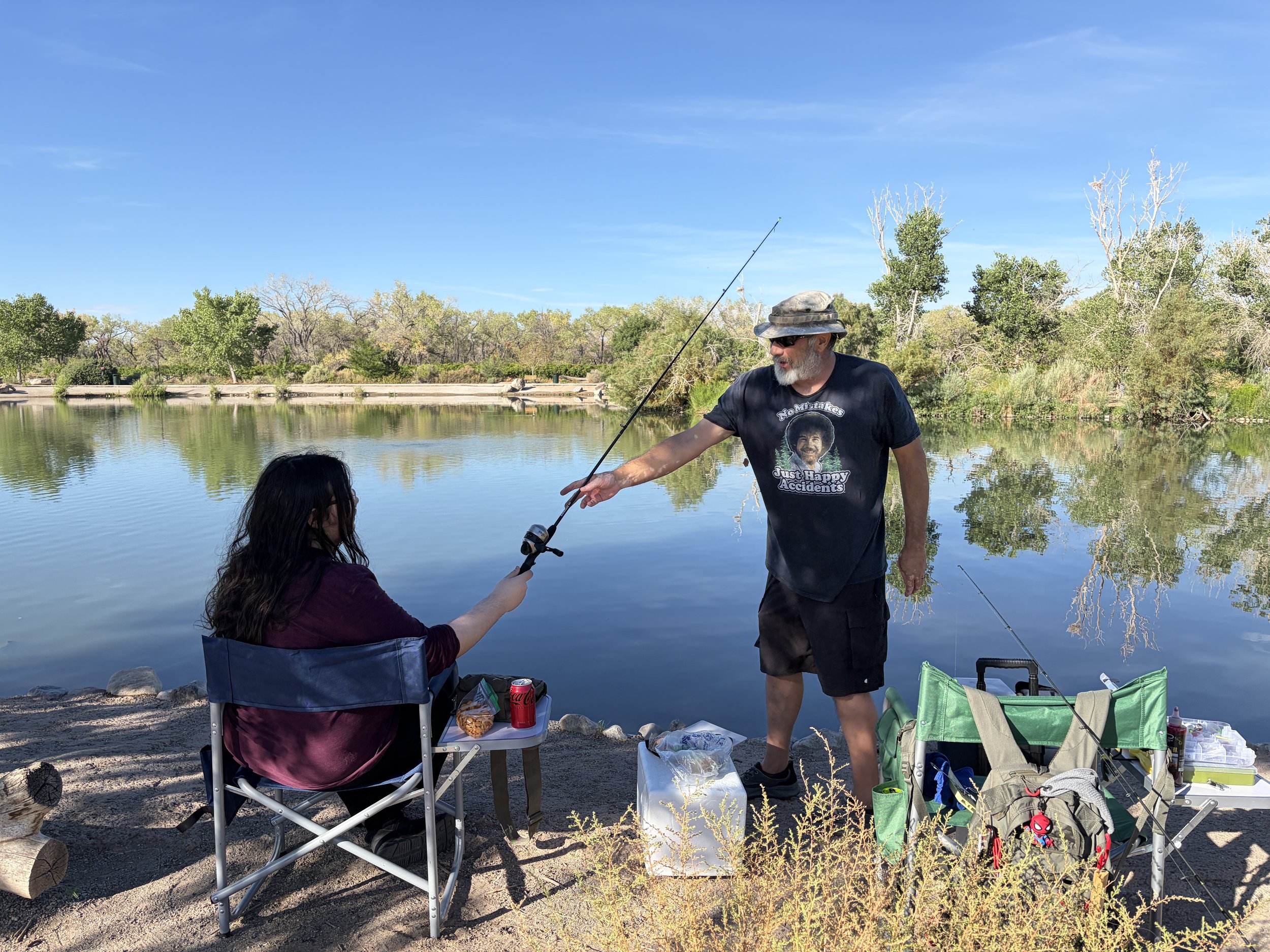
Matt Springer is wearing a camo bucket hat and a Bob Ross t-shirt with the quote “No Mistakes, Just Happy Accidents.” He’s got two folding chairs set out for him and his son, one of those little styrofoam coolers, a box of tackle. This is not his first rodeo.
Matt Springer: I used to fish down, like, off Rio Bravo right next to the river there’s drains, and they stocked trout in the winter in those drains. And, like, no one goes there. So it’s like free fishing time. But the river was flowing so good! And now I’ve gone to the drains and there’s water and there’s catfish and I’m sure there’s bluegill, but then you go 50 yards to the west and the rivers just… and you see catfish skeletons or, you know, hooks that people have lost or whatever…
Marina Henke: Meanwhile, Tingley shields you from that. Where Matt and I are standing, you literally can’t see the river at all. It’s easy to imagine it’s not there. Or that this fake pond is a real pond. But it’s not. The ponds are artificial. The water’s pumped from nearby wells. Even the sand is trucked in.
Marina Henke: I mean, I guess even this what you're saying behind would not actually be here unless we made it happen.
Matt Springer: No! Yeah, it's all man made! I mean, we get, we get more hooks snagged on the like dumb carpet stuff they put lining the bottom. But, I'll take the trade. You know, it's 15 minutes for me to come fish, whereas it'd be an hour drive to go anywhere else for us close.
[MUX IN, Capocollo]
Marina Henke: Matt has taught 3 of his 4 kids to fish here. For him, Tingley means easy access to a hobby that he loves.
Matt Springer: There's a couple little bluegills right there if you can see them. You might not be able to without polarized glasses, but here, trade my glasses.
Marina Henke: Okay here I go.
Matt Springer: … and then right there. See them moving?
Marina Henke: Oh! Oh my gosh.
Matt Springer: Yep. There they are. Those are probably the two we caught. And they came back to say hello. [FADES]
Marina Henke: Starting around the sixties, Tingley Beach fell into disrepair. A fancy renovation didn’t come until 2004, headed by then Mayor Martin Chavez. Matt tells me he wishes he could thank Mayor Chavez personally. That’s how much he appreciates the place.
Marina Henke: So yeah you're holding both things when you come here…
Matt Springer: Yes!
Marina Henke: … you're sad about the river…
Matt Springer: But I appreciate that we can fish like you. And I totally see the devil's advocate side of, like, this is a lot of water being pumped in. And so could this water be used elsewhere more beneficially for crops in Corrales or Ranchos? Maybe. Maybe. Probably. But I've got a freezer full of trout that I like to eat. So… there's trade-offs, I don’t know! You know, I spent so many years in the service. I'm just like, just let people live now. Just let people be who they want to be and, and let them fish if they can find the water.
[MUX UP AND FADE]
Marina Henke: Matt is not alone in wrestling with these contradictions. To live in this desert city is to reckon with two facts: life requires water and Albuquerque uses more water than it has. The contradiction can be an invisible one though. When Matt or Carmelita get home from Tingley they will still be able to turn on their faucets, hop in the shower, or wash their car.
How can that be? The city’s water utility likes to put it this way: the river is Albuquerque’s checking account… groundwater is their savings. In April when the Rio Grande started to dry, the water utility stopped pulling any water from the river, and switched to siphoning 100% of their supply from out of the ground. Just like when someone’s low on cash, and has to dip into their savings. The issue here is that in Albuquerque’s case, scientists think both accounts are shrinking. David Gutzler again.
David Gutzler: As we face a future with diminishing river water supplies, this is happening at the same time that we are facing up to the fact that many places around our region have been pumping groundwater at rates that far exceed the diminishing capacity of nature to replenish the groundwater. And so wells are going dry.
Marina Henke: If things keep trending the way they are, more water has been promised than there is water available.
David Gutzler: There's just not enough water in the system to satisfy all the water rights that people have.
Marina Henke: This problem is at the heart of what environmental journalist Laura Paskus covers. For her part, she has a very specific thing she’d like to see done.
Laura Paskus: I would love for New Mexico to make sure that rivers in the state have rights to their own waters.
Marina Henke: What’s important to understand here is how managed the water of the Rio Grande is. By the time this river reaches Albuquerque, at least half of its water has already been siphoned off for agricultural or domestic use. Who gets to use how much is determined by a tangle of treaties and laws that allocate percentages to all sorts of different stakeholders. But nowhere in that tangle is there something that says, when water is in short supply, the river gets to keep any of it. Laura thinks rivers having rights to their own water could change that.
[MUX IN, So It Goes]
Laura Paskus: And I realize that's a crazy thing to say when we're standing in the middle of a dry riverbed, but if rivers had rights first ahead of humans and humans had to work together and share to keep that baseline flow in the river. For the ecosystem itself, I think humans would be a lot better at sharing water and taking care of water and ecosystems
Marina Henke: But to give one thing more water rights, means someone else has to get fewer. When asked how those decisions should be, David has what’s clearly an often-said line. “I’m just the climate guy,” he tells me. “I’ll leave it to elected officials to make the hard choices.” Laura doesn’t pretend to know the answer either. That being said, there’s one fact that comes up in many of my conversations with people: 87 percent of Rio Grande water consumption comes from agriculture. 87.
Marina Henke: It sounds like some hard choices have to be made.
David Gutzler: There is no way to get around that
[MUX FADES UNDER CRINKLE OF LEAVES]
Marina Henke: But even if the people of the Southwest make the hard choices, and the health of the Rio Grande improves, the Bosque of Albuquerque is still going to change.
Kim Eichorst: So some of these, though, are last year's leaves that never dropped.
Marina Henke: This is Kim Eichorst. She’s the program director of BEMP – the Bosque Ecosystem Monitoring Program. One of her jobs is helping people prepare for those changes. Especially when it comes to the dying cottonwood trees.
Kim Eichorst: That continuous cottonwood forest we won't see again in our lifetime.
Marina Henke: The Bosque’s cottonwoods are sort of the celebrity tree of Albuquerque. But what Kim tells me is that the only reason the Bosque ever looked like how it does now, is because of human intervention. Hundreds of years ago, you’d find pockets of cottonwood trees here, but not these similar-sized stands that hug the riverside today.
Kim Eichorst: Historically the riparian area or the area by the river would have been 50% salt grass meadows, grassy meadows, right? And obviously that's not a forest.
[MUX IN, Capocollo]
Marina Henke: In the early 20th century, engineers sucked water from these meadows and wetlands. New levees stopped floods – floods that cottonwood trees need to reproduce. The Rio Grande’s Bosque became a big, aging forest.
Kim Eichorst: Which was never. A natural part of this ecosystem, but rather, again, that that artifact of the river management. And it means it's not as healthy. It can't… you can't have one single age of one species and then add stress. They're all going to respond the same.
Marina Henke: The area where we are standing has seen an 80% decline in its cottonwood canopy over the past thirty years or so. And this year, Kim says, is accelerating their decline.
Kim Eichorst: Like if we were to come back in a year. Um… yeah, I bet a lot of these trees aren't going to, uh, make it.
[MUX PEAKS AND FADES]
Marina Henke: And so even though it's a difficult one for people to accept, BEMP has a vision for what a healthier Rio Grande riverbank would look like here, especially as the climate warms. It’s a vision with less of these celebrity trees. But one that might make more ecological sense.
Kim Eichorst: We need our wetlands back. We need more of the understory riparian shrubs. We need to see more areas that are dry land species. That's going to be better for this area than trying to force it to continue to be a cottonwood willow forest.
[MUX IN, Bogs Reverie AND AMBI OF BOSQUE]
Marina Henke: Earlier, after Laura Paskus and I finished our walk in the dry riverbed of the Rio Grande, she hopped in her truck, off to cover a meeting of resource managers a couple hours south. I lingered a bit longer at the flood baffle – that pool of trash-filled water filled with snapping turtles and frogs. That morning, there’d been another set of animals that Laura had hoped we’d see: a pair of beavers. Laura had come across them about a month ago, and posted a video of them onto her blog. It was hard to watch. Just like today, the water looked thick and smelly. 5 minutes into standing at the baffle, a woman called out to me: “Do you see them?” Turns out, Laura isn’t the one who’s been trying to spot the beavers.
Alida Davila: A couple of beavers came in a house right there on the other side, and they sat there, oh, so beautiful! And we loved them. And before we know… they are gone!
Marina Henke: Alida Davila has been walking the Bosque for 17 years.
Alida Davila: And we tried to help, but we didn't know how because nature, you know, sometimes takes care of itself and sometimes you can interfere in things, but not all the time.
[MUX, Order of Entrance]
Marina Henke: At this point, she and her friends have assumed they’ve died. Laura thinks so too.
Alida Davila: I don't know what's going to happen. It rains just a few drops and that's it. And I'm coming from a country that never stops raining. So it's just… I feel like… I tell my husband, ‘I want to live and see rain again.’
Marina Henke: Do you find joy while walking here this summer?
Alida Davila: Of course I have to because it's… it's joy and it's, um.... how do you say? I mean, how can you not love nature even like this? You know, it's sad. It is very sad. But still it is, it is the bosque… But no, this is it.
[MUX PEAKS AND FADES]
[CREDITS MUX IN, SUMIRE]
CREDITS
Nate Hegyi: That does it for this week’s episode of Outside/In. Did you know that in Mexico the Rio Grande goes by a totally different name – the Rio Bravo. Aka “The Fierce River.” This episode was reported and mixed by our fierce and intrepid producer Marina Henke. It was edited by our Director of Podcasts Taylor Quimby. Our team also includes Justine Paradis, Felix Poon, and Jessica Hunt. I’m your host, Nate Hegyi. Laura Paskus wrote a whole book about climate change in New Mexico, it’s called At the Precipice. We’ll link to that and her Substack in our show notes. Special thanks to Mark Kelly and Shane Baron-Deutsch – who gave Marina a truly incredible zine about how to spot porcupines in the Bosque. Which by the way… you know what a baby porcupine is called? A porcupet. And three or more porcupines? A prickle. Remember we are on Patreon. Become a member there for just 5 bucks a month and you’ll get ad-free episodes. Shout-out to our Raven members: Jeannie Bartlett. Be like them, head to our show notes where you’ll find a link to join. My dog Gilly once got 500 porcupine quills stuck in her face and chest, she is a record holder for most quills taken out at our local vet! Music in this episode come from Blue Dot Sessions and Silver Maple. Outside/In is a production of New Hampshire Public Radio.