The scale of plastic pollution in the ocean is immense. Plastic can choke or entangle animals; break down to microscopic sizes and release pollutants as it degrades; and can also be eaten by all manner of marine life, including fish, who can then be caught and eaten by humans. We don’t really know how all this plastic is changing the ocean, and impacting our bodies.
“Most people know at this point that there’s plastics in pretty much every environment you look in, from Mars to the bottom of the ocean, but it’s really uneven in all those places,” said Dr. Max Liboiron, an associate professor of geography at Memorial University at Newfoundland and the founder of the Civic Laboratory for Environmental Action Research (CLEAR).
“My job is to look at the specific plastic profile in Newfoundland and Labrador, the Canadian province I work in. It’s a big fishing industry, there’s a lot of sustenance food, hunting and fishing, and the plastic is very unique here, and so is our environment and our shorelines.”
But when Liboiron set out to study plastic pollution in Newfoundland in 2014, they experienced a moment on the coast that, for them, called into question the basic principles of the scientific method. A moment which brought into focus the degree to which science can have a point of view, which Liboiron ended up writing about for Orion Magazine in 2020.
Outside/In producer Justine Paradis spoke with Liboiron about their research, and how the focus on sand beaches can limit our understanding of the world.
This interview has been condensed for clarity and brevity.
Paradis: Can you tell me about the shores and landscape of Newfoundland and specifically the research site?
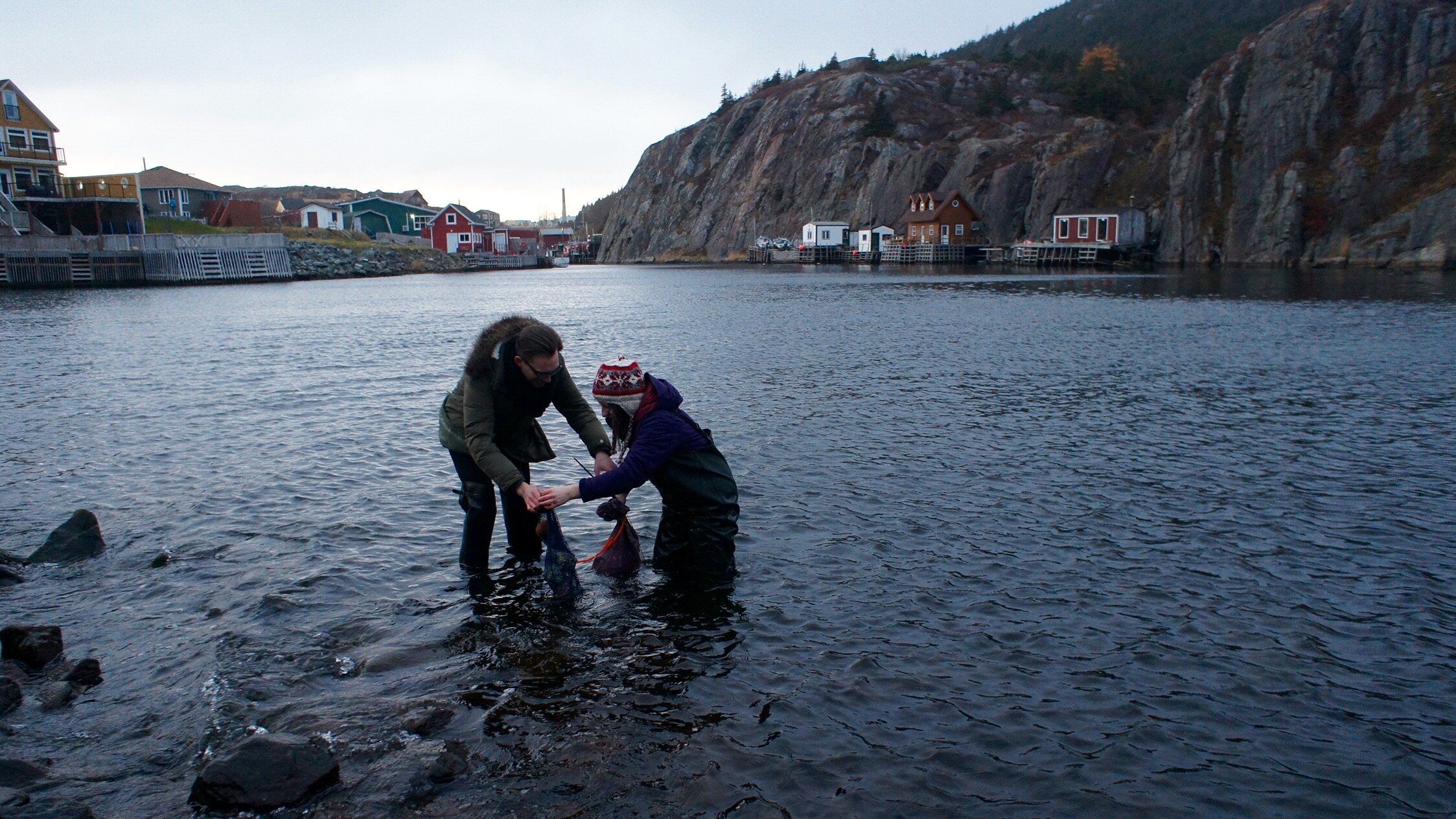
Liboiron: Newfoundland and Labrador is a province with two parts, and the island of Newfoundland is nicknamed “the Rock.” So, our shorelines are rocks, cliffs… there’s occasionally sand that’s gotten swept up from somewhere, but the vast majority are these black, pointy, shiny, frozen rocks.
I wrote a piece for Orion about [the Gut]. They’re called “tickles” here… like appendixes, little tiny bays that come in. The Gut is a tickle: it’s a little appendix of water that comes right into the edge of town.
Because I can get to it with public transit, and because it’s still a fishing area with water coming in from the Atlantic Ocean, we do our research tests there.
That is one of the first places I went when I got my job here several years ago. I had been trained in the standardized method for looking for small plastics - microplastics - on shorelines… and what you do is you scoop sand and sieve it.
And there was no sand. There wasn't even gravel [in the Gut]. There were boulders and sheer rock and ice. I was like, 'do I have to quit my job? Do I make science that doesn't make sense with other science? What do I do?'
I ended up working with brilliant people, including someone named Jess Melvin. She has gone to different parts of the province and finds the same problem. They did this huge study where they looked at all the different scientific publications about marine plastics on shorelines. That’s 361 studies, well over 3000 research sites. Only 4% of them talked about not-sand, and that’s everything from little gravel to boulders, so coarse sediment, generally.
But the world has way more than 4% not-sand beaches!
So, we were like, 'oh my god, the scientific community doesn't know anything about beaches that don't look like resort beaches. They don’t know anything that [doesn’t] look like San Francisco. How is this possible? How is it that we have a global knowledge on plastic pollution without global landscapes?'
Paradis: What does that say about how plastics pollution (science) “sees” the coast?
Liboiron: It's interesting because there's very little standardized in plastic pollution research because it's a brand new field. And whenever a new field kicks off, everyone is what you call a "coldwater cowboy.” People are trying things that work. The one place in our field that is standardized is shoreline plastics because these two government agencies from the EU and the US made them, and this is the sand protocol.
And so, in these papers we're reviewing, people will be like: ‘it was a huge rocky beach and we found the one place with sand,’ or, ‘there was snow, and we dug around it.’ Because there’s no protocol for how to deal with not-sand.
I think scientists have an anxiety, a professional anxiety, where if you can't replicate something, the phantom of it not being valid is very real. And so they'll do these tricky moves… so they can replicate something even if the replicant doesn't represent their environment, because otherwise your science becomes questionable. Can you publish this? Can you compare it? What does it even mean?
There’s this call for standardization, but we're worried it will be standardized to very specific environments [so that] places like Newfound and Labrador and the Arctic, where I work, will be left out of those standards, because we're not the primary imagined landscape in which knowledge takes place.